
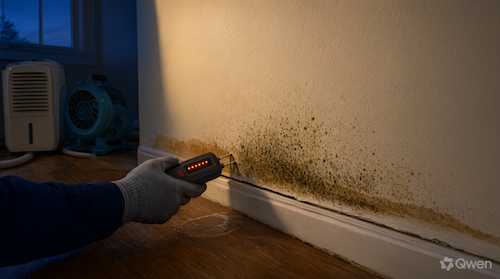
Mold spores can start colonizing damp building materials within 24 to 48 hours of a plumbing leak, roof failure, or indoor flood. Microscopic spores float continuously through indoor and outdoor air in every U.S. climate, waiting for a single missing ingredient: sustained moisture. Once water saturates paper-faced drywall, wood framing, or carpet padding, dormant spores absorb water, swell, and send out microscopic root threads called hyphae.
Catching a wet floor within the first hour gives you a straightforward cleanup job. Waiting until the weekend to deal with a slow leak behind a washing machine often turns that same spill into a multi-thousand-dollar remediation project.
How mold progresses hour by hour after a leak
Fungal growth does not happen on a rigid stopwatch, yet field observations from restoration technicians and building-science researchers show a predictable progression whenever wet organic materials sit stagnant:
- 0 to 12 hours (saturation and wicking): Water spreads across subfloors and wicks upward into porous drywall and baseboards through capillary action. Spores settle onto wet surfaces and begin hydrating, though no visible spots or odors appear yet.
- 24 to 48 hours (germination and early colonization): On warm, damp cellulose—especially the paper facing on standard gypsum drywall and cardboard boxes—spores germinate and form microscopic colonies. At this stage, growth is rarely visible to the naked eye, even though biological activity is already underway.
- 3 to 7 days (visible spotting and musty odor): Colonies mature and release microbial volatile organic compounds (mVOCs), producing that unmistakable earthy, musty basement smell. Small dark, green, white, or powdery specks begin showing up along baseboard seams, tack strips, and damp drywall corners.
- 1 to 2+ weeks (deep material penetration and secondary damage): Mold digests the starches and cellulose in drywall paper and wood fibers, staining surfaces permanently, weakening gypsum board, and spreading behind vapor barriers or inside insulated wall cavities where room fans cannot reach.
Why some leaks trigger mold faster than others
Two homes can experience the exact same ten-gallon water spill and end up with completely different outcomes. Four physical variables govern how quickly spores multiply:
- Food source (material porosity): Mold cannot digest glass, ceramic tile, bare concrete, or sheet metal—it only grows on dust or soap film sitting on top of those non-porous surfaces. By contrast, paper-faced drywall, engineered wood subfloors (OSB), untreated framing lumber, ceiling tiles, and natural carpet fibers act as ready-made meals once wet.
- Indoor temperature: Common household molds like Aspergillus, Penicillium, and Cladosporium grow fastest between 60°F and 80°F (15°C to 27°C)—the exact range most American homes maintain year-round. Cold winter basements slow growth down, though they rarely stop it completely unless temperatures drop near freezing.
- Relative humidity and stagnant air: When indoor relative humidity climbs above 60%, surfaces stop releasing moisture into the room. Water trapped under floating vinyl plank flooring, behind kitchen toe-kicks, or inside fiberglass-insulated exterior walls stays wet for days even when the center of the room feels dry.
- Water category: Clean water from a burst copper supply line or refrigerator ice-maker tube still causes mold if left wet past 48 hours. Gray water (from a dishwasher or washing machine drain) and black water (from a sewage backup or outdoor river flooding) carry bacteria and organic solids that accelerate microbial growth and require immediate professional containment rather than DIY drying.
Practical steps to stop mold inside the 48-hour window
If the water came from a clean supply source and affected a manageable area (the U.S. Environmental Protection Agency uses 10 square feet as a rough benchmark for small, homeowner-manageable moisture issues), aggressive drying within the first day usually prevents colonization:
- Shut off the water and fix the source: Close the fixture shutoff valve or main water valve first. Drying a floor while a pinhole pipe leak continues spraying inside the wall cavity accomplishes nothing.
- Extract liquid water mechanically: Use a wet/dry shop vacuum to pull standing water off hard floors and out of carpet pile. Evaporation alone is far too slow when gallons of water have soaked into padding.
- Pull away trapping barriers: Pry up wet baseboards carefully so air can reach the bottom edge of the drywall, lift saturated area rugs, and pull back wet carpet to remove soggy foam padding—padding almost never dries fast enough in place to prevent subfloor mold.
- Drive indoor humidity down below 50%: Close exterior windows and run a high-capacity dehumidifier alongside box fans or axial air movers angled across the wet walls and floor. Keep equipment running continuously until a pin-type moisture meter shows wood framing and subfloors have dropped back below 15% to 16% moisture content.
- Discard porous items that stayed wet past two days: Cardboard boxes, wet insulation batts, and swollen particleboard furniture hold moisture deep inside their fibers and should be bagged and removed rather than saved.
When to bring in a certified restoration crew
Skip DIY drying and contact an IICRC-certified water-damage restoration specialist if water soaked an area larger than roughly 10 square feet, wicked up into insulated exterior walls or ceiling cavities, sat untouched for more than 48 hours, or involved sewage, drain backups, or floodwater. Professionals use thermal imaging cameras, penetrating moisture meters, and commercial low-grain refrigerant (LGR) dehumidifiers to dry structural framing before hidden colonies take hold.
Sources and further reading
- U.S. Environmental Protection Agency (EPA): Mold Course — Moisture Control
- U.S. Environmental Protection Agency (EPA): A Brief Guide to Mold, Moisture and Your Home
This is independent educational content, not environmental testing or water-restoration advice. If water has affected structural cavities, large areas, or contaminated water sources, consult certified water-damage and mold professionals.
Frequently Asked Questions
- Should I test for mold before starting cleanup?
- In most homes the decision is driven by moisture and material condition rather than by species, so cleanup does not need to wait for a test result. Testing is worth considering when you need documentation for an insurance claim or a property transaction, and that is a separate professional service.
- How fast can mold start growing after water damage?
- Mold spores can begin colonizing damp surfaces within 24 to 48 hours under favorable moisture and temperature conditions, with visible growth and musty odors often appearing within a few days to two weeks.
- What indoor conditions help mold grow faster?
- Mold thrives on damp organic materials—such as drywall paper, wood framing, carpet padding, and cellulose insulation—especially when indoor temperatures are warm (roughly 60°F to 80°F) and airflow is stagnant.
- Does clean water from a supply line still cause mold?
- Yes. Even clean water from a supply line or appliance hose will support mold growth if porous building materials stay wet past 24 to 48 hours without proper drying and dehumidification.
- When should I call a water damage restoration professional for mold risk?
- Contact professionals promptly when water has soaked drywall, insulation, or subfloors, when affected areas exceed roughly 10 square feet, or when gray/black water from drains, appliances, or flooding is involved.