
New York, NY-NJ · metro guide
Water Damage Restoration in New York: What to Compare
In New York, water damage is often a building question: where the water came from, who is responsible, and what record exists after drying.
Metro snapshot
New York in numbers
Sources named below each block
- Population
- 19.8M
- Households
- 7.4M
- Housing units
- 8.0M
- People / household
- 2.67
- population ÷ households
Owner-occupied homes 52%
The rest are rented. Owners are the ones who commission most exterior work.
Single-family detached 35%
Detached houses carry their own roof, gutters and exterior walls.
Built before 1980 73%
Older housing stock shapes what fails first: gutters, flashing, pipe material.
Season
The year in New York
- Precipitation
- 49.5 in
- Snowfall
- 29.8 in
Average temperature by month, °F — the shape of the year is what decides when exterior work gets done.
Precipitation by month, inches.
Snowfall by month, inches.
| Month | Average temperature (°F) | Precipitation (in) | Snowfall (in) |
|---|---|---|---|
| January | 33.7°F | 3.64 in | 8.8 in |
| February | 35.9°F | 3.19 in | 10.1 in |
| March | 42.8°F | 4.29 in | 5.0 in |
| April | 53.7°F | 4.09 in | 0.4 in |
| May | 63.2°F | 3.96 in | 0.0 in |
| June | 72.0°F | 4.54 in | 0.0 in |
| July | 77.5°F | 4.60 in | 0.0 in |
| August | 76.1°F | 4.56 in | 0.0 in |
| September | 69.2°F | 4.31 in | 0.0 in |
| October | 57.9°F | 4.38 in | 0.1 in |
| November | 48.0°F | 3.58 in | 0.5 in |
| December | 39.1°F | 4.38 in | 4.9 in |
NOAA 1991–2020 climate normals, station NEW YORK CNTRL PK TWR, NY US (USW00094728). Station observations, not a metro-wide average — a metro that spans a mountain range can differ by more than this record shows.
Population, households and housing shares: U.S. Census Bureau, American Community Survey 2024 5-year estimates, metropolitan statistical area.
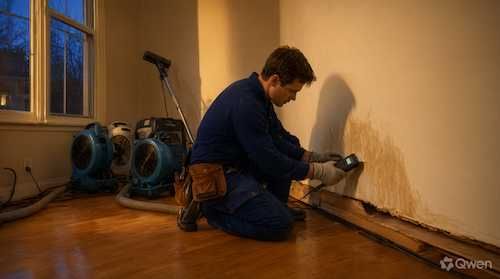
Water damage in New York often starts somewhere else. A pipe in the unit above, a roof drain, or a shared riser can send water into a ceiling that belongs to someone who was not home. About 73% of metro housing units were built before 1980, according to ACS estimates, so the pipes and the finishes around them are often older than the people dealing with the claim.
Find the source and the responsibility
The first questions are where the water came from and whether it is still entering. In a multi-unit building, that also means asking who is responsible for the repair: the unit owner, the building, or a neighbor. A restoration scope can address the damage, but it cannot settle responsibility. Ask how the source was confirmed and what repair is needed before reconstruction begins.
Drying in apartments and shared walls
Ask for moisture readings with locations and dates, equipment placement, and the dry standard used to close the job. In a building with shared walls and ceilings, hidden moisture can affect more than one unit. A useful plan states how the contractor will check adjacent spaces and what happens if a wall cavity stays wet.
Access, boards, and neighbors
Only about half of occupied homes in the metro are owner-occupied. If you rent, ask who authorizes the work. In a co-op or condo, ask whether board approval, an alteration agreement, or building access rules apply before equipment arrives. Confirm how neighbors will be notified and who is responsible for protecting common areas.
Documentation for insurance
Photograph and date the affected areas before work starts, and keep an inventory of damaged items. Ask how the contractor documents the loss and whether they will share readings and photos with the insurer. Coverage depends on the policy, the cause, exclusions, and the deductible; this guide cannot determine coverage.
Questions worth asking before work begins
Where this page stops
This guide does not assess an active loss remotely and does not publish local prices. If water is still entering or there is an electrical safety concern, contact the appropriate emergency service. Coverage and remediation requirements depend on the property, the policy, and the responsible local authority.
New York metro context
The 2024 ACS 5-year estimates put the metro at about 19.8 million residents and 7.4 million households. About 51.5% of occupied homes are owner-occupied, and about 34.9% of housing units are single-family detached, so a large share of losses involve a building or a board. About 73% of housing units were built before 1980, which makes older piping and finishes part of the context. These figures describe the metro, not a specific building.
New York metro housing indicators
| Indicator | Value |
|---|---|
| Population | 19,798,537 |
| Households | 7,409,947 |
| Owner-occupied share | 51.5% |
| Housing units built before 1980 | 73.0% |
| Single-family detached share | 34.9% |
Metro-level estimates. Building age does not establish the condition of a specific pipe or assembly.
Frequently Asked Questions
What should I do first after discovering water damage in an apartment?
Stop the source if it is safe to do so, keep people away from electrical hazards, and document the affected area with dated photos. Then notify the building and arrange an assessment of the source and the wet materials.
Who is responsible for water damage in a co-op or condo?
Responsibility depends on the governing documents, the source, and the building's insurance. The restoration scope does not decide it. Ask the board or managing agent and review the policy before assuming who pays.
How is drying verified?
Drying is normally checked with moisture readings taken at documented locations and compared over time, along with visual inspection. Ask for the readings and the dry standard used to close the job.
How will adjacent units be checked?
Ask how the contractor will inspect shared walls and ceilings, and what access is required. Hidden moisture in a neighboring unit can turn a small loss into a recurring problem.
Does insurance cover water damage?
Coverage depends on the policy, the cause, exclusions, the deductible, and the insurer's review. Keep dated documentation and ask the insurer about the specific policy.
What is the population of the New York metro area?
The U.S. Census Bureau's 2024 ACS 5-year estimates report about 19.8 million residents in the metro area. The figure describes regional scale, not the number of homes or providers.
Sources and review date
- American Community Survey 2024 5-year estimates (CBSA tables) — U.S. Census Bureau, 2024 ACS 5-year estimates.
Reviewed on 2026-11-17.