
New York, NY-NJ · metro guide
Roofing in New York: What to Compare Before You Sign
New York roofs range from flat membranes on rowhouses to pitched shingle roofs on detached homes. The proposal should name the assembly, not just the covering.
Metro snapshot
New York in numbers
Sources named below each block
- Population
- 19.8M
- Households
- 7.4M
- Housing units
- 8.0M
- People / household
- 2.67
- population ÷ households
Owner-occupied homes 52%
The rest are rented. Owners are the ones who commission most exterior work.
Single-family detached 35%
Detached houses carry their own roof, gutters and exterior walls.
Built before 1980 73%
Older housing stock shapes what fails first: gutters, flashing, pipe material.
Season
The year in New York
- Precipitation
- 49.5 in
- Snowfall
- 29.8 in
Average temperature by month, °F — the shape of the year is what decides when exterior work gets done.
Precipitation by month, inches.
Snowfall by month, inches.
| Month | Average temperature (°F) | Precipitation (in) | Snowfall (in) |
|---|---|---|---|
| January | 33.7°F | 3.64 in | 8.8 in |
| February | 35.9°F | 3.19 in | 10.1 in |
| March | 42.8°F | 4.29 in | 5.0 in |
| April | 53.7°F | 4.09 in | 0.4 in |
| May | 63.2°F | 3.96 in | 0.0 in |
| June | 72.0°F | 4.54 in | 0.0 in |
| July | 77.5°F | 4.60 in | 0.0 in |
| August | 76.1°F | 4.56 in | 0.0 in |
| September | 69.2°F | 4.31 in | 0.0 in |
| October | 57.9°F | 4.38 in | 0.1 in |
| November | 48.0°F | 3.58 in | 0.5 in |
| December | 39.1°F | 4.38 in | 4.9 in |
NOAA 1991–2020 climate normals, station NEW YORK CNTRL PK TWR, NY US (USW00094728). Station observations, not a metro-wide average — a metro that spans a mountain range can differ by more than this record shows.
Population, households and housing shares: U.S. Census Bureau, American Community Survey 2024 5-year estimates, metropolitan statistical area.
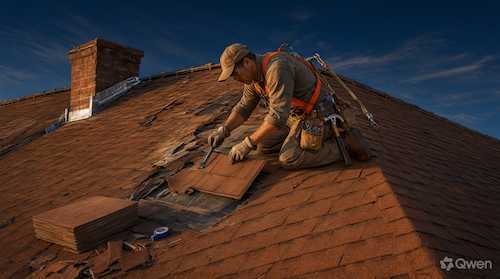
A roof problem in New York rarely stays small for long. A stain spreads across a ceiling, a parapet starts pulling away, or a neighbor's replacement forces the question. Because the housing stock is old — about 73% of metro housing units were built before 1980, according to ACS estimates — the roof you are pricing is often a layered assembly with decades of repairs underneath it.
Start with the assembly, not the shingle
A roof is a system: structure, deck, underlayment, membrane or shingles, flashing, drainage, and for flat roofs, insulation and surfacing. Two proposals can use the same product name and still describe different work. Ask what is removed, what is inspected underneath, and what is added at edges, penetrations, and transitions. On older buildings, the answer often decides whether the repair lasts or returns in two winters.
Flat and pitched roofs fail differently
Flat and low-slope roofs usually fail at seams, drains, scuppers, and parapet walls; pitched roofs fail at valleys, penetrations, and flashing. That difference should show up in the scope. A flat-roof proposal that does not mention drainage or parapet details is incomplete, and a pitched-roof proposal that does not mention flashing around chimneys and skylights leaves out the places leaks actually start.
How to compare two New York roof proposals
Put the proposals side by side and check whether they describe the same roof area and the same system. Compare tear-off versus overlay, deck repair allowances, underlayment, insulation, flashing, drainage work, disposal, and who handles permits and inspections. Then compare warranties: coverage length is less useful than what is excluded and who performs the labor if something fails.
What to ask for in writing
Request the inspection findings, photo documentation of the affected area, and a written scope that separates required work from optional upgrades. If a storm or insurance claim is involved, keep dated photos and the claim number with the proposal. For buildings with multiple units, ask how access, staging, and neighbor notification will be handled before work starts.
Questions worth asking before you approve
Where this page stops
This is a comparison guide, not an inspection. Roof condition can only be assessed at the property, and permit or licensing requirements must be confirmed with the authority responsible for the address. Nothing here is a price estimate or a recommendation of a specific contractor.
New York metro context
ACS 2024 5-year estimates put the metro population at about 19.8 million, with roughly 7.4 million households. About 51.5% of occupied homes are owner-occupied, which matters for roof work in co-ops, condos, and multi-unit buildings: the person who approves the scope is not always the person who lives under the roof. These figures describe the metro, not a specific building.
New York metro housing indicators
| Indicator | Value |
|---|---|
| Population | 19,798,537 |
| Households | 7,409,947 |
| Owner-occupied share | 51.5% |
| Housing units built before 1980 | 73.0% |
| Single-family detached share | 34.9% |
Metro-level estimates, not a description of an individual building or block.
Frequently Asked Questions
How do I know whether my New York roof needs repair or replacement?
There is no single test. The usual signals are how much area is affected, the condition of the deck and underlayment, and whether leaks return at the same location. Ask for the inspection findings in writing and compare what each proposal says about the cause, not only the price.
What should a roof proposal include in New York?
The roof area, the removal and installation scope, materials and underlayment, flashing and drainage work, disposal, permit responsibilities, schedule, and warranty terms. Exclusions should be written down as well, because they are where comparisons usually break down.
Does homeowners or building insurance cover roof work?
Coverage depends on the policy, the cause, exclusions, the deductible, and the insurer's review. Keep dated photos and the inspection report, and ask the insurer about the specific policy. This guide cannot determine coverage.
How long does a roof replacement take?
Duration depends on roof size and complexity, material, weather, and crew scheduling. Ask for a written sequence that shows when the roof will be dried in each day, and what happens if rain interrupts the work.
Why does flashing matter more than the shingle brand?
Flashing seals edges, valleys, and penetrations such as chimneys, vents, and skylights. Many leaks start there rather than in the field of the roof, so ask whether flashing is replaced or reused.
What is the population of the New York metro area?
The U.S. Census Bureau's 2024 ACS 5-year estimates report about 19.8 million residents and roughly 7.4 million households in the metro area. The figures describe regional scale, not the number of homes or contractors.
Sources and review date
- American Community Survey 2024 5-year estimates (CBSA tables) — U.S. Census Bureau, 2024 ACS 5-year estimates.
Reviewed on 2026-11-17.