
Philadelphia, PA-NJ-DE-MD · metro guide
Roofing in Philadelphia: Rowhouse Roofs and What to Compare
Philadelphia roofing is decided by the roof you actually have: flat, low-slope, slate, or a mix over a hundred years of additions.
Metro snapshot
Philadelphia in numbers
Sources named below each block
- Population
- 6.3M
- Households
- 2.5M
- Housing units
- 2.6M
- People / household
- 2.54
- population ÷ households
Owner-occupied homes 67%
The rest are rented. Owners are the ones who commission most exterior work.
Single-family detached 43%
Detached houses carry their own roof, gutters and exterior walls.
Built before 1980 67%
Older housing stock shapes what fails first: gutters, flashing, pipe material.
Season
The year in Philadelphia
- Precipitation
- 44.1 in
- Snowfall
- 23.1 in
Average temperature by month, °F — the shape of the year is what decides when exterior work gets done.
Precipitation by month, inches.
Snowfall by month, inches.
| Month | Average temperature (°F) | Precipitation (in) | Snowfall (in) |
|---|---|---|---|
| January | 33.7°F | 3.13 in | 7.1 in |
| February | 35.9°F | 2.75 in | 8.4 in |
| March | 43.6°F | 3.96 in | 3.6 in |
| April | 54.5°F | 3.47 in | 0.3 in |
| May | 64.3°F | 3.34 in | 0.0 in |
| June | 73.5°F | 4.04 in | 0.0 in |
| July | 78.7°F | 4.38 in | 0.0 in |
| August | 76.8°F | 4.29 in | 0.0 in |
| September | 69.9°F | 4.40 in | 0.0 in |
| October | 58.2°F | 3.47 in | 0.0 in |
| November | 47.4°F | 2.91 in | 0.2 in |
| December | 38.6°F | 3.97 in | 3.5 in |
NOAA 1991–2020 climate normals, station PHILADELPHIA INTL AP, PA US (USW00013739). Station observations, not a metro-wide average — a metro that spans a mountain range can differ by more than this record shows.
Population, households and housing shares: U.S. Census Bureau, American Community Survey 2024 5-year estimates, metropolitan statistical area.
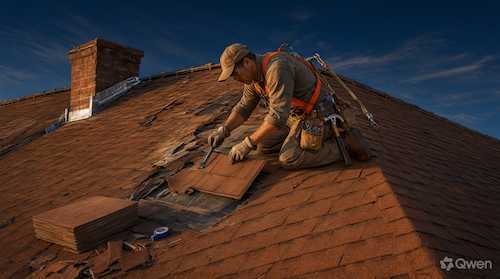
In a metro where about 66.6% of housing units were built before 1980, according to ACS estimates, roofs are rarely one system. A rowhouse may have a flat roof at the rear, a pitched section at the front, and a parapet wall shared with a neighbor. The scope that matters is the one written for that specific assembly, not a general roof replacement package.
Identify the assembly first
Ask what roof type and covering the proposal addresses: built-up or modified bitumen on a flat, asphalt shingle on a slope, slate or tile on an older pitched roof. Each has different repair methods, different expected service life, and different skill requirements. A contractor who mostly installs shingles may not be the right one for a low-slope roof.
Party walls, parapets, and flashing
In attached housing, the most common leak points are junctions: where the roof meets a shared wall, where a parapet cap has failed, and where a chimney passes through. Ask how these details are addressed, whether counter-flashing is replaced or reused, and how the work is coordinated with a neighbor if the wall is shared.
Tear-off, layers, and decking
Ask whether the quote includes a full tear-off or an overlay, how many existing layers are present, and what happens if the decking is found to be soft or deteriorated. The condition of the sheathing is unknown until the old roof comes off, so ask how that discovery is priced and approved.
Ventilation and interior moisture
Ask how the roof assembly ventilates and how attic or ceiling moisture is handled. In older homes with bathroom fans discharging into an attic, the roof deck can be wet from the inside — a problem that a new roof does not fix. Ask whether ventilation is in scope.
Questions to ask before signing
Where this page stops
This page does not inspect a roof or estimate cost for a specific property. Roof condition, permit requirements, and historic-district rules vary by address and jurisdiction, and should be confirmed on site and with the responsible local authority.
Philadelphia metro context
The 2024 ACS 5-year estimates put the metro at about 6.3 million residents and 2.5 million households. About 66.8% of occupied homes are owner-occupied, and about 43.4% of housing units are single-family detached, so a majority of households live in attached homes where roof work touches shared walls. About 66.6% of housing units were built before 1980.
Philadelphia metro housing indicators
| Indicator | Value | Source |
|---|---|---|
| Metro population | 6,272,014 | U.S. Census Bureau |
| Households | 2,467,761 | U.S. Census Bureau |
| Owner-occupied share | 66.8% | U.S. Census Bureau |
| Single-family detached share | 43.4% | U.S. Census Bureau |
| Housing units built before 1980 | 66.6% | U.S. Census Bureau |
Census values describe the metro area, not an individual property. A climate station is not reported for this metro in the site dataset.
Mapped in OpenStreetMap
Roofing businesses mapped in the Philadelphia metro
OpenStreetMap contributors have mapped 33 roofing entries inside the Philadelphia-Camden-Wilmington, PA-NJ-DE-MD CBSA; 33 have a name. This is a map-coverage indicator, not a count of all licensed roofing businesses in the metro.
- Mapped entries
- 33
- OSM features
- Phone listed
- 73%
- 24 of 33
- Website listed
- 70%
- 23 of 33
- Street address
- 76%
- 25 of 33
OSM coverage varies by area: a low count can mean low mapping activity, not a small market. OpenStreetMap does not record contractor licenses. To check a license, use the Pennsylvania HIC registration search. Search the Attorney General's Home Improvement Contractor registration.
Query: craft=roofer.
Snapshot: 2026-11-17. Data:
© OpenStreetMap contributors,
ODbL 1.0.
CBSA boundary:
U.S. Census Bureau, 2023.
Frequently Asked Questions
How do I compare roofing estimates in Philadelphia?
Compare the roof areas covered, the specified system and manufacturer, tear-off versus overlay, flashing and party-wall details, decking allowances, ventilation, disposal, permit handling, exclusions, and both workmanship and manufacturer warranties.
Can a flat roof on a rowhouse be repaired instead of replaced?
Sometimes, if the failure is local and the membrane is otherwise sound. Ask what testing or inspection supports a repair, how the repair ties into the existing membrane, and what warranty applies to a partial repair.
Who is responsible when a party wall leaks?
Responsibility depends on ownership, the source of the water, and local rules. Ask the contractor to document what they find and consider getting the neighbor involved before work begins.
Will the crew need access through my neighbor's property?
It is possible for rear roofs and shared walls. Ask how access and any required permission will be arranged, and put it in the scope.
Does a roof replacement require a permit?
Requirements depend on the jurisdiction and the scope. Confirm with the authority responsible for the address and ask whether permit handling and inspection are included.
What is the population of the Philadelphia metro area?
The U.S. Census Bureau's 2024 ACS 5-year estimates report about 6.3 million residents in the metro area. The figure describes regional scale, not the number of homes or providers.
Sources and review date
- American Community Survey 2024 5-year estimates (CBSA tables) — U.S. Census Bureau, 2024 ACS 5-year estimates.
- OpenStreetMap contributors — craft=roofer features in the Philadelphia-Camden-Wilmington, PA-NJ-DE-MD CBSA — OpenStreetMap contributors, Snapshot 2026-11-17.
Reviewed on 2026-11-18.
Other Home Services in Philadelphia–Camden–Wilmington
All guides for the Philadelphia–Camden–Wilmington metro area