
Philadelphia, PA-NJ-DE-MD · metro guide
Solar Panels in Philadelphia: Flat Roofs and Winter Sun
Philadelphia solar is usually a flat-roof question. Mounting, ballast, and winter shading decide more than panel brand.
Metro snapshot
Philadelphia in numbers
Sources named below each block
- Population
- 6.3M
- Households
- 2.5M
- Housing units
- 2.6M
- People / household
- 2.54
- population ÷ households
Owner-occupied homes 67%
The rest are rented. Owners are the ones who commission most exterior work.
Single-family detached 43%
Detached houses carry their own roof, gutters and exterior walls.
Built before 1980 67%
Older housing stock shapes what fails first: gutters, flashing, pipe material.
Season
The year in Philadelphia
- Precipitation
- 44.1 in
- Snowfall
- 23.1 in
Average temperature by month, °F — the shape of the year is what decides when exterior work gets done.
Precipitation by month, inches.
Snowfall by month, inches.
| Month | Average temperature (°F) | Precipitation (in) | Snowfall (in) |
|---|---|---|---|
| January | 33.7°F | 3.13 in | 7.1 in |
| February | 35.9°F | 2.75 in | 8.4 in |
| March | 43.6°F | 3.96 in | 3.6 in |
| April | 54.5°F | 3.47 in | 0.3 in |
| May | 64.3°F | 3.34 in | 0.0 in |
| June | 73.5°F | 4.04 in | 0.0 in |
| July | 78.7°F | 4.38 in | 0.0 in |
| August | 76.8°F | 4.29 in | 0.0 in |
| September | 69.9°F | 4.40 in | 0.0 in |
| October | 58.2°F | 3.47 in | 0.0 in |
| November | 47.4°F | 2.91 in | 0.2 in |
| December | 38.6°F | 3.97 in | 3.5 in |
NOAA 1991–2020 climate normals, station PHILADELPHIA INTL AP, PA US (USW00013739). Station observations, not a metro-wide average — a metro that spans a mountain range can differ by more than this record shows.
Population, households and housing shares: U.S. Census Bureau, American Community Survey 2024 5-year estimates, metropolitan statistical area.
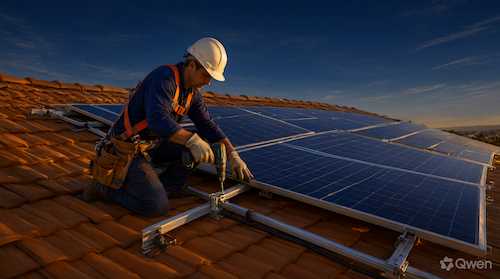
Most Philadelphia roofs were not designed with solar in mind. About 66.6% of metro housing units were built before 1980, according to ACS estimates, and only about 43.4% are single-family detached — so the typical candidate is a rowhouse with a flat or low-slope roof behind a parapet. That changes the mounting question from "which shingle" to "how is this rack attached and how is it kept from leaking."
Low-slope mounting details
Ask how the array is attached: ballasted, mechanically fastened, or a hybrid, and why that method suits the roof. Ask how the membrane is protected, how penetrations are sealed, and whether the installation voids any existing roof warranty. On a flat roof, the flashing details and the weight distribution matter more than module efficiency.
Winter production and shading
Ask for estimated production by month. Philadelphia winters are shorter and cloudier, and a low winter sun casts long shadows from chimneys, parapets, and neighboring buildings. Ask how shade was measured and whether the analysis includes those obstructions, not just trees.
Historic districts and approvals
Ask whether the property is in a historic district or subject to design review, and who prepares that submission. Requirements vary by address, and a project that ignores them can stall after equipment is ordered. Ask the installer how they handle approvals and what happens to the schedule.
Roof condition before panels
Ask how the installer evaluates the roof and when it was last replaced. A flat roof near the end of its life should be addressed before mounting, because removal and reinstallation of an array is a real cost and is usually excluded from both the solar contract and the roof warranty.
Questions to ask before signing
Where this page stops
This page does not estimate production, savings, or payback for a specific property and does not confirm which incentives apply. Those depend on the roof, shading, equipment, utility rules, and current tax law, which should be checked with the relevant official source.
Philadelphia metro context
The 2024 ACS 5-year estimates put the metro at about 6.3 million residents and 2.5 million households. About 66.8% of occupied homes are owner-occupied, and about 43.4% of housing units are single-family detached, so many installations are on attached homes where the roof is shared with a neighbor. About 66.6% of housing units were built before 1980.
Philadelphia metro housing indicators
| Indicator | Value | Source |
|---|---|---|
| Metro population | 6,272,014 | U.S. Census Bureau |
| Households | 2,467,761 | U.S. Census Bureau |
| Owner-occupied share | 66.8% | U.S. Census Bureau |
| Single-family detached share | 43.4% | U.S. Census Bureau |
| Housing units built before 1980 | 66.6% | U.S. Census Bureau |
Census values describe the metro area, not an individual property. A climate station is not reported for this metro in the site dataset.
Frequently Asked Questions
Can solar go on a flat rowhouse roof?
Often yes, using ballasted or mechanically fastened racking designed for low-slope roofs. Ask how the membrane is protected, how penetrations are sealed, and whether the roof warranty is affected.
What should I compare between solar quotes in Philadelphia?
Compare the gross cash price, system size, equipment models, monthly production estimates and assumptions, mounting details, included roof and electrical work, exclusions, and each warranty.
Do I need approval in a historic district?
Possibly. Requirements vary by address, and design review may apply to visible equipment. Ask the installer how they handle approvals and confirm the rules for the property.
How much does shading matter here?
A lot, especially in winter when the sun is low and chimneys or neighboring buildings cast long shadows. Ask for a shade analysis that includes those obstructions.
Who handles permits and utility interconnection?
It varies by contract. Ask which party prepares the permit and interconnection application, who schedules inspections, and who confirms permission to operate.
What is the population of the Philadelphia metro area?
The U.S. Census Bureau's 2024 ACS 5-year estimates report about 6.3 million residents in the metro area. The figure describes regional scale, not the number of homes or providers.
Sources and review date
- American Community Survey 2024 5-year estimates (CBSA tables) — U.S. Census Bureau, 2024 ACS 5-year estimates.
Reviewed on 2026-11-17.
Other Home Services in Philadelphia–Camden–Wilmington
All guides for the Philadelphia–Camden–Wilmington metro area