
Chicago, IL-IN · metro guide
Solar Panels in Chicago: Roof, Snow, and What to Compare
Chicago solar is a production-assumption question as much as a roof question. Snow, soiling, and roof age all shape what the system will actually deliver.
Metro snapshot
Chicago in numbers
Sources named below each block
- Population
- 9.4M
- Households
- 3.6M
- Housing units
- 3.9M
- People / household
- 2.57
- population ÷ households
Owner-occupied homes 66%
The rest are rented. Owners are the ones who commission most exterior work.
Single-family detached 52%
Detached houses carry their own roof, gutters and exterior walls.
Built before 1980 63%
Older housing stock shapes what fails first: gutters, flashing, pipe material.
Season
The year in Chicago
- Precipitation
- 37.9 in
- Snowfall
- 38.4 in
Average temperature by month, °F — the shape of the year is what decides when exterior work gets done.
Precipitation by month, inches.
Snowfall by month, inches.
| Month | Average temperature (°F) | Precipitation (in) | Snowfall (in) |
|---|---|---|---|
| January | 25.2°F | 1.99 in | 11.3 in |
| February | 28.8°F | 1.97 in | 10.7 in |
| March | 39.0°F | 2.45 in | 5.5 in |
| April | 49.7°F | 3.75 in | 1.3 in |
| May | 60.6°F | 4.49 in | 0.0 in |
| June | 70.6°F | 4.10 in | 0.0 in |
| July | 75.4°F | 3.71 in | 0.0 in |
| August | 73.8°F | 4.25 in | 0.0 in |
| September | 66.3°F | 3.19 in | 0.0 in |
| October | 54.0°F | 3.43 in | 0.2 in |
| November | 41.3°F | 2.42 in | 1.8 in |
| December | 30.5°F | 2.11 in | 7.6 in |
NOAA 1991–2020 climate normals, station CHICAGO OHARE INTL AP, IL US (USW00094846). Station observations, not a metro-wide average — a metro that spans a mountain range can differ by more than this record shows.
Population, households and housing shares: U.S. Census Bureau, American Community Survey 2024 5-year estimates, metropolitan statistical area.
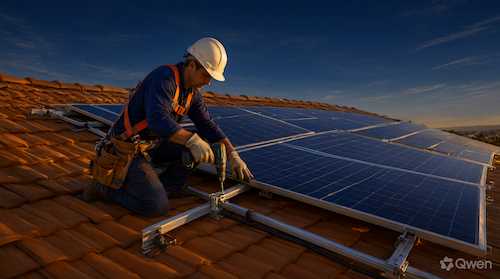
Solar works in Chicago, but it is not the easy case. The metro gets less sun than southern markets, the O'Hare station records about 38.4 inches of snow and 37.9 inches of precipitation a year, and winter days are short. That does not rule out solar; it changes which assumptions in the proposal deserve scrutiny and how much the production estimate should be trusted.
The roof and the winter
About 62.7% of metro housing units were built before 1980, according to ACS estimates, so many roofs are older than the array will be. Ask how the installer evaluates roof condition, how mounting is sealed, and what happens if the roof needs replacement later. Snow and ice add load and movement; the mounting details should be appropriate for the assembly and the climate.
Production assumptions with snow and soiling
Ask which production model was used, what snow, soiling, and degradation assumptions it contains, and whether it uses historical consumption or a standard profile. A production estimate that ignores winter losses is optimiztic. Compare estimated first-year production and the assumptions behind it rather than a single payback figure.
Equipment, warranties, and monitoring
Compare module and inverter models, system size, monitoring, and the separate warranties for equipment, production, and workmanship. Ask which party honours each warranty and how long it lasts. In a snowy climate, monitoring is also how you notice a drop in output that is not explained by weather.
Permits, interconnection, and net metering
A solar project usually involves a building permit, an electrical inspection, and a utility interconnection request before the system can operate. Ask which party prepares and files each item, who schedules inspections, and how the utility's billing arrangement is expected to work. Terms can change; keep the current documents.
Questions to ask before signing
Where this page stops
This page does not estimate production, savings, or payback for a specific property and does not confirm which incentives apply. Those depend on the roof, shading, equipment, utility rules, and current tax law, which should be checked with the relevant official source.
Chicago metro context
The 2024 ACS 5-year estimates put the metro at about 9.4 million residents and 3.6 million households. About 65.5% of occupied homes are owner-occupied, and about 51.5% of housing units are single-family detached, the segment where rooftop solar is most common. About 62.7% of housing units were built before 1980, so roof age is a standard part of the conversation. NOAA's O'Hare station records January averaging 25.2°F, July 75.4°F, about 37.9 inches of precipitation, and 38.4 inches of snow in a typical year.
Chicago reference station and housing indicators
| Indicator | Value | Source |
|---|---|---|
| January mean temperature | 25.2°F | NOAA NCEI |
| July mean temperature | 75.4°F | NOAA NCEI |
| Annual precipitation | 37.9 in. | NOAA NCEI |
| Annual snowfall | 38.4 in. | NOAA NCEI |
| Metro population | 9,371,595 | U.S. Census Bureau |
| Single-family detached share | 51.5% | U.S. Census Bureau |
Station normals are historical averages for one location, not a forecast. Census values describe the metro area, not an individual property.
Frequently Asked Questions
Does solar make sense in Chicago?
It can, depending on roof orientation, shading, electricity use, and the utility's billing arrangement. The key is to compare production assumptions, including snow and soiling, rather than a headline payback figure.
How does snow affect solar production?
Snow cover reduces output while it lasts, and the effect depends on roof pitch, access, and weather. Ask whether the production estimate includes a snow assumption and how the array is expected to perform in winter.
What should I compare between two solar quotes?
Compare the gross cash price, system size, equipment models, estimated first-year production and assumptions, included roof and electrical work, exclusions, and each warranty.
Should I replace my roof before installing solar?
If the roof is near the end of its service life, it is usually cheaper to address it before mounting. Ask how roof condition is evaluated and who is responsible for removal and reinstallation later.
Who handles permits and utility interconnection?
It varies by contract. Ask which party prepares the permit and interconnection application, who schedules inspections, and who confirms permission to operate.
What is the population of the Chicago metro area?
The U.S. Census Bureau's 2024 ACS 5-year estimates report about 9.4 million residents in the metro area. The figure describes regional scale, not the number of homes or providers.
Sources and review date
- American Community Survey 2024 5-year estimates (CBSA tables) — U.S. Census Bureau, 2024 ACS 5-year estimates.
- 1991–2020 station normals — CHICAGO OHARE INTL AP, IL US (USW00094846) — NOAA National Centers for Environmental Information, 1991–2020 climate normals.
Reviewed on 2026-11-17.