
Chicago, IL-IN · metro guide
HVAC in Chicago: Heating, Cooling, and What to Compare
Chicago HVAC decisions are heating decisions first. Combustion safety, venting, and distribution matter more than the cooling season length.
Metro snapshot
Chicago in numbers
Sources named below each block
- Population
- 9.4M
- Households
- 3.6M
- Housing units
- 3.9M
- People / household
- 2.57
- population ÷ households
Owner-occupied homes 66%
The rest are rented. Owners are the ones who commission most exterior work.
Single-family detached 52%
Detached houses carry their own roof, gutters and exterior walls.
Built before 1980 63%
Older housing stock shapes what fails first: gutters, flashing, pipe material.
Season
The year in Chicago
- Precipitation
- 37.9 in
- Snowfall
- 38.4 in
Average temperature by month, °F — the shape of the year is what decides when exterior work gets done.
Precipitation by month, inches.
Snowfall by month, inches.
| Month | Average temperature (°F) | Precipitation (in) | Snowfall (in) |
|---|---|---|---|
| January | 25.2°F | 1.99 in | 11.3 in |
| February | 28.8°F | 1.97 in | 10.7 in |
| March | 39.0°F | 2.45 in | 5.5 in |
| April | 49.7°F | 3.75 in | 1.3 in |
| May | 60.6°F | 4.49 in | 0.0 in |
| June | 70.6°F | 4.10 in | 0.0 in |
| July | 75.4°F | 3.71 in | 0.0 in |
| August | 73.8°F | 4.25 in | 0.0 in |
| September | 66.3°F | 3.19 in | 0.0 in |
| October | 54.0°F | 3.43 in | 0.2 in |
| November | 41.3°F | 2.42 in | 1.8 in |
| December | 30.5°F | 2.11 in | 7.6 in |
NOAA 1991–2020 climate normals, station CHICAGO OHARE INTL AP, IL US (USW00094846). Station observations, not a metro-wide average — a metro that spans a mountain range can differ by more than this record shows.
Population, households and housing shares: U.S. Census Bureau, American Community Survey 2024 5-year estimates, metropolitan statistical area.
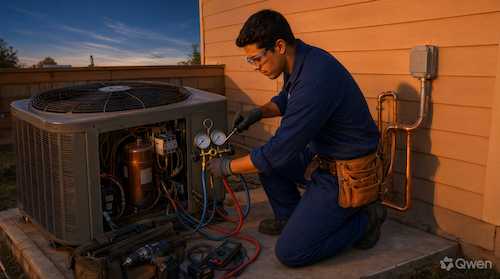
In Chicago, the heating system carries the house. January at O'Hare averages 25.2°F, the station records about 38.4 inches of snow in a typical year, and a failed furnace is not an inconvenience — it is an emergency. Cooling matters too, but the metro's July mean of 75.4°F means the heating side usually deserves the closer look.
Furnace or boiler: different scopes
A forced-air furnace, a hot-water boiler, and a steam boiler are compared on different details. Ask which one you have, what distributes the heat, and what the proposal covers. For combustion equipment, the scope should include venting, combustion air, and safety checks. A replacement that ignores venting or chimney condition can create a new problem while solving an old one.
What a diagnosis should include
Ask for the measurements behind the recommendation: temperature rise, static pressure, combustion readings, gas pressure, or a heat-exchanger inspection. 'It's old' is not a diagnosis. In older homes, uneven heat is often a distribution or insulation issue, and replacing equipment without addressing it can leave the same cold rooms in place.
Cooling and humidity
Chicago summers are shorter than southern metros but humid enough that oversized equipment can cool the air without removing moisture. A cooling proposal should state the load calculation basis, the equipment capacity, and how the system handles airflow. If ducts are part of the scope, ask for leakage or static pressure results rather than a description of new flex duct.
Older housing stock
About 62.7% of metro housing units were built before 1980, according to ACS estimates. Older homes may have chimneys sized for different equipment, limited return-air paths, or insulation that has settled. Those conditions affect both the recommendation and the expected performance, so ask how the proposal accounts for them.
Questions to ask before approving work
Limits of this guide
This page does not diagnose equipment remotely and does not publish local prices. Combustion safety, venting, and permit requirements must be confirmed at the property and with the responsible authority.
Chicago metro context
The 2024 ACS 5-year estimates put the metro at about 9.4 million residents and 3.6 million households. About 65.5% of occupied homes are owner-occupied, and about 51.5% of housing units are single-family detached. NOAA's O'Hare station records January averaging 25.2°F, July 75.4°F, about 37.9 inches of precipitation, and 38.4 inches of snow in a typical year. These are station averages, not a forecast or a property-level measurement.
Chicago reference station and housing indicators
| Indicator | Value | Source |
|---|---|---|
| January mean temperature | 25.2°F | NOAA NCEI |
| July mean temperature | 75.4°F | NOAA NCEI |
| Annual precipitation | 37.9 in. | NOAA NCEI |
| Annual snowfall | 38.4 in. | NOAA NCEI |
| Metro population | 9,371,595 | U.S. Census Bureau |
| Housing units built before 1980 | 62.7% | U.S. Census Bureau |
Station normals are historical averages for one location, not a forecast. Census values describe the metro area, not an individual property.
Frequently Asked Questions
How do I know whether to repair or replace a furnace in Chicago?
The decision usually turns on the age and condition of the equipment, the cost of the diagnosed repair relative to replacement, parts availability, and whether the same problem keeps returning. Ask for the measurements and inspection findings behind the recommendation.
What is the difference between a furnace and a boiler?
A furnace heats air and distributes it through ducts; a boiler heats water or produces steam and distributes heat through radiators, baseboards, or tubing. The two require different scopes, different venting, and different maintenance.
Why does my house feel cold even with the heat on?
The cause can be distribution, insulation, air leakage, thermostat placement, or equipment performance. Ask for measurements such as temperature rise, static pressure, and room-by-room temperatures before replacing equipment.
Should I replace my AC and furnace at the same time?
Sometimes it makes sense because the systems share ductwork and controls, but it is not automatic. Compare the condition and remaining life of each component and ask for separate pricing so the decision is visible.
Is maintenance required to keep a warranty valid?
Manufacturer terms vary. Ask for the warranty document, confirm what maintenance is required, and keep records of the work performed.
What is the population of the Chicago metro area?
The U.S. Census Bureau's 2024 ACS 5-year estimates report about 9.4 million residents in the metro area. The figure describes regional scale, not the number of homes or providers.
Sources and review date
- American Community Survey 2024 5-year estimates (CBSA tables) — U.S. Census Bureau, 2024 ACS 5-year estimates.
- 1991–2020 station normals — CHICAGO OHARE INTL AP, IL US (USW00094846) — NOAA National Centers for Environmental Information, 1991–2020 climate normals.
Reviewed on 2026-11-17.