
Dallas, TX · metro guide
HVAC in Dallas–Fort Worth: Heat, Humidity, and What to Compare
DFW systems earn their keep in summer. Comparing capacity, ducts, and commissioning matters more than comparing brand names.
Metro snapshot
Dallas in numbers
Sources named below each block
- Population
- 8.0M
- Households
- 2.9M
- Housing units
- 3.1M
- People / household
- 2.76
- population ÷ households
Owner-occupied homes 60%
The rest are rented. Owners are the ones who commission most exterior work.
Single-family detached 63%
Detached houses carry their own roof, gutters and exterior walls.
Built before 1980 30%
Older housing stock shapes what fails first: gutters, flashing, pipe material.
Season
The year in Dallas
- Precipitation
- 37 in
- Snowfall
- 1.6 in
Average temperature by month, °F — the shape of the year is what decides when exterior work gets done.
Precipitation by month, inches.
Snowfall by month, inches.
| Month | Average temperature (°F) | Precipitation (in) | Snowfall (in) |
|---|---|---|---|
| January | 46.3°F | 2.53 in | 0.1 in |
| February | 50.5°F | 2.76 in | 1.0 in |
| March | 58.2°F | 3.30 in | 0.3 in |
| April | 65.6°F | 3.22 in | 0.0 in |
| May | 74.0°F | 4.78 in | 0.0 in |
| June | 81.9°F | 3.70 in | 0.0 in |
| July | 85.7°F | 2.08 in | 0.0 in |
| August | 85.7°F | 2.18 in | 0.0 in |
| September | 78.5°F | 2.72 in | 0.0 in |
| October | 67.7°F | 4.37 in | 0.0 in |
| November | 56.4°F | 2.53 in | 0.0 in |
| December | 48.1°F | 2.84 in | 0.2 in |
NOAA 1991–2020 climate normals, station DALLAS FT WORTH AP, TX US (USW00003927). Station observations, not a metro-wide average — a metro that spans a mountain range can differ by more than this record shows.
Population, households and housing shares: U.S. Census Bureau, American Community Survey 2024 5-year estimates, metropolitan statistical area.
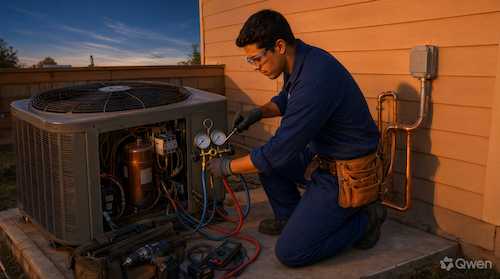
Dallas–Fort Worth asks a lot of an air conditioner. July at the airport station averages 85.7°F, the cooling season is long, and the same system has to handle the occasional winter cold snap — January averages 46.3°F. Most replacement decisions here are cooling-first, but a proposal that ignores heating, ducts, or commissioning is only solving part of the problem.
Cooling capacity and the long season
Ask whether a load calculation was performed and what it assumed about windows, insulation, orientation, and internal gains. In a metro where the system runs for months, oversizing is not a harmless upgrade: it can shorten equipment life and leave humidity higher than it should be. Capacity should follow the calculation, not a rule of thumb.
Heating still matters
Winter is milder than in Chicago, but heating equipment still runs, and heat pumps are common in newer construction. Ask how the proposed system handles heating, what auxiliary heat is included, and how the system switches between modes. For a heat pump, the commissioning readings and the control settings matter as much as the rated capacity.
Ductwork and attic heat
Many DFW homes have ducts in the attic, where summer temperatures run well above the outdoor reading. Ask for static pressure or duct leakage results if ductwork is part of the scope, and ask whether ducts will be sealed, replaced, or rerouted. Equipment performance depends on the ducts delivering the air where it is needed.
What a replacement quote should include
Compare equipment models and capacity, load calculation basis, duct and electrical work, controls, condensate routing, permit handling, commissioning measurements, exclusions, and warranty terms. Ask what will be recorded at startup: refrigerant charge, airflow, and temperature split. Those readings show whether the system was commissioned or merely connected.
Questions to ask before approving work
Limits of this guide
This page does not diagnose a system remotely and does not publish local prices. Refrigerant handling, permit requirements, and equipment condition must be confirmed at the property and with the responsible authority.
Dallas–Fort Worth metro context
The 2024 ACS 5-year estimates put the metro at about 8.0 million residents and 2.9 million households. About 60.1% of occupied homes are owner-occupied, and about 62.6% of housing units are single-family detached. Only about 29.8% of housing units were built before 1980, so much of the stock is newer — but newer systems still fail, and the same commissioning questions apply. NOAA's airport station records July averaging 85.7°F, January 46.3°F, and about 37.0 inches of precipitation a year.
Dallas–Fort Worth reference station and housing indicators
| Indicator | Value | Source |
|---|---|---|
| January mean temperature | 46.3°F | NOAA NCEI |
| July mean temperature | 85.7°F | NOAA NCEI |
| Annual precipitation | 37.0 in. | NOAA NCEI |
| Metro population | 7,985,590 | U.S. Census Bureau |
| Owner-occupied share | 60.1% | U.S. Census Bureau |
| Single-family detached share | 62.6% | U.S. Census Bureau |
Station normals are historical averages for one location, not a forecast. Census values describe the metro area, not an individual property.
Frequently Asked Questions
How do I know whether to repair or replace my AC in DFW?
The decision usually turns on the age and condition of the equipment, the cost of the diagnosed repair relative to replacement, refrigerant type and availability, and whether the same problem keeps returning. Ask for the measurements behind the recommendation.
Is a heat pump a good choice in Dallas–Fort Worth?
Heat pumps are common in the region, but the right choice depends on the home, the electricity rate, the existing ductwork, and how the system is configured. Ask how heating and cooling performance were evaluated and what auxiliary heat the proposal includes.
Why is my house humid even with the AC running?
Humidity can come from oversized equipment, short run times, leaky ducts, or excessive infiltration. The cause should be identified with measurements rather than by lowering the thermostat.
What should an HVAC replacement quote include?
Equipment models and capacity, the load calculation basis, included duct or electrical work, controls, commissioning steps, permit handling, exclusions, and both equipment and labor warranty terms.
How long does a replacement take?
Most residential replacements are scheduled within a day or two, but timing depends on equipment availability, permit and inspection steps, and any duct or electrical work. Ask for a written sequence.
What is the population of the Dallas–Fort Worth metro area?
The U.S. Census Bureau's 2024 ACS 5-year estimates report about 8.0 million residents in the metro area. The figure describes regional scale, not the number of homes or providers.
Sources and review date
- American Community Survey 2024 5-year estimates (CBSA tables) — U.S. Census Bureau, 2024 ACS 5-year estimates.
- 1991–2020 station normals — DALLAS FT WORTH AP, TX US (USW00003927) — NOAA National Centers for Environmental Information, 1991–2020 climate normals.
Reviewed on 2026-11-17.