
San Antonio, TX · metro guide
HVAC in San Antonio: A Long Cooling Season and a Short Freeze
The system is designed for July and then tested in January — usually once a decade, and badly.
Metro snapshot
San Antonio in numbers
Sources named below each block
- Population
- 2.7M
- Households
- 967K
- Housing units
- 1.1M
- People / household
- 2.75
- population ÷ households
Owner-occupied homes 63%
The rest are rented. Owners are the ones who commission most exterior work.
Single-family detached 66%
Detached houses carry their own roof, gutters and exterior walls.
Built before 1980 33%
Older housing stock shapes what fails first: gutters, flashing, pipe material.
Season
The year in San Antonio
- Precipitation
- 32.4 in
- Snowfall
- 0.2 in
Average temperature by month, °F — the shape of the year is what decides when exterior work gets done.
Precipitation by month, inches.
Snowfall by month, inches.
| Month | Average temperature (°F) | Precipitation (in) | Snowfall (in) |
|---|---|---|---|
| January | 52.2°F | 1.96 in | 0.0 in |
| February | 56.3°F | 1.74 in | 0.1 in |
| March | 62.8°F | 2.31 in | 0.0 in |
| April | 69.4°F | 2.42 in | 0.0 in |
| May | 76.5°F | 4.40 in | 0.0 in |
| June | 82.6°F | 3.28 in | 0.0 in |
| July | 84.8°F | 2.41 in | 0.0 in |
| August | 85.5°F | 2.15 in | 0.0 in |
| September | 79.9°F | 3.88 in | 0.0 in |
| October | 71.3°F | 3.75 in | 0.0 in |
| November | 60.7°F | 2.08 in | 0.0 in |
| December | 53.5°F | 2.00 in | 0.1 in |
NOAA 1991–2020 climate normals, station SAN ANTONIO INTL AP, TX US (USW00012921). Station observations, not a metro-wide average — a metro that spans a mountain range can differ by more than this record shows.
Population, households and housing shares: U.S. Census Bureau, American Community Survey 2024 5-year estimates, metropolitan statistical area.
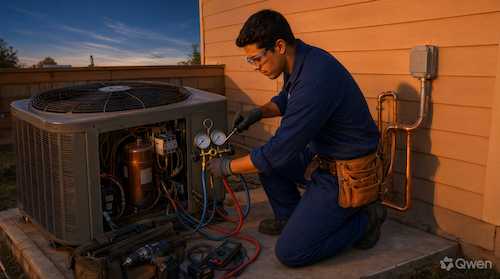
The reference station records a July mean of 84.8°F and a January mean of 52.2°F, and those two numbers describe the design problem exactly: a cooling season that runs most of the year and a heating season that is short, mild — and occasionally interrupted by a hard freeze that the housing stock is not built for. Two-thirds of the housing is single-family detached and a third predates 1980, so the typical job is a system in an attic serving a house whose ducts and insulation were specified for a different era of energy costs.
Cooling load, humidity and the right size
Gulf moisture arrives with the summer air, so the load is not only temperature. A system that is oversized will reach the set point quickly and shut off before it has removed much moisture, which produces a house that feels clammy at 74°F. A load calculation that treats latent load as a design condition — and equipment that can run longer at reduced capacity — is the answer. Ask whether the calculation was done room by room, whether it accounts for humidity, and what the airflow setting will be.
Ducts and equipment in a very hot attic
Attic air handlers and flex duct are standard here, and in a metro where the attic is hot for months, every unsealed plenum, boot and cabinet is a capacity leak. It is not unusual for a system to be correctly sized and still fail to cool the far end of the house because the distribution is losing more than the equipment is adding. Ask whether the ducts will be tested or inspected, what insulation value is specified, and whether the plenum and boots will be sealed as part of the work.
What a hard freeze does to heating
The heating side is neglected because it is needed so rarely, and that is exactly when it fails. A heat pump that has not been checked may run in defrost constantly, auxiliary heat may be undersized or misconfigured, and outdoor units may be installed where they cannot drain properly in freezing weather. Ask whether the equipment has been tested in heating mode, how auxiliary heat is staged, and whether the system can hold temperature through a multi-day freeze rather than only a cold morning.
Windows, shade and the load before equipment
In a cooling-dominated climate the envelope decisions — window shading, attic insulation, radiant barriers, air sealing at the ceiling plane — change the load the equipment has to meet, and they are usually cheaper than capacity. The best moment to address them is when the system is being replaced anyway, because the attic is open and the ducts are accessible. Ask whether any of that work is included, whether the sizing assumed it would happen, and what the expected effect on the load is.
Service before the long season
The season starts early and runs late, so the annual service has to happen before it, not after the first failure. Coil cleaning, a filter that is actually changed, a condensate line that drains and correct charge are the ordinary items, and a system that skips them loses capacity precisely when it is needed most. Ask what the visit covers and whether the condensate line is included, because that is the item that damages houses when it clogs.
What to pin down in the estimate
Where this page stops
No prices, sizes or efficiency figures are quoted here. Refrigerant rules, code requirements and equipment ratings change, and the applicable version should be confirmed from the manufacturer's literature and the local authority.
San Antonio metro context
The 2024 ACS 5-year estimates describe about 2.66 million residents in 967,488 households and 1,057,823 housing units, with 63.3% owner-occupied and 66.1% single-family detached. About 32.7% of units predate 1980. At the reference station the annual mean is 69.6°F, with July at 84.8°F and January at 52.2°F; annual precipitation is 32.4 inches.
San Antonio reference station and housing indicators
| Indicator | Value | Source |
|---|---|---|
| January mean temperature | 52.2°F | NOAA NCEI |
| July mean temperature | 84.8°F | NOAA NCEI |
| Annual precipitation | 32.4 in. | NOAA NCEI |
| Metro population | 2,662,733 | U.S. Census Bureau |
| Owner-occupied share | 63.3% | U.S. Census Bureau |
| Housing units built before 1980 | 32.7% | U.S. Census Bureau |
Station normals are historical averages for one location, not a forecast. An average January near 52°F says nothing about the occasional hard freeze that decides whether a heating system actually works.
Frequently Asked Questions
Why does my house feel damp when the air is running?
Usually because the system is oversized or the fan is set to run continuously, so the coil does not stay cold long enough to pull moisture out. In a humid climate, temperature alone does not describe comfort.
How important are the ducts?
Very. In a hot attic, leaky plenums and boots waste capacity before the air reaches the room, and no amount of extra tonnage fixes a distribution problem.
Is a heat pump suitable here?
It handles both seasons in a climate with a long cooling season and a mild winter, and it is efficient in cooling mode. What matters is that the heating side is configured and tested rather than assumed.
What should I do before a forecast hard freeze?
Know how the system behaves in heating mode, protect outdoor equipment, and keep filters clean so airflow is not restricted. The failures tend to be on the heating side that has not run since the previous winter.
Should I add attic insulation with a new system?
It often makes sense to consider it at the same time, since the attic is open and the ducts are accessible. Whether it changes the equipment size should come out of the load calculation.
How often should the system be serviced?
In a cooling-dominated climate, an annual visit before the season — coil cleaning, charge check, condensate line cleared — prevents most of the failures that matter.
Sources and review date
- American Community Survey 2024 5-year estimates (CBSA tables) — U.S. Census Bureau, 2024 ACS 5-year estimates.
- 1991–2020 station normals — SAN ANTONIO INTL AP, TX US (USW00012921) — NOAA National Centers for Environmental Information, 1991–2020 climate normals.
Reviewed on 2026-11-18.