
Los Angeles, CA · metro guide
AC Repair in Los Angeles: Climate, Sizing, and What to Compare
Los Angeles cooling needs vary from the coast to the valleys, so a diagnosis and a capacity recommendation should be tied to the property, not to a metro average.
Metro snapshot
Los Angeles in numbers
Sources named below each block
- Population
- 13.0M
- Households
- 4.5M
- Housing units
- 4.8M
- People / household
- 2.88
- population ÷ households
Owner-occupied homes 48%
The rest are rented. Owners are the ones who commission most exterior work.
Single-family detached 48%
Detached houses carry their own roof, gutters and exterior walls.
Built before 1980 67%
Older housing stock shapes what fails first: gutters, flashing, pipe material.
Season
The year in Los Angeles
- Precipitation
- 14.2 in
- Snowfall
- —
Average temperature by month, °F — the shape of the year is what decides when exterior work gets done.
Precipitation by month, inches.
| Month | Average temperature (°F) | Precipitation (in) | Snowfall (in) |
|---|---|---|---|
| January | 58.4°F | 3.29 in | — |
| February | 59.0°F | 3.64 in | — |
| March | 61.1°F | 2.23 in | — |
| April | 63.6°F | 0.69 in | — |
| May | 65.9°F | 0.32 in | — |
| June | 69.3°F | 0.09 in | — |
| July | 73.3°F | 0.02 in | — |
| August | 74.7°F | 0.00 in | — |
| September | 73.6°F | 0.13 in | — |
| October | 69.3°F | 0.58 in | — |
| November | 63.0°F | 0.78 in | — |
| December | 57.8°F | 2.48 in | — |
NOAA 1991–2020 climate normals, station LOS ANGELES DWTN USC CAMPUS, CA US (USW00093134). Station observations, not a metro-wide average — a metro that spans a mountain range can differ by more than this record shows.
Population, households and housing shares: U.S. Census Bureau, American Community Survey 2024 5-year estimates, metropolitan statistical area.
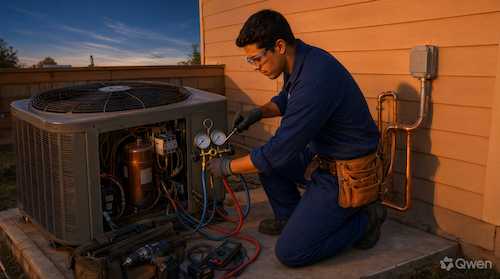
Los Angeles is an easy place to underestimate air conditioning. The coast rarely gets hot enough to think about it, while the valleys can run well above the downtown station's July mean of 73.3°F. That gap is the first thing to keep in mind when a contractor recommends a repair, a new system, or a different size.
What the climate data does and does not say
NOAA's 1991–2020 normals for the downtown USC campus station show January averaging 58.4°F and July 73.3°F, with about 14.2 inches of precipitation a year. Those are station averages. They do not describe the San Fernando Valley, the San Gabriel Valley, or a westside apartment, and they cannot diagnose a system. Use them as a reminder that cooling load changes across the metro.
A diagnosis should come before a parts list
For a repair, ask what was measured: supply and return temperatures, refrigerant pressures, electrical readings, airflow, or a leak test. A capacitor, a contactor, or a fan motor may be the visible failure, but the reason it failed matters. A proposal that replaces parts without explaining the measurement behind the diagnosis is a guess with an invoice.
Sizing and ducts decide comfort
A replacement proposal should state whether a load calculation was performed and what assumptions it used, including insulation, window area, orientation, and internal gains. Capacity is only half of it: ducts that are undersized, leaky, or poorly balanced can make a correctly sized system uncomfortable. Ask for static pressure or duct leakage results where ductwork is part of the scope.
Older housing stock and electrical capacity
About 67% of metro housing units were built before 1980, according to ACS estimates, and many of those homes have had equipment replaced more than once. Age is not a defect, but it is a reason to ask about the electrical circuit serving the equipment, the condition of the ductwork, and whether the new system needs a different disconnect or breaker. Those items belong in the written scope.
Questions to ask before approving work
Limits of this guide
This page does not diagnose a system remotely and does not publish local prices. Refrigerant handling rules, permit requirements, and equipment condition must be confirmed at the property and with the responsible authority.
Los Angeles metro context
The 2024 ACS 5-year estimates put the metro at about 13.0 million residents and 4.5 million households. About 48.4% of occupied homes are owner-occupied, so a meaningful share of cooling decisions involve a landlord or property manager. About 47.8% of housing units are single-family detached, which is where rooftop condensers and attic ductwork are most common. These figures describe the metro, not a specific home.
Los Angeles reference station and housing indicators
| Indicator | Value | Source |
|---|---|---|
| January mean temperature | 58.4°F | NOAA NCEI |
| July mean temperature | 73.3°F | NOAA NCEI |
| Annual mean temperature | 65.8°F | NOAA NCEI |
| Annual precipitation | 14.2 in. | NOAA NCEI |
| Metro population | 12,974,487 | U.S. Census Bureau |
| Housing units built before 1980 | 67.1% | U.S. Census Bureau |
Station normals are historical averages for one location, not a metro-wide average or a forecast. Census values describe the metro area, not an individual property.
Frequently Asked Questions
How do I know whether to repair or replace my AC in Los Angeles?
The decision usually turns on the age and condition of the equipment, the cost of the diagnosed repair relative to replacement, refrigerant type and availability, and whether the same problem keeps returning. Ask for the measurements behind the recommendation.
What is a Manual J load calculation?
It is a room-by-room method for estimating heating and cooling loads from the home's construction, insulation, windows, and orientation. Its result informs equipment sizing, which is why a proposal should state whether one was performed.
Why might cooling needs differ between Los Angeles neighborhoods?
The NOAA values used here come from one downtown station. Coastal distance, elevation, shade, and building design can change conditions elsewhere, so a system that fits one neighborhood may be oversized or undersized in another.
Should ductwork be replaced with a new AC system?
Not automatically. Ask for duct leakage or static pressure results and compare what the proposal includes. Sealing or repairing ducts can be enough in some homes, while others need partial replacement because of access, condition, or layout.
What should an AC replacement quote include?
Equipment models and capacity, the load calculation basis, included duct or electrical work, controls, commissioning steps, permit handling, exclusions, and both equipment and labor warranty terms.
What is the population of the Los Angeles metro area?
The U.S. Census Bureau's 2024 ACS 5-year estimates report about 13.0 million residents in the metro area. The figure describes regional scale, not the number of homes or providers.
Sources and review date
- American Community Survey 2024 5-year estimates (CBSA tables) — U.S. Census Bureau, 2024 ACS 5-year estimates.
- 1991–2020 station normals — LOS ANGELES DWTN USC CAMPUS, CA US (USW00093134) — NOAA National Centers for Environmental Information, 1991–2020 climate normals.
Reviewed on 2026-11-17.
Other Home Services in Los Angeles-Long Beach-Anaheim
All guides for the Los Angeles-Long Beach-Anaheim metro area