
Riverside, CA · metro guide
HVAC in the Inland Empire: Desert Heat, Mountain Cold and Smoke
One metro, three climates — valley, high desert and mountain — and equipment sized for the wrong one is the most common mistake.
Metro snapshot
Riverside in numbers
Sources named below each block
- Population
- 4.7M
- Households
- 1.5M
- Housing units
- 1.6M
- People / household
- 3.22
- population ÷ households
Owner-occupied homes 66%
The rest are rented. Owners are the ones who commission most exterior work.
Single-family detached 69%
Detached houses carry their own roof, gutters and exterior walls.
Built before 1980 36%
Older housing stock shapes what fails first: gutters, flashing, pipe material.
Season
The year in Riverside
- Precipitation
- 9.4 in
- Snowfall
- —
Average temperature by month, °F — the shape of the year is what decides when exterior work gets done.
Precipitation by month, inches.
| Month | Average temperature (°F) | Precipitation (in) | Snowfall (in) |
|---|---|---|---|
| January | 55.6°F | 2.29 in | — |
| February | 56.3°F | 2.41 in | — |
| March | 59.5°F | 1.21 in | — |
| April | 62.9°F | 0.59 in | — |
| May | 67.6°F | 0.20 in | — |
| June | 73.0°F | 0.01 in | — |
| July | 78.6°F | 0.12 in | — |
| August | 79.8°F | 0.02 in | — |
| September | 76.6°F | 0.11 in | — |
| October | 68.9°F | 0.33 in | — |
| November | 61.0°F | 0.57 in | — |
| December | 54.8°F | 1.51 in | — |
NOAA 1991–2020 climate normals, station RIVERSIDE MUNI AP, CA US (USW00003171). Station observations, not a metro-wide average — a metro that spans a mountain range can differ by more than this record shows.
Population, households and housing shares: U.S. Census Bureau, American Community Survey 2024 5-year estimates, metropolitan statistical area.
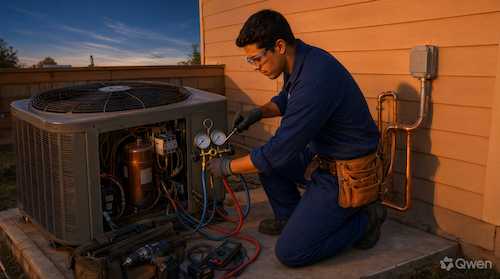
This metro is not one climate. It runs from the valleys around Riverside and Ontario, where summer afternoons dominate the year's cooling load, out to the Coachella Valley low desert, and up into mountain communities above the San Bernardino foothills, where the design condition is snow rather than heat. The reference station's July mean of 78.6°F says very little about a well-insulated tract house in Moreno Valley or a cabin in the mountains. Because 69.2% of the stock is single-family detached and much of it was built between 1960 and 2000, the practical questions are about the equipment that already exists: a split system at the end of its life, ducts running through an attic, and a refrigerant transition that has changed what a replacement looks like.
Cooling-dominated load, but sized for which site
The typical job here is cooling-led, and the failure mode is oversizing: a system chosen by square footage rather than by a room-by-room calculation cools the house quickly, cycles short, leaves the house clammy during a monsoon week and wears out early. Altitude changes the numbers again in the mountain communities, where equipment derating and heating capacity matter more than tonnage. Ask whether a room-by-room load calculation has been done, whether altitude was accounted for, and whether the proposal explains why that size and not one step up.
Ducts in a hot attic
In a single-storey house with the air handler and the ducts in the attic, the distribution system runs through the hottest space on the property, and every leak and every uninsulated run costs capacity. A system that is technically the right size can fail to cool the far bedroom because the ducts are losing more than the equipment is adding. Sealing and insulating the ducts is often the highest-return work available, and it is far cheaper before a new condenser than after. Ask whether the ducts will be tested or inspected, what the insulation value is, and whether the estimate includes sealing the boots, plenums and the connection at the air handler.
Monsoon humidity and the desert cooler
For a few weeks in summer the flow turns and moist air arrives from the south, which is exactly when an evaporative cooler — otherwise a sensible choice in dry desert air — stops working, because it depends on evaporation to cool. That is why a lot of desert-area houses run both, or have replaced the cooler with a refrigerated system. In the valleys the same humidity makes latent capacity matter. Ask what the house uses now, whether the proposed system handles a humid week, and how a dual approach would be controlled so the two systems do not fight each other.
Wildfire smoke and filtration
Smoke from fires in the mountains and the surrounding wildland settles into these valleys and can persist for days. Standard filters are not designed for that, and a system running with a high-efficiency filter needs a fan sized to handle the added resistance. The other issue is the return path: a house with a central return and an old, leaky cabinet pulls attic or garage air into the distribution instead of filtering it. Ask what filtration the equipment can support, whether the cabinet and return ducts will be sealed, and whether a separate filtration unit makes more sense than a filter upgrade.
Maintenance through a long cooling season
Equipment that runs for months on end accumulates dirt on the coil, a filter that loads faster than the label suggests, and a condensate line that grows something inside it. None of that fails dramatically, and all of it shows up as reduced capacity and a higher bill in the hottest weeks. Ask what the maintenance interval should be for this climate rather than for a temperate one, whether the coil and the condensate trap are part of it, and what the owner can reasonably check between visits.
What to pin down in the estimate
Where this page stops
No prices, sizes or efficiency figures are quoted here. Refrigerant rules, code requirements and equipment ratings change, and the applicable version should be confirmed from the manufacturer's literature and the local authority rather than from any page.
Riverside metro context
The 2024 ACS 5-year estimates describe about 4.68 million residents in 1,450,250 households and 1,613,300 housing units, with 65.8% owner-occupied and 69.2% single-family detached. About 36.2% of units predate 1980. At the Riverside reference station the annual mean is 66.2°F with a July mean of 78.6°F and January at 55.6°F; annual precipitation is 9.4 inches, almost all of it outside summer.
Riverside reference station and housing indicators
| Indicator | Value | Source |
|---|---|---|
| January mean temperature | 55.6°F | NOAA NCEI |
| July mean temperature | 78.6°F | NOAA NCEI |
| Annual precipitation | 9.4 in. | NOAA NCEI |
| Metro population | 4,675,704 | U.S. Census Bureau |
| Owner-occupied share | 65.8% | U.S. Census Bureau |
| Housing units built before 1980 | 36.2% | U.S. Census Bureau |
Station normals describe one valley location, not the metro: the same county contains desert communities far hotter in summer and mountain towns that see snow. Sizing should follow the site, not this table.
Frequently Asked Questions
Is a bigger air conditioner better in this heat?
No. Oversizing cools the air quickly but does not remove enough moisture during humid weeks, and it cycles the equipment harder. A room-by-room calculation is what determines the right size.
Why is one bedroom always warmer?
Usually the ducts, not the equipment. Long runs through a hot attic lose capacity, leak at the boots and plenums, and deliver less air to the far room. Sealing and insulating the distribution is often the fix.
Should I keep my evaporative cooler?
In the dry desert air it can be efficient, but it stops being effective when monsoon moisture arrives. Many houses end up with both, or replace the cooler with a refrigerated system for reliability through the humid weeks.
Do I need a special filter for wildfire smoke?
A higher-efficiency filter helps, but only if the blower can handle the added resistance and the cabinet and return ducts are sealed. Otherwise the system pulls unfiltered air in past the filter.
Does altitude matter for equipment?
Yes, in the mountain communities. Capacity and combustion both change with elevation, so equipment selected for a valley house is not automatically correct higher up.
How long should a system last here?
A cooling-dominated climate runs equipment hard, and life depends on installation quality, duct condition and maintenance. Asking for a maintenance schedule is more useful than asking for a number of years.
Sources and review date
- American Community Survey 2024 5-year estimates (CBSA tables) — U.S. Census Bureau, 2024 ACS 5-year estimates.
- 1991–2020 station normals — RIVERSIDE MUNI AP, CA US (USW00003171) — NOAA National Centers for Environmental Information, 1991–2020 climate normals.
Reviewed on 2026-11-18.
Other Home Services in Riverside–San Bernardino–Ontario
All guides for the Riverside–San Bernardino–Ontario metro area