
Sacramento, CA · metro guide
HVAC in Sacramento: Adding Cooling to a House That Never Had It
Much of the housing here was built to be heated and not cooled — which makes the duct question the whole project.
Metro snapshot
Sacramento in numbers
Sources named below each block
- Population
- 2.4M
- Households
- 882K
- Housing units
- 955K
- People / household
- 2.75
- population ÷ households
Owner-occupied homes 63%
The rest are rented. Owners are the ones who commission most exterior work.
Single-family detached 68%
Detached houses carry their own roof, gutters and exterior walls.
Built before 1980 44%
Older housing stock shapes what fails first: gutters, flashing, pipe material.
Season
The year in Sacramento
- Precipitation
- 18.1 in
- Snowfall
- —
Average temperature by month, °F — the shape of the year is what decides when exterior work gets done.
Precipitation by month, inches.
| Month | Average temperature (°F) | Precipitation (in) | Snowfall (in) |
|---|---|---|---|
| January | 47.6°F | 3.66 in | — |
| February | 51.4°F | 3.49 in | — |
| March | 55.4°F | 2.68 in | — |
| April | 59.5°F | 1.26 in | — |
| May | 66.1°F | 0.75 in | — |
| June | 72.2°F | 0.23 in | — |
| July | 75.9°F | 0.00 in | — |
| August | 75.3°F | 0.04 in | — |
| September | 72.5°F | 0.09 in | — |
| October | 64.5°F | 0.85 in | — |
| November | 53.9°F | 1.66 in | — |
| December | 47.3°F | 3.43 in | — |
NOAA 1991–2020 climate normals, station SACRAMENTO EXECUTIVE AP, CA US (USW00023232). Station observations, not a metro-wide average — a metro that spans a mountain range can differ by more than this record shows.
Population, households and housing shares: U.S. Census Bureau, American Community Survey 2024 5-year estimates, metropolitan statistical area.
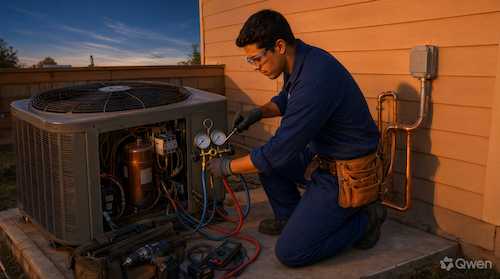
Sacramento's post-war housing was designed around a wall heater or a central gas furnace and a window unit in the living room. Nearly 44% of the stock predates 1980, and a good part of that predates central air altogether. So the request that comes up most often here is not replacing a system but adding one: putting cooling into a single-storey ranch house with a low attic, no return path between rooms, and fifty years of remodelling in the way. Because single-family detached housing is 68.4% of the stock, this is almost always a one-house decision, and the quality of the answer depends on the duct design rather than on the equipment label.
The ducts are the project
A house that never had central cooling also never had a place for ductwork. Retrofit options are real and each has consequences: overhead in a low attic means tight spaces and short runs; under the floor is possible where there is a crawlspace; high-velocity small-duct systems fit where conventional ducts will not, at a cost. Returns matter as much as supplies — a system with one central return and doors closed in every bedroom will not distribute air properly. Ask how the routing was designed, how many returns there are, and what happens to the parts of the house that are hardest to reach.
Ducts in an attic that bakes
Where the ducts run through an attic, summer heat in that space works directly against the equipment, and unsealed plenums and boots pull hot attic air into the supply. In a valley climate with a long cooling season, that loss is not theoretical — it is the difference between a system that keeps up and one that never quite does. Sealing and insulating the distribution is often the highest-return work available and the cheapest moment to do it is during a replacement. Ask whether the ducts will be tested, what insulation value is specified, and whether the plenum and boots will be sealed.
Hot days, cool nights and the shoulder seasons
The valley's pattern — hot afternoons and considerably cooler nights — is friendly to equipment that can modulate, and it also means the shoulder months swing widely between heating and cooling within a day. That is why heat pumps suit the climate, provided the controls are set up so the system is not fighting itself. Ask whether the proposal is a heat pump, how the changeover and auxiliary heat are configured, and whether the thermostat can handle a day that needs both.
Shade, windows and the load you already have
A 1950s ranch house often has single-pane windows in large west-facing openings, minimal wall insulation and a mature tree canopy that may or may not shade the right side of the building. The equipment has to meet whatever load those choices created. Before buying capacity, it is worth knowing what the load actually is: a room-by-room calculation shows whether the answer is a bigger system or a smaller problem. Ask whether the calculation was done, what assumptions it makes about the windows and insulation, and whether any of those assumptions are being addressed.
Service before the season, not during it
Equipment that is neglected until it fails will fail in the first hot week, when every contractor is booked. The checks that prevent it are ordinary: a clean filter, a clean condenser coil, a condensate line that drains, and refrigerant charge that is right rather than merely present. Ask what an annual visit covers, whether the condensate line is cleared as part of it, and what the owner should check monthly during the season.
What to pin down in the estimate
Where this page stops
No prices, sizes or efficiency figures are quoted here. Refrigerant rules, code requirements and equipment ratings change, and the applicable version should be confirmed from the manufacturer's literature and the local authority rather than from any page.
Sacramento metro context
The 2024 ACS 5-year estimates describe about 2.43 million residents in 881,889 households and 954,751 housing units, with 63.0% owner-occupied and 68.4% single-family detached. About 43.9% of units predate 1980, which is the cohort most likely to have been built without central cooling. No climate station is reported for this metro in the site dataset, so no temperature or precipitation normals appear on this page.
Sacramento housing indicators
| Indicator | Value | Source |
|---|---|---|
| Housing units built before 1980 | 43.9% | U.S. Census Bureau |
| Single-family detached share | 68.4% | U.S. Census Bureau |
| Owner-occupied share | 63.0% | U.S. Census Bureau |
| Metro households | 881,889 | U.S. Census Bureau |
| Housing units | 954,751 | U.S. Census Bureau |
| Metro population | 2,426,388 | U.S. Census Bureau |
No climate normals are shown because no station record is held for this metro in the site dataset. The pre-1980 share is the useful indicator here: the older the house, the more likely it was built without ductwork for cooling.
Frequently Asked Questions
Can central air be added to a house with no ducts?
Yes, but the design is the job. Overhead in an attic, under the floor in a crawlspace, or a small-duct high-velocity system are the usual routes, and each has different costs and trade-offs. A quote that names equipment without describing the routing has not answered the question.
Why is one end of my house always hotter?
Usually because of the distribution: a long duct run through a hot attic, a leaking boot, or too few returns. Balancing and sealing often fix what a bigger unit cannot.
Is a heat pump a good fit for this climate?
The wide swing between hot afternoons and cool nights suits equipment that can modulate and provide both heating and cooling. What matters is how the controls stage auxiliary heat and changeover.
Should I replace windows before the HVAC?
Not necessarily, but the two decisions are related. A load calculation tells you how much of the problem is the envelope; spending on equipment before knowing that can mean buying capacity you could have avoided.
How often does the system need service?
In a long cooling season, an annual visit that cleans the coil, checks the charge and clears the condensate line is a reasonable baseline. Most failures that matter start as something small.
Does the age of the house change the plan?
It changes the constraints. A pre-1980 ranch house has a low attic, small closets and no return path, so the design has to work with those rather than assume a modern layout.
Sources and review date
- American Community Survey 2024 5-year estimates (CBSA tables) — U.S. Census Bureau, 2024 ACS 5-year estimates.
Reviewed on 2026-11-18.