
Sacramento, CA · metro guide
Water Damage in Sacramento: Winter Storms, Levees and Slab Leaks
A city at the confluence of two rivers, with a dry season that hides every leak until the rain returns.
Metro snapshot
Sacramento in numbers
Sources named below each block
- Population
- 2.4M
- Households
- 882K
- Housing units
- 955K
- People / household
- 2.75
- population ÷ households
Owner-occupied homes 63%
The rest are rented. Owners are the ones who commission most exterior work.
Single-family detached 68%
Detached houses carry their own roof, gutters and exterior walls.
Built before 1980 44%
Older housing stock shapes what fails first: gutters, flashing, pipe material.
Season
The year in Sacramento
- Precipitation
- 18.1 in
- Snowfall
- —
Average temperature by month, °F — the shape of the year is what decides when exterior work gets done.
Precipitation by month, inches.
| Month | Average temperature (°F) | Precipitation (in) | Snowfall (in) |
|---|---|---|---|
| January | 47.6°F | 3.66 in | — |
| February | 51.4°F | 3.49 in | — |
| March | 55.4°F | 2.68 in | — |
| April | 59.5°F | 1.26 in | — |
| May | 66.1°F | 0.75 in | — |
| June | 72.2°F | 0.23 in | — |
| July | 75.9°F | 0.00 in | — |
| August | 75.3°F | 0.04 in | — |
| September | 72.5°F | 0.09 in | — |
| October | 64.5°F | 0.85 in | — |
| November | 53.9°F | 1.66 in | — |
| December | 47.3°F | 3.43 in | — |
NOAA 1991–2020 climate normals, station SACRAMENTO EXECUTIVE AP, CA US (USW00023232). Station observations, not a metro-wide average — a metro that spans a mountain range can differ by more than this record shows.
Population, households and housing shares: U.S. Census Bureau, American Community Survey 2024 5-year estimates, metropolitan statistical area.
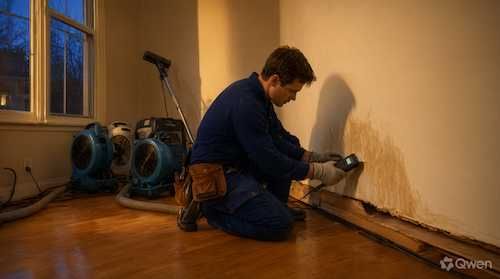
Sacramento has an unusual water profile: a long dry season in which nothing leaks, followed by a wet season in which everything that was going to leak does. The first substantial storm of the year is reliably busy, because a cracked pipe boot, a blocked gutter or a valley with a small gap has been quietly waiting since spring. Beneath that sits the larger question of flood exposure — the metro sits where the Sacramento and American rivers meet, much of it behind levees, and the local drainage is a subject residents know well. And under the houses, a large stock of post-war slab construction means plumbing failures show up inside the structure rather than in a basement.
The first storm finds everything
The damage from a seasonal storm is rarely caused by that storm. It is caused by the maintenance that was deferred through the dry months: gutters full of oak litter, a downspout that discharges against the foundation, a roof penetration whose seal has baked in the sun, a window flashing that has been marginal for years. When several inches arrive in a couple of days, all of them fail together. Ask what the pre-season check covers, whether the roof and the gutters will be looked at before the rain rather than after, and where the downspouts actually discharge.
Levees, drainage and the flood question
A significant part of this metro is protected by levee systems and drained by a network of channels, which means flood risk is a function of infrastructure as much as of rainfall. Insurance treatment follows that: flood is typically a separate policy from a standard property policy, and the mapped zone at the address decides a great deal. The practical step is to know the zone and the elevation rather than to assume, and to know where water would enter if the local drainage surcharged. Ask whether the property is in a mapped flood zone, what the elevation certificate says if there is one, and whether the insurer treats the exposure as flood or as storm.
Slab leaks and the hidden supply line
In a single-storey house on a slab, a supply leak has nowhere to show itself except through the floor. The evidence is indirect: a warm patch, a water bill that climbs, the sound of running water with everything off, or a section of baseboard that stays damp. Left alone, the water undermines flooring and wicks into walls, and the drying is more complicated than a surface spill because the slab itself holds moisture. Ask how the source will be isolated, what equipment is used to dry a slab assembly, and how the result will be verified with readings rather than by touch.
Drying in a dry climate is still not automatic
Low outdoor humidity helps, and it also hides the problem: surfaces read dry within a day while the wall cavity and the slab underneath are still wet. That is why the visible moisture disappearing is not the end of the job. The vulnerable assemblies here are the ones with the least airflow — under cabinets, inside a wall with insulation, and the interior of a floor assembly. Ask what is being measured and where, how long the equipment will run, and what evidence of dryness is provided at the end.
The leaks that happen while you are away
Most losses in a dry climate are not weather: a supply hose on a washing machine, a water heater, a refrigerator line or a fitting under a sink lets go and runs for hours before anyone notices. The consequences are worse in a slab house, where water spreads across the floor and into the wall base rather than draining away. Ask whether the flexible hoses have been replaced with braided stainless, whether the heater sits in a pan with a drain, and whether a leak detector with an automatic shut-off is worth fitting.
What to pin down before work starts
Where this page stops
No prices are quoted and no loss is assessed here. Flood zone determination, elevation and coverage questions belong to the local authority, a surveyor and the insurer, and mold or structural questions require inspection.
Sacramento metro context
The 2024 ACS 5-year estimates describe about 2.43 million residents in 881,889 households and 954,751 housing units, with 63.0% owner-occupied and 68.4% single-family detached. About 43.9% of units predate 1980, and much of that stock is single-storey slab construction where plumbing failures stay hidden inside the building. No climate station is reported for this metro in the site dataset, so no temperature or precipitation normals appear on this page.
Sacramento housing indicators
| Indicator | Value | Source |
|---|---|---|
| Housing units built before 1980 | 43.9% | U.S. Census Bureau |
| Single-family detached share | 68.4% | U.S. Census Bureau |
| Owner-occupied share | 63.0% | U.S. Census Bureau |
| Metro households | 881,889 | U.S. Census Bureau |
| Housing units | 954,751 | U.S. Census Bureau |
| Metro population | 2,426,388 | U.S. Census Bureau |
No climate normals are shown because no station record is held for this metro in the site dataset. Flood exposure here depends on the drainage infrastructure serving a specific address, so the mapped zone matters more than any metro-wide average.
Frequently Asked Questions
Why does my roof only leak in the wet season?
Because the entry points stay dry for months and then take a concentrated load. A cracked boot or a small valley gap is invisible in summer and obvious in the first real storm, which is also when contractors are busiest.
Is flood damage covered by my property policy?
Usually not — flood is typically a separate policy. Whether a particular event counts as flood or as storm water depends on the wording and on the source, so check the policy and the mapped zone before assuming.
The floor looks dry — is the slab dry?
Not necessarily. A slab and the wall base hold moisture long after the surface reads dry, which is why readings rather than appearance should decide when drying is finished and flooring goes back.
How do I find a slab leak?
Shut everything off and watch the meter; if it moves, isolate sections to narrow it down. A warm patch on the floor or a persistent damp baseboard can point to a hot or cold line, and confirmation means an inspection rather than a guess.
What maintenance prevents the first-storm losses?
Clearing gutters and downspouts, checking roof penetrations and flashings, making sure discharge points are away from the foundation, and knowing where the main shut-off is. It is unglamorous and it prevents most of the calls.
Can I stay in the house while it dries?
Often yes, depending on which rooms are affected and how much equipment is running. If a bedroom or a kitchen is out of use, additional-living-expense coverage may apply where it exists.
Sources and review date
- American Community Survey 2024 5-year estimates (CBSA tables) — U.S. Census Bureau, 2024 ACS 5-year estimates.
Reviewed on 2026-11-18.