
Sacramento, CA · metro guide
Solar Panels in Sacramento: Shade, Roof Age and Two Utilities
The sun is not the constraint here — the oak canopy, the roof under the array and the utility's rules are.
Metro snapshot
Sacramento in numbers
Sources named below each block
- Population
- 2.4M
- Households
- 882K
- Housing units
- 955K
- People / household
- 2.75
- population ÷ households
Owner-occupied homes 63%
The rest are rented. Owners are the ones who commission most exterior work.
Single-family detached 68%
Detached houses carry their own roof, gutters and exterior walls.
Built before 1980 44%
Older housing stock shapes what fails first: gutters, flashing, pipe material.
Season
The year in Sacramento
- Precipitation
- 18.1 in
- Snowfall
- —
Average temperature by month, °F — the shape of the year is what decides when exterior work gets done.
Precipitation by month, inches.
| Month | Average temperature (°F) | Precipitation (in) | Snowfall (in) |
|---|---|---|---|
| January | 47.6°F | 3.66 in | — |
| February | 51.4°F | 3.49 in | — |
| March | 55.4°F | 2.68 in | — |
| April | 59.5°F | 1.26 in | — |
| May | 66.1°F | 0.75 in | — |
| June | 72.2°F | 0.23 in | — |
| July | 75.9°F | 0.00 in | — |
| August | 75.3°F | 0.04 in | — |
| September | 72.5°F | 0.09 in | — |
| October | 64.5°F | 0.85 in | — |
| November | 53.9°F | 1.66 in | — |
| December | 47.3°F | 3.43 in | — |
NOAA 1991–2020 climate normals, station SACRAMENTO EXECUTIVE AP, CA US (USW00023232). Station observations, not a metro-wide average — a metro that spans a mountain range can differ by more than this record shows.
Population, households and housing shares: U.S. Census Bureau, American Community Survey 2024 5-year estimates, metropolitan statistical area.
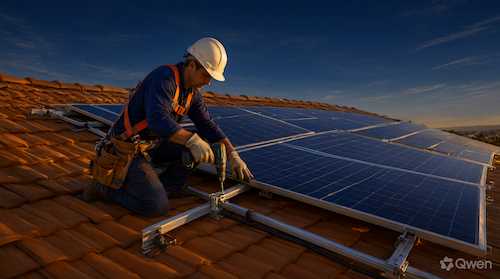
Sacramento has excellent sun and one of the highest rates of residential solar in the country, largely because a municipal utility here has supported it for years. That history means the market is mature and the differences between quotes are rarely about the modules — they are about shading, roof condition, electrical capacity and how the system is configured as export rules change. Nearly 44% of the housing predates 1980, and the older neighborhoods are heavily shaded by mature trees, so a production estimate built on a generic model of sun and roof area will not describe the property you actually own.
The canopy is the design constraint
In the central neighborhoods and the older suburbs, a mature street tree or a valley oak in the yard can shade a roof for most of the day, and the shading gets worse in winter when the sun is low. Module-level electronics can limit the loss from a shaded corner, but they cannot create production that is not there. The honest first step is a shade study rather than a layout. Ask how shading was measured and when, what the design does about the shaded hours, and whether the production estimate accounts for the trees as they will be in ten years.
The roof under the array
A solar array is a twenty-five year decision mounted on a covering that may not have twenty-five years left. Removing and reinstalling panels to replace a roof adds cost and labor that no original quote includes, and it puts the penetration seals through a second cycle. On a 1950s or 1960s house the question is sharper, because the deck underneath may already be questionable. Ask the age of the covering, whether the roof will be checked before mounting, what the penetrations will be sealed with, and what the arrangement is if the roof has to be replaced later.
Service capacity and the interconnection
The array connects through the service panel, and older houses may lack either the busbar allowance or the physical space for the breaker. The interconnection application is a separate process with the utility, with its own review and its own timeline, and a service upgrade in front of it adds a utility disconnect and reconnect. Ask what was found at the panel, whether an upgrade is included, and who files the interconnection — because the delay usually sits there rather than in the installation.
Export rules and the storage question
Compensation for exported power has been reduced across California, which changes the economics of a system designed to export at midday toward one designed to serve the house in the evening. That pushes design decisions — orientation, sizing and whether a battery is included — into the foreground. Ask what the current compensation arrangement is for the address, how the design accounts for evening use, and whether storage is being proposed because it improves the system or because it is being sold.
Permits, inspection and the utility queue
The panels go up in a few days; the project does not. A building permit, an electrical permit in some jurisdictions, an inspection, and the utility's interconnection approval all sit around that short installation, and the last of them is usually the bottleneck. Ask who files each application, what the recent timeline has been, and what happens to the schedule if the utility asks for a design change.
What to pin down in the estimate
Where this page stops
No system sizes, prices or production figures are quoted here. Tariffs, interconnection rules and incentive programs change, so current terms should be confirmed with the utility and the state authorities rather than taken from any page, including this one.
Sacramento metro context
The 2024 ACS 5-year estimates describe about 2.43 million residents in 881,889 households and 954,751 housing units, with 63.0% owner-occupied and 68.4% single-family detached — a stock where most roofs are individually owned and individually shaded. About 43.9% of units predate 1980. No climate station is reported for this metro in the site dataset, so no temperature or precipitation normals appear on this page.
Sacramento housing indicators
| Indicator | Value | Source |
|---|---|---|
| Housing units built before 1980 | 43.9% | U.S. Census Bureau |
| Single-family detached share | 68.4% | U.S. Census Bureau |
| Owner-occupied share | 63.0% | U.S. Census Bureau |
| Metro households | 881,889 | U.S. Census Bureau |
| Housing units | 954,751 | U.S. Census Bureau |
| Metro population | 2,426,388 | U.S. Census Bureau |
No climate normals are shown because no station record is held for this metro in the site dataset. Roof age and tree cover vary street by street, which is why production should be modelled for the site rather than estimated from a metro average.
Frequently Asked Questions
My street is full of mature trees — is solar still worth it?
It depends on which roof planes are clear and for how many hours. A shade study answers that before a layout is drawn; a design that ignores the canopy will underperform whatever the model says.
Should the roof be replaced first?
If it has limited life left, yes. Removing and reinstalling an array later costs more than doing the roof first, and it forces the penetration seals through a second cycle.
Does my old panel block solar?
It can, if there is no busbar allowance or no physical space for the breaker. An electrician has to check on site, and a service upgrade has to be planned before the interconnection is filed.
Is a battery necessary?
Not always, but reduced compensation for exported power makes evening self-consumption more valuable than it used to be. The question is whether storage improves the system's usefulness, not whether it is fashionable.
Why does the installation take longer than the installer says?
Because the visible work is short and the approvals are not. The building permit, the inspection and the utility's interconnection review each add time, and the last one is usually the bottleneck.
Which utility handles my interconnection?
It depends on the address — this metro is served by more than one utility, with different processes and timelines. Confirm before signing, and find out who is filing the application.
Sources and review date
- American Community Survey 2024 5-year estimates (CBSA tables) — U.S. Census Bureau, 2024 ACS 5-year estimates.
Reviewed on 2026-11-18.