
San Jose, CA · metro guide
Solar Panels in San Jose: Strong Sun, High Rates, New Export Rules
High electricity prices make solar attractive here. The export rules make self-consumption the point.
Metro snapshot
San Jose in numbers
Sources named below each block
- Population
- 2.0M
- Households
- 680K
- Housing units
- 720K
- People / household
- 2.90
- population ÷ households
Owner-occupied homes 56%
The rest are rented. Owners are the ones who commission most exterior work.
Single-family detached 52%
Detached houses carry their own roof, gutters and exterior walls.
Built before 1980 59%
Older housing stock shapes what fails first: gutters, flashing, pipe material.
Season
The year in San Jose
- Precipitation
- 13.5 in
- Snowfall
- —
Average temperature by month, °F — the shape of the year is what decides when exterior work gets done.
Precipitation by month, inches.
| Month | Average temperature (°F) | Precipitation (in) | Snowfall (in) |
|---|---|---|---|
| January | 50.8°F | 2.80 in | — |
| February | 53.2°F | 2.69 in | — |
| March | 56.1°F | 2.08 in | — |
| April | 58.8°F | 1.07 in | — |
| May | 63.0°F | 0.39 in | — |
| June | 67.3°F | 0.18 in | — |
| July | 69.5°F | 0.00 in | — |
| August | 70.0°F | 0.05 in | — |
| September | 69.0°F | 0.07 in | — |
| October | 64.3°F | 0.53 in | — |
| November | 55.9°F | 1.33 in | — |
| December | 50.6°F | 2.29 in | — |
NOAA 1991–2020 climate normals, station SAN JOSE, CA US (USW00023293). Station observations, not a metro-wide average — a metro that spans a mountain range can differ by more than this record shows.
Population, households and housing shares: U.S. Census Bureau, American Community Survey 2024 5-year estimates, metropolitan statistical area.
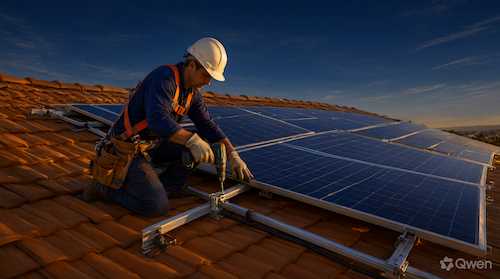
Silicon Valley is one of the few places where the economics of solar are carried by the price of the electricity being avoided rather than by the quality of the resource. The sun is excellent, but what makes a system pay is the retail rate it offsets. California's rules for exported power changed substantially, reducing what a household is paid for the electricity it sends to the grid, and that has shifted the design question from maximum production to maximum self-consumption. With 59.0% of metro housing built before 1980, roof and panel condition add a second layer.
Exports are worth much less than they were
Under the current California structure, exported electricity is compensated at a value that is generally well below the retail rate, and the rate varies by time of day. That means an array sized purely to offset annual consumption can produce a lot of low-value exports. Ask for a monthly and hourly view of production against household consumption, not one annual total, and ask what share of production is expected to be self-consumed. Then ask how the design encourages consumption when the array is producing — an EV charged at midday, for instance, is a different proposition from one charged at night.
Batteries change the arithmetic
Where exports are worth little, storing production to use in the evening is the obvious counterweight, and it is why storage is discussed in nearly every project here. Ask what the battery is expected to do — evening load, backup, or both — what it costs per kilowatt-hour of usable capacity, whether it qualifies for any current incentive, and how the system behaves when it is full or depleted. Storage is not automatically worth it, and a proposal that adds it without showing the modelled effect on the bill is asking you to take it on faith.
Older homes and the electrical service
A house built in 1965 may have a 100-amp service and a full panel, and adding solar plus storage plus a car charger may require a service upgrade before any of it works. Ask whether the main service is adequate, what an upgrade would cost and involve, whether the utility needs to be involved, and how long that takes. Putting the electrical work in the same project as the array is usually simpler than coming back to it later.
Tile roofs and roof age
A large share of the local stock has tile or composition roofs, and tile requires mounting details designed for it — walking on it and drilling it carelessly causes damage that appears later as a leak. Ask what the covering is, how old it is, how the installer mounts on that specific material, and how broken tiles will be replaced. If the roof is near the end of its life, sequencing replacement first avoids paying twice for disconnection and reinstallation.
Shade from mature trees and neighboring buildings
Established neighborhoods have large trees, and in denser parts of the valley a neighbor's second storey can matter as much. Ask which hours of the year were modelled, whether the design uses per-panel electronics so one shaded section does not pull down a string, and what happens to production if a tree is removed or a neighbor builds. With export value reduced, a shaded array is doubly penalised because the production lost was worth the most at the time it was lost.
What to ask a Bay Area installer
Where this page stops
No prices, incentives or production figures are published here, because none can be produced honestly without a site assessment. Roof condition, structural capacity and service capacity require inspection, and financial and regulatory questions belong to a qualified adviser and the utility.
San Jose metro context
The 2024 ACS 5-year estimates count about 1.97 million residents in 679,914 households across 720,159 housing units, with 55.5% owner-occupied and 51.6% single-family detached — the low detached share means a significant part of the stock is in attached or multi-unit buildings where roof control is not guaranteed. About 59.0% of units predate 1980. A climate station is not reported for this metro in the site dataset, so no temperature or precipitation normals appear on this page.
San Jose housing and ownership indicators
| Indicator | Value | Source |
|---|---|---|
| Housing units built before 1980 | 59.0% | U.S. Census Bureau |
| Single-family detached share | 51.6% | U.S. Census Bureau |
| Owner-occupied share | 55.5% | U.S. Census Bureau |
| Housing units | 720,159 | U.S. Census Bureau |
| Metro households | 679,914 | U.S. Census Bureau |
| Metro population | 1,969,337 | U.S. Census Bureau |
No climate normals are shown because no station record is held for this metro in the site dataset. Electricity tariffs and export values change and must be confirmed with the utility for the current interconnection period.
Frequently Asked Questions
Is solar still worth it in California after the export rules changed?
It can be, because retail rates are high and the electricity a household uses directly is worth the full rate. What has changed is that oversized arrays exporting most of their production are far less attractive. The design should target self-consumption, and storage is often part of that conversation.
Do I need a battery?
Not necessarily, but the case is stronger here than in most markets because exported power is worth much less than power used on site. Ask for the modelled bill with and without storage, and for the cost per usable kilowatt-hour, rather than accepting storage as a default add-on.
Will I need a panel upgrade?
If the service is 100 amps and already full, adding solar, storage and vehicle charging may require one. That is an electrical project with its own cost and utility involvement, so establish it before the solar design is finalized rather than after.
Can panels go on a tile roof here?
Yes, with mounting designed for tile and an installer who has worked on it. Tile is easy to break and expensive to match, so ask how the mounting is done and how damaged tiles are replaced.
Does shade matter more now?
In a sense, yes. Production lost to shade is lost at the times it is worth the most, since it would otherwise have been consumed on site. A seasonal shade study and per-panel electronics matter more than they did under generous export credits.
How do I check the current export value?
Ask the installer for the applicable tariff terms in writing and confirm them with the utility. The structure changed materially and applies based on when the system is interconnected.
Sources and review date
- American Community Survey 2024 5-year estimates (CBSA tables) — U.S. Census Bureau, 2024 ACS 5-year estimates.
Reviewed on 2026-11-18.
Other Home Services in San Jose-Sunnyvale-Santa Clara
All guides for the San Jose-Sunnyvale-Santa Clara metro area