
Los Angeles, CA · metro guide
Solar Panels in Los Angeles: Roof, Production, and What to Compare
Los Angeles is sunny, but a solar quote is still a projection. Roof condition, shade, and the assumptions behind production decide whether it holds up.
Metro snapshot
Los Angeles in numbers
Sources named below each block
- Population
- 13.0M
- Households
- 4.5M
- Housing units
- 4.8M
- People / household
- 2.88
- population ÷ households
Owner-occupied homes 48%
The rest are rented. Owners are the ones who commission most exterior work.
Single-family detached 48%
Detached houses carry their own roof, gutters and exterior walls.
Built before 1980 67%
Older housing stock shapes what fails first: gutters, flashing, pipe material.
Season
The year in Los Angeles
- Precipitation
- 14.2 in
- Snowfall
- —
Average temperature by month, °F — the shape of the year is what decides when exterior work gets done.
Precipitation by month, inches.
| Month | Average temperature (°F) | Precipitation (in) | Snowfall (in) |
|---|---|---|---|
| January | 58.4°F | 3.29 in | — |
| February | 59.0°F | 3.64 in | — |
| March | 61.1°F | 2.23 in | — |
| April | 63.6°F | 0.69 in | — |
| May | 65.9°F | 0.32 in | — |
| June | 69.3°F | 0.09 in | — |
| July | 73.3°F | 0.02 in | — |
| August | 74.7°F | 0.00 in | — |
| September | 73.6°F | 0.13 in | — |
| October | 69.3°F | 0.58 in | — |
| November | 63.0°F | 0.78 in | — |
| December | 57.8°F | 2.48 in | — |
NOAA 1991–2020 climate normals, station LOS ANGELES DWTN USC CAMPUS, CA US (USW00093134). Station observations, not a metro-wide average — a metro that spans a mountain range can differ by more than this record shows.
Population, households and housing shares: U.S. Census Bureau, American Community Survey 2024 5-year estimates, metropolitan statistical area.
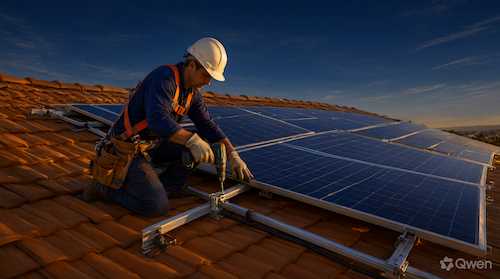
Los Angeles looks like an easy solar market, and in some ways it is: the downtown station records about 14.2 inches of rain a year and July averaging 73.3°F, with long stretches of clear weather. The complication is not the sun. It is the roof underneath, the shade across it, and the assumptions an installer uses to turn sunlight into a production number.
The roof comes first
About 67.1% of metro housing units were built before 1980, according to ACS estimates, so many roofs are older than the solar system will be. Ask how the installer evaluates roof condition, what happens if repairs are needed, and who is responsible for removal and reinstallation if the roof is replaced later. A solar array on a roof that needs work in five years is an expensive sequencing mistake.
Production is a projection, not a measurement
Ask which production model was used, what shading and soiling assumptions it contains, and whether it uses historical consumption or a standard profile. Coastal marine layer, nearby trees, and rooftop equipment can all change output. Compare estimated first-year production and the assumptions behind it rather than a single payback figure.
Equipment and warranties
Compare module and inverter models, system size, monitoring, and the separate warranties for equipment, production, and workmanship. Ask which party honours each warranty and how long it lasts. A lower price may reflect different equipment, a smaller system, or excluded electrical work.
Permits, interconnection, and who owns the steps
A solar project usually involves a building permit, an electrical inspection, and a utility interconnection request before the system can operate. Ask which party prepares and files each item, who schedules inspections, and what happens if the utility changes its requirements. Keep the approval-to-operate date with the contract.
Questions to ask before signing
Where this page stops
This page does not estimate production, savings, or payback for a specific property and does not confirm which incentives apply. Those depend on the roof, shading, equipment, utility rules, and current tax law, which should be checked with the relevant official source.
Los Angeles metro context
The 2024 ACS 5-year estimates put the metro at about 13.0 million residents and 4.5 million households. About 48.4% of occupied homes are owner-occupied, so a meaningful share of decisions involve a landlord or property manager. About 47.8% of housing units are single-family detached, the segment where rooftop solar is most common. NOAA's downtown station records January averaging 58.4°F, July 73.3°F, and about 14.2 inches of precipitation a year.
Los Angeles reference station and housing indicators
| Indicator | Value | Source |
|---|---|---|
| January mean temperature | 58.4°F | NOAA NCEI |
| July mean temperature | 73.3°F | NOAA NCEI |
| Annual precipitation | 14.2 in. | NOAA NCEI |
| Metro population | 12,974,487 | U.S. Census Bureau |
| Owner-occupied share | 48.4% | U.S. Census Bureau |
| Single-family detached share | 47.8% | U.S. Census Bureau |
| Housing units built before 1980 | 67.1% | U.S. Census Bureau |
Station normals are historical averages for one location, not a forecast. Census values describe the metro area, not an individual property.
Frequently Asked Questions
What should I compare between two solar quotes in Los Angeles?
Compare the gross cash price, system size, equipment models, estimated first-year production and its assumptions, included roof and electrical work, exclusions, and each warranty. A lower price may reflect a smaller system or excluded work.
Does shade matter in a sunny metro like Los Angeles?
Yes. Partial shade can reduce output disproportionately depending on the inverter and wiring design. Ask how the production estimate models shade and whether optimizers or microinverters are proposed for shaded areas.
Should I replace my roof before installing solar?
If the roof is near the end of its service life, it is usually cheaper to address it before mounting. Ask the installer how roof condition is evaluated and who is responsible for removal and reinstallation later.
Who handles permits and the utility interconnection?
It varies by contract. Ask which party prepares the building permit and the utility interconnection application, who schedules inspections, and who confirms permission to operate.
Are battery storage and panel upgrades included?
Usually they are separate line items. Ask explicitly whether battery storage and main service panel upgrades are included, and what each adds to the total.
What is the population of the Los Angeles metro area?
The U.S. Census Bureau's 2024 ACS 5-year estimates report about 13.0 million residents in the metro area. The figure describes regional scale, not the number of homes or providers.
Sources and review date
- American Community Survey 2024 5-year estimates (CBSA tables) — U.S. Census Bureau, 2024 ACS 5-year estimates.
- 1991–2020 station normals — LOS ANGELES DWTN USC CAMPUS, CA US (USW00093134) — NOAA National Centers for Environmental Information, 1991–2020 climate normals.
Reviewed on 2026-11-17.
Other Home Services in Los Angeles-Long Beach-Anaheim
All guides for the Los Angeles-Long Beach-Anaheim metro area