
Los Angeles, CA · metro guide
Plumbing in Los Angeles: Older Homes and What to Compare
Los Angeles is dry, but its plumbing is old. The useful comparison is how the cause was found and what gets opened, repaired, and restored.
Metro snapshot
Los Angeles in numbers
Sources named below each block
- Population
- 13.0M
- Households
- 4.5M
- Housing units
- 4.8M
- People / household
- 2.88
- population ÷ households
Owner-occupied homes 48%
The rest are rented. Owners are the ones who commission most exterior work.
Single-family detached 48%
Detached houses carry their own roof, gutters and exterior walls.
Built before 1980 67%
Older housing stock shapes what fails first: gutters, flashing, pipe material.
Season
The year in Los Angeles
- Precipitation
- 14.2 in
- Snowfall
- —
Average temperature by month, °F — the shape of the year is what decides when exterior work gets done.
Precipitation by month, inches.
| Month | Average temperature (°F) | Precipitation (in) | Snowfall (in) |
|---|---|---|---|
| January | 58.4°F | 3.29 in | — |
| February | 59.0°F | 3.64 in | — |
| March | 61.1°F | 2.23 in | — |
| April | 63.6°F | 0.69 in | — |
| May | 65.9°F | 0.32 in | — |
| June | 69.3°F | 0.09 in | — |
| July | 73.3°F | 0.02 in | — |
| August | 74.7°F | 0.00 in | — |
| September | 73.6°F | 0.13 in | — |
| October | 69.3°F | 0.58 in | — |
| November | 63.0°F | 0.78 in | — |
| December | 57.8°F | 2.48 in | — |
NOAA 1991–2020 climate normals, station LOS ANGELES DWTN USC CAMPUS, CA US (USW00093134). Station observations, not a metro-wide average — a metro that spans a mountain range can differ by more than this record shows.
Population, households and housing shares: U.S. Census Bureau, American Community Survey 2024 5-year estimates, metropolitan statistical area.
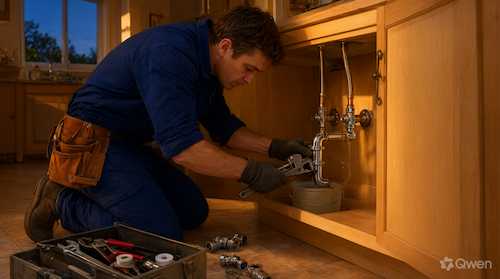
Los Angeles plumbing is not a rain problem. It is an age problem. About 67.1% of metro housing units were built before 1980, according to ACS estimates, and about 48.4% of occupied homes are owner-occupied, so a lot of work happens in older properties where pipes have been patched, rerouted, or replaced in stages. The useful question is not only what failed, but how the cause was confirmed and what has to be opened to reach it.
A diagnosis should name the cause
Ask what was inspected, how the cause was confirmed, and whether the finding is local or part of a wider problem. A leak can come from a supply line, a drain joint, a fixture, or a line under the slab; each has a different scope. A proposal that jumps to a repair without a finding is expensive guesswork.
Access and restoration
Compare proposals on how the pipe is reached, who opens the surface, and who closes it afterwards. A repair that leaves a hole in a wall, a lifted tile, or an unfinished ceiling is not complete, and restoration is often excluded. Ask in writing whether patching, texture, paint, or flooring repair is included.
Slab and under-floor questions
Many Los Angeles homes sit on slabs, and supply or drain lines can run beneath the floor. If a leak is suspected under the slab, ask which test confirmed it, where the line is thought to run, and what access is proposed. Options range from spot repair to rerouting, and the comparison should be based on the finding rather than on the first estimate.
Water heaters and location
For a water heater, ask what failed — tank, valve, element, burner, or venting — and what the replacement includes: pan and drain routing, expansion control, venting, and permit handling where required. Location matters: a heater in a closet, garage, or attic can cause more damage than one in a utility room.
Questions worth asking before you approve
Where this page stops
This page does not diagnose a plumbing system remotely and does not publish local prices. Pipe condition, water quality, and code requirements vary by property and jurisdiction and must be confirmed on site and with the responsible authority.
Los Angeles metro context
The 2024 ACS 5-year estimates put the metro at about 13.0 million residents and 4.5 million households. About 48.4% of occupied homes are owner-occupied, so a meaningful share of plumbing decisions involve a landlord or property manager. About 47.8% of housing units are single-family detached, and about 67.1% were built before 1980 — a combination that makes older piping and access planning common. NOAA's downtown station records January averaging 58.4°F, July 73.3°F, and about 14.2 inches of precipitation a year.
Los Angeles reference station and housing indicators
| Indicator | Value | Source |
|---|---|---|
| January mean temperature | 58.4°F | NOAA NCEI |
| July mean temperature | 73.3°F | NOAA NCEI |
| Annual precipitation | 14.2 in. | NOAA NCEI |
| Metro population | 12,974,487 | U.S. Census Bureau |
| Owner-occupied share | 48.4% | U.S. Census Bureau |
| Housing units built before 1980 | 67.1% | U.S. Census Bureau |
Station normals are historical averages for one location, not a forecast. Census values describe the metro area, not an individual property.
Mapped in OpenStreetMap
Plumbing businesses mapped in the Los Angeles metro
OpenStreetMap contributors have mapped 69 plumbing entries inside the Los Angeles-Long Beach-Anaheim, CA CBSA; 66 have a name. This is a map-coverage indicator, not a count of all licensed plumbing businesses in the metro.
- Mapped entries
- 69
- OSM features
- Phone listed
- 71%
- 49 of 69
- Website listed
- 72%
- 50 of 69
- Street address
- 72%
- 50 of 69
OSM coverage varies by area: a low count can mean low mapping activity, not a small market. OpenStreetMap does not record contractor licenses. To check a license, use the California CSLB license lookup. CSLB licenses these trades by classification: C-39 roofing, C-36 plumbing, C-20 HVAC, C-10 electrical, C-46 solar, C-27 landscaping, C-33 painting.
Query: craft=plumber.
Snapshot: 2026-11-17. Data:
© OpenStreetMap contributors,
ODbL 1.0.
CBSA boundary:
U.S. Census Bureau, 2023.
Frequently Asked Questions
How do I compare plumbing estimates in Los Angeles?
Compare the stated cause, the repair area, included parts, access and restoration work, exclusions, permit assumptions, and warranty terms. Ask each provider to price the same scope so the numbers are comparable.
How do I know if I have a slab leak?
Signs can include an unexplained increase in the water bill, the sound of running water when fixtures are off, warm spots on a floor, or a meter that keeps moving. The cause should be confirmed with a test at the property rather than assumed from a single symptom.
Should I repair or replace a water heater?
It depends on what failed, the unit's condition, parts availability, and efficiency considerations. Ask what the inspection found and whether the recommendation addresses the cause rather than a symptom.
Who repairs the wall or floor after a plumbing repair?
It depends on the contract. Some plumbers include patching and finish repair, others exclude it. Ask before work starts and get the restoration scope in writing.
Does a plumbing repair require a permit?
Requirements depend on the type of work and the jurisdiction. Confirm with the authority responsible for the address and ask whether permit handling and inspection are included in the written scope.
What is the population of the Los Angeles metro area?
The U.S. Census Bureau's 2024 ACS 5-year estimates report about 13.0 million residents in the metro area. The figure describes regional scale, not the number of homes or providers.
Sources and review date
- American Community Survey 2024 5-year estimates (CBSA tables) — U.S. Census Bureau, 2024 ACS 5-year estimates.
- 1991–2020 station normals — LOS ANGELES DWTN USC CAMPUS, CA US (USW00093134) — NOAA National Centers for Environmental Information, 1991–2020 climate normals.
- OpenStreetMap contributors — craft=plumber features in the Los Angeles-Long Beach-Anaheim, CA CBSA — OpenStreetMap contributors, Snapshot 2026-11-17.
Reviewed on 2026-11-18.
Other Home Services in Los Angeles-Long Beach-Anaheim
All guides for the Los Angeles-Long Beach-Anaheim metro area