
Fresno, CA · metro guide
Plumbing in Fresno: Hard Water, Slab Lines, and Irrigation
The water is hard, the pipes are often under concrete, and half the outdoor plumbing is a separate system.
Metro snapshot
Fresno in numbers
Sources named below each block
- Population
- 1.2M
- Households
- 370K
- Housing units
- 396K
- People / household
- 3.18
- population ÷ households
Owner-occupied homes 57%
The rest are rented. Owners are the ones who commission most exterior work.
Single-family detached 69%
Detached houses carry their own roof, gutters and exterior walls.
Built before 1980 46%
Older housing stock shapes what fails first: gutters, flashing, pipe material.
Season
The year in Fresno
- Precipitation
- 11 in
- Snowfall
- 0 in
Average temperature by month, °F — the shape of the year is what decides when exterior work gets done.
Precipitation by month, inches.
| Month | Average temperature (°F) | Precipitation (in) | Snowfall (in) |
|---|---|---|---|
| January | 48.0°F | 2.16 in | 0.0 in |
| February | 52.3°F | 1.93 in | 0.0 in |
| March | 57.4°F | 1.90 in | 0.0 in |
| April | 62.3°F | 1.04 in | 0.0 in |
| May | 70.2°F | 0.42 in | 0.0 in |
| June | 77.6°F | 0.24 in | 0.0 in |
| July | 83.5°F | 0.03 in | 0.0 in |
| August | 82.2°F | 0.00 in | 0.0 in |
| September | 77.1°F | 0.05 in | 0.0 in |
| October | 66.7°F | 0.56 in | 0.0 in |
| November | 55.1°F | 0.87 in | 0.0 in |
| December | 47.5°F | 1.79 in | 0.0 in |
NOAA 1991–2020 climate normals, station FRESNO YOSEMITE INTL AP, CA US (USW00093193). Station observations, not a metro-wide average — a metro that spans a mountain range can differ by more than this record shows.
Population, households and housing shares: U.S. Census Bureau, American Community Survey 2024 5-year estimates, metropolitan statistical area.
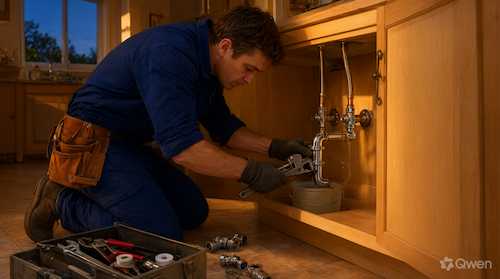
Plumbing in the San Joaquin Valley is shaped by water chemistry and by construction. The water is hard enough that scale is a routine maintenance item rather than a surprise, and it shortens the life of water heaters, fixtures and anything with a small orifice. Much of the housing is slab-on-grade, so supply lines are buried and a leak announces itself through a warm floor patch or an unexplained bill rather than a puddle. And nearly every detached house has an irrigation system with its own backflow assembly, which is separate plumbing with its own rules.
Hard water is a cost that arrives slowly
Scale builds on heated surfaces, in the water heater, on aerators and inside appliances, and the expensive version of that is a tank heating through a layer of mineral deposit before it fails early. Flushing the tank annually is the cheapest intervention available and is routinely skipped. Ask when the heater was last flushed, whether the anode rod has been inspected, whether a softener is fitted and sized for the household, and — where one exists — whether the outdoor irrigation is bypassed so softened water is not used in the garden.
Leaks under a slab
In a slab-on-grade house the supply lines are buried, and a failure shows up as a warm patch on a hard floor, a bill that climbs without explanation, or the sound of running water in a quiet house. The decision is between breaking concrete to repair a section and rerouting the line through the attic or the walls. Ask how the leak was located and whether the evidence is documented, how much finished flooring and concrete the repair affects, and what the reroute costs including patching and finish. Water running under a slab for weeks also affects the ground beneath it.
The irrigation system is plumbing too
An in-ground system holds water in laterals, a manifold and a backflow assembly, and it fails at the points where water stands. Many jurisdictions require periodic backflow testing by a certified tester, with results filed locally. Ask when the assembly was last tested, whether the plumber performing other work is certified to test it, and whether the valves and the controller are in good order. A leaking irrigation valve is also one of the most common causes of a high water bill.
Pressure and the components downstream
Municipal pressure can exceed what fixtures and appliances are designed for, and the wear it causes is invisible until a valve or supply line fails. A pressure-reducing valve at the service is standard on newer construction and can be missing or failed on older homes. Ask whether the pressure has been measured and what it reads, whether a regulator is fitted and set correctly, and whether the angle stops and supply lines under the sinks were checked while the plumber was on site.
Older pipe in a valley house
Nearly half the housing predates 1980, and some of it still has galvanized supply or cast iron drains. Galvanized pipe corrodes inward until flow drops and pinholes appear; cast iron rusts until it cracks or channels. Ask what material the affected lines are, whether a camera inspection was done on the drains, and whether the proposal replaces a section or a run. In a slab house, those questions carry more weight because access is expensive.
Questions for a plumbing estimate
Where this page stops
This page does not diagnose a system and publishes no prices. Gas work, sewer work and water heater installation require a licensed plumber and, depending on the address, a permit and inspection. Water quality questions belong to the local water authority.
Fresno metro context
ACS 2024 5-year estimates report about 1.18 million residents in 370,081 households and 395,909 housing units, with 57.0% owner-occupied and 69.1% single-family detached — a detached stock where most households own both a slab and an irrigation system. About 46.0% of units predate 1980. A climate station is not reported for this metro in the site dataset, so no temperature figures are published here.
Fresno housing indicators
| Indicator | Value | Source |
|---|---|---|
| Housing units built before 1980 | 46.0% | U.S. Census Bureau |
| Single-family detached share | 69.1% | U.S. Census Bureau |
| Owner-occupied share | 57.0% | U.S. Census Bureau |
| Metro households | 370,081 | U.S. Census Bureau |
| Housing units | 395,909 | U.S. Census Bureau |
| Metro population | 1,177,665 | U.S. Census Bureau |
No climate normals are shown because no station record is held for this metro in the site dataset. Water hardness varies with the source serving the address, so a test describes a moment rather than a constant.
Frequently Asked Questions
Do I need a water softener in Fresno?
Many households use one because the water is hard and scale shortens appliance life. It is a maintenance decision rather than a requirement. If you have one, size it for the household and keep the outdoor irrigation on unsoftened water.
How do I know if I have a slab leak?
A warm patch on a hard floor, the sound of running water with everything off, or a bill that rises without a change in use. Confirming it means isolating the system and locating the loss, and the evidence should be documented before concrete is opened.
Repair the slab or reroute the pipe?
Both are legitimate, and the choice depends on location, the piping's history and how much finished flooring is involved. Ask for both options priced including concrete and finish repair, not just the plumbing line items.
Do I need backflow testing for irrigation?
Many jurisdictions require it at set intervals, with results filed by a certified tester. Confirm the requirement for the address and keep the documentation with your records.
What causes a high water bill with no visible leak?
A running toilet, a leaking irrigation valve or a slab leak, in roughly that order of frequency. Reading the meter with everything off tells you whether water is moving; isolating the irrigation tells you which side it is on.
How often should a water heater be flushed?
Annually where water is hard, which is the cheapest way to extend tank life. Ask about the anode rod at the same time and confirm the pan and drain are intact.
Sources and review date
- American Community Survey 2024 5-year estimates (CBSA tables) — U.S. Census Bureau, 2024 ACS 5-year estimates.
Reviewed on 2026-11-18.