
Fresno, CA · metro guide
Roofing in Fresno: Sun Damage, Tile, and Rain That Arrives All at Once
Nine dry months age the roof. The first real storm is what reveals it.
Metro snapshot
Fresno in numbers
Sources named below each block
- Population
- 1.2M
- Households
- 370K
- Housing units
- 396K
- People / household
- 3.18
- population ÷ households
Owner-occupied homes 57%
The rest are rented. Owners are the ones who commission most exterior work.
Single-family detached 69%
Detached houses carry their own roof, gutters and exterior walls.
Built before 1980 46%
Older housing stock shapes what fails first: gutters, flashing, pipe material.
Season
The year in Fresno
- Precipitation
- 11 in
- Snowfall
- 0 in
Average temperature by month, °F — the shape of the year is what decides when exterior work gets done.
Precipitation by month, inches.
| Month | Average temperature (°F) | Precipitation (in) | Snowfall (in) |
|---|---|---|---|
| January | 48.0°F | 2.16 in | 0.0 in |
| February | 52.3°F | 1.93 in | 0.0 in |
| March | 57.4°F | 1.90 in | 0.0 in |
| April | 62.3°F | 1.04 in | 0.0 in |
| May | 70.2°F | 0.42 in | 0.0 in |
| June | 77.6°F | 0.24 in | 0.0 in |
| July | 83.5°F | 0.03 in | 0.0 in |
| August | 82.2°F | 0.00 in | 0.0 in |
| September | 77.1°F | 0.05 in | 0.0 in |
| October | 66.7°F | 0.56 in | 0.0 in |
| November | 55.1°F | 0.87 in | 0.0 in |
| December | 47.5°F | 1.79 in | 0.0 in |
NOAA 1991–2020 climate normals, station FRESNO YOSEMITE INTL AP, CA US (USW00093193). Station observations, not a metro-wide average — a metro that spans a mountain range can differ by more than this record shows.
Population, households and housing shares: U.S. Census Bureau, American Community Survey 2024 5-year estimates, metropolitan statistical area.
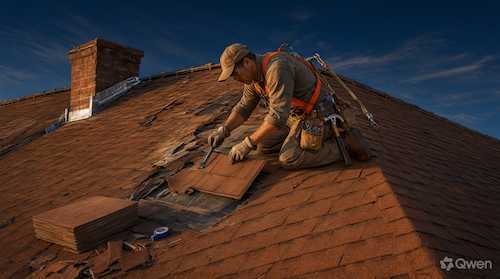
A Fresno roof spends most of the year being cooked and very little of it being rained on, and that imbalance defines its failure pattern. Ultraviolet breaks down asphalt and sealants through a long hot season, and small cracks and lifted edges develop while nothing is testing them. Then the winter rain arrives in a handful of storms and finds every one of them at once. Because 46.0% of metro housing predates 1980, many of the roofs involved are on their second or third covering, with attic construction that was never designed for the temperatures a valley attic reaches.
Ultraviolet is the main wear mechanism
Sun exposure ages a covering faster than the calendar suggests, and the south and west slopes go first. Granule loss, curling edges and a brittle feel underfoot are the signs, and once the mat is exposed the decline accelerates. Ask how old the roof is, which slopes are worst, and whether the proposal addresses ventilation as well as covering — because an attic that runs extremely hot in summer shortens the life of the shingles from below.
Tile roofs and what is underneath them
Tile is common in California and it is a different proposition from asphalt: it lasts a long time, it is repairable, and the part that fails first is usually the underlayment beneath it rather than the tile itself. Walking on tile carelessly breaks pieces that are hard to match. Ask what the covering is, whether the tiles can be lifted and reused, how the underlayment will be replaced, and how broken tiles are sourced. A quote that treats tile as a disposable surface has misunderstood the job.
Low-slope sections and the rainy season
Additions, patios and porch roofs are often low-slope, and they are where a winter storm finds the weakest detail. Water on a low-slope roof can travel before it appears indoors, so the stain is often not below the defect. Ask how the membrane is being handled, whether drains or scuppers were cleared, and whether the flashing at the wall junction is being replaced rather than patched.
Attic heat and ductwork in the same space
A valley attic gets far hotter than the outdoor air, and that affects both the shingles above and the air-conditioning equipment and ducts inside it. Ask what the ventilation calculation is, whether baffles will protect the soffit intake from insulation, and whether any duct insulation in the attic is damaged. A roof replacement is the natural moment to correct ventilation, and doing it later means paying for access twice.
What the first storm will find
Before the rainy season, walk the roof or have it inspected rather than waiting for a stain. The items worth checking are the ones that sat unused for months: gutter and downspout debris, sealant at penetrations, the state of any skylight, and the flashing at wall junctions. Ask the contractor what their inspection covers and whether they will document the condition with photographs, because a record before the season is what makes an insurance conversation possible afterwards.
Questions to ask before signing
Where this page stops
This page does not inspect roofs and publishes no prices. Deck condition, tile condition and structural capacity require on-site assessment, and insurance questions belong to the carrier and the policy.
Fresno metro context
ACS 2024 5-year estimates put the metro at about 1.18 million residents in 370,081 households and 395,909 housing units, with 57.0% owner-occupied and 69.1% single-family detached. About 46.0% of units were built before 1980, which is where original attic construction and first-generation ventilation are most likely. A climate station is not reported for this metro in the site dataset, so no temperature or precipitation normals are published here.
Fresno housing indicators
| Indicator | Value | Source |
|---|---|---|
| Housing units built before 1980 | 46.0% | U.S. Census Bureau |
| Single-family detached share | 69.1% | U.S. Census Bureau |
| Owner-occupied share | 57.0% | U.S. Census Bureau |
| Housing units | 395,909 | U.S. Census Bureau |
| Metro households | 370,081 | U.S. Census Bureau |
| Metro population | 1,177,665 | U.S. Census Bureau |
No climate normals are shown because no station record is held for this metro in the site dataset. Sun exposure and attic temperatures vary by slope orientation and by roof construction.
Frequently Asked Questions
How long does a roof last in the valley?
Sun exposure ages a covering faster than the calendar suggests, and an attic that runs very hot shortens it further. South and west slopes usually fail first. Ask which slopes are worst and whether ventilation is being corrected.
Should I repair or replace a tile roof?
Often repair. Tile itself lasts a long time, and the failure is usually in the underlayment beneath it or at the flashings. Lifting and reusing tile with new underlayment is a legitimate approach and should be compared with replacement.
Why does my roof only leak in winter?
Because that is when rain arrives. Cracks and failed sealants develop during the long dry season while nothing tests them, and the first storms find them all. An inspection before the season is worth more than a call afterwards.
Does attic ventilation matter this much?
Yes. Heat degrades the covering from below and also stresses the air-conditioning equipment and duct insulation in the attic. Correcting it during a roof replacement is far cheaper than coming back later.
Can I put a second layer of shingles on?
It may be permitted depending on how many layers exist, but it hides the deck and adds weight. Ask for the current layer count in writing and for the tear-off price so the two can be compared.
What should I check before the rainy season?
Gutter and downspout debris, sealant at penetrations, skylights, and the flashing where the roof meets a wall. Have the condition documented with photographs, since a record made beforehand is what makes an insurance claim possible later.
Sources and review date
- American Community Survey 2024 5-year estimates (CBSA tables) — U.S. Census Bureau, 2024 ACS 5-year estimates.
Reviewed on 2026-11-18.