
Fresno, CA · metro guide
Water Damage Restoration in Fresno: Winter Rain, Slabs, and Dry Air
After nine dry months, the first storm tests details nobody has thought about since March.
Metro snapshot
Fresno in numbers
Sources named below each block
- Population
- 1.2M
- Households
- 370K
- Housing units
- 396K
- People / household
- 3.18
- population ÷ households
Owner-occupied homes 57%
The rest are rented. Owners are the ones who commission most exterior work.
Single-family detached 69%
Detached houses carry their own roof, gutters and exterior walls.
Built before 1980 46%
Older housing stock shapes what fails first: gutters, flashing, pipe material.
Season
The year in Fresno
- Precipitation
- 11 in
- Snowfall
- 0 in
Average temperature by month, °F — the shape of the year is what decides when exterior work gets done.
Precipitation by month, inches.
| Month | Average temperature (°F) | Precipitation (in) | Snowfall (in) |
|---|---|---|---|
| January | 48.0°F | 2.16 in | 0.0 in |
| February | 52.3°F | 1.93 in | 0.0 in |
| March | 57.4°F | 1.90 in | 0.0 in |
| April | 62.3°F | 1.04 in | 0.0 in |
| May | 70.2°F | 0.42 in | 0.0 in |
| June | 77.6°F | 0.24 in | 0.0 in |
| July | 83.5°F | 0.03 in | 0.0 in |
| August | 82.2°F | 0.00 in | 0.0 in |
| September | 77.1°F | 0.05 in | 0.0 in |
| October | 66.7°F | 0.56 in | 0.0 in |
| November | 55.1°F | 0.87 in | 0.0 in |
| December | 47.5°F | 1.79 in | 0.0 in |
NOAA 1991–2020 climate normals, station FRESNO YOSEMITE INTL AP, CA US (USW00093193). Station observations, not a metro-wide average — a metro that spans a mountain range can differ by more than this record shows.
Population, households and housing shares: U.S. Census Bureau, American Community Survey 2024 5-year estimates, metropolitan statistical area.
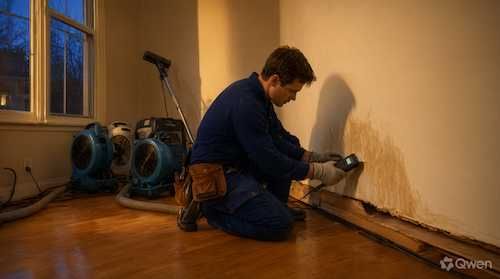
Fresno's water damage is concentrated into a short rainy season, and much of it is created by the dry months that precede it. Sealants dry out and crack, gutters fill with dust and leaves, flashings lift, and none of it is tested until the first real storm. Then several inches of rain arrive in a few days and the water finds every one of those openings. The rest of the year, the sources are internal: a supply line under a slab, an air-conditioner condensate line in an attic, or an irrigation break that runs unnoticed under a lawn.
The first storm of the season
The failures cluster in the places that sat unused: a skylight seal, a vent boot, the flashing where a patio roof meets the wall, a low-slope section whose drain is blocked, and gutters that overflow because a downspout is plugged. Water enters high and travels along framing, so the stain can be several feet from the actual opening. Ask how the entry point was identified, whether the flashing or sealant repair is part of the scope, and whether the same detail will survive the next storm.
Low-slope sections hide the source
Additions, patio covers and porch roofs are often low-slope, and water on them can travel a long way before it appears indoors. That is why the stain on a ceiling is frequently not below the defect. Ask whether the drain or scupper was cleared, whether the parapet cap and base flashing were examined rather than just the field of the roof, and how the repair is being verified before the ceiling is closed.
Leaks under the slab
In a slab-on-grade house the supply lines are buried, and a failure shows as a warm patch on a hard floor, a bill that climbs with no change in use, or the sound of running water in a quiet house. Water can run under the slab for weeks before it is noticed, and it affects the ground beneath the floor as well as the interior. Ask how the leak was located and whether the evidence is documented, how much finished flooring and concrete the repair affects, and what the reroute option would cost by comparison.
Condensate where the air handler lives
Where the air handler sits in the attic, the condensate drain runs above finished rooms through a long cooling season, and a blocked line overflows the pan. In a valley summer the equipment produces condensate for months. Ask whether the pan has a float switch, where the secondary drain discharges, and when the line was last cleared. A stain that appears in July or August is almost always this rather than the roof.
Irrigation leaks run quietly
A sprinkler break under turf can run for days before it surfaces as a wet patch or a rising bill, and a leaking valve does the same thing invisibly. Ask who maintains the system, whether the valves have been checked, and whether there is a master valve or flow sensor that shuts the system down after a break. These are small components that convert a flooded yard into an inconvenience.
Dry air helps, and can mislead
Low ambient humidity speeds evaporation, which is welcome, and it also lets surfaces read dry while the assembly behind them is still wet — particularly under tile or inside a wall cavity. Ask for readings by material and location, a stated dry standard, and a recheck before the rebuild. Where water came through a roof over a vaulted ceiling, ask how the cavity will be verified dry before it is closed up.
Questions to ask on the first visit
Where this page stops
This page does not assess a specific loss and publishes no prices. Sewage, mold and active intrusion require on-site assessment, and coverage questions belong to your insurer and the policy documents.
Fresno metro context
ACS 2024 5-year estimates report about 1.18 million residents in 370,081 households and 395,909 housing units, with 57.0% owner-occupied and 69.1% single-family detached. About 46.0% of units predate 1980, so many losses involve slab construction, older pipe and low-slope additions. A climate station is not reported for this metro in the site dataset, so no precipitation figures are published on this page.
Fresno housing indicators
| Indicator | Value | Source |
|---|---|---|
| Housing units built before 1980 | 46.0% | U.S. Census Bureau |
| Single-family detached share | 69.1% | U.S. Census Bureau |
| Owner-occupied share | 57.0% | U.S. Census Bureau |
| Metro households | 370,081 | U.S. Census Bureau |
| Housing units | 395,909 | U.S. Census Bureau |
| Metro population | 1,177,665 | U.S. Census Bureau |
No climate normals are shown because no station record is held for this metro in the site dataset. Rainfall varies enormously between years, which is why roof and drainage details can go untested for long periods.
Frequently Asked Questions
Why does my roof leak in the first storm of the season?
Because sealants and flashings dry out over the long hot season and nothing tests them until rain arrives. Gutter and downspout debris makes it worse. An inspection before the season is far cheaper than a repair afterwards.
How do I find a leak on a low-slope roof?
By tracing the water rather than the stain, since it can travel along the deck before appearing indoors. Clearing and testing drains and scuppers comes first, then examining the parapet cap and base flashing.
Is a slab leak urgent?
It should be located promptly, because water running under a slab for weeks affects the ground beneath the floor as well as the interior. A rising bill or a warm patch should prompt a measurement rather than a wait-and-see approach.
Why is there a ceiling stain when it has not rained?
Because in summer the air handler condensate line is the likely cause, especially where the equipment is in the attic. A blocked drain overflows the pan and finds the ceiling below. The timing is the diagnostic clue.
Can irrigation really cause that much damage?
A break under turf can run for days before it surfaces, and a leaking valve is invisible. Together they are a common cause of high bills and of saturated ground against a foundation. A master valve or flow sensor limits the damage.
Is drying fast in this climate?
Surfaces dry quickly in low humidity, but assemblies can stay wet behind them. That is why readings by material and location matter more than how the surface feels, particularly under tile.
Sources and review date
- American Community Survey 2024 5-year estimates (CBSA tables) — U.S. Census Bureau, 2024 ACS 5-year estimates.
Reviewed on 2026-11-18.