
Riverside, CA · metro guide
Roofing in the Inland Empire: Tile, Underlayment and Santa Ana Wind
The tile on these roofs usually outlives the roof. The underlayment underneath it is what fails.
Metro snapshot
Riverside in numbers
Sources named below each block
- Population
- 4.7M
- Households
- 1.5M
- Housing units
- 1.6M
- People / household
- 3.22
- population ÷ households
Owner-occupied homes 66%
The rest are rented. Owners are the ones who commission most exterior work.
Single-family detached 69%
Detached houses carry their own roof, gutters and exterior walls.
Built before 1980 36%
Older housing stock shapes what fails first: gutters, flashing, pipe material.
Season
The year in Riverside
- Precipitation
- 9.4 in
- Snowfall
- —
Average temperature by month, °F — the shape of the year is what decides when exterior work gets done.
Precipitation by month, inches.
| Month | Average temperature (°F) | Precipitation (in) | Snowfall (in) |
|---|---|---|---|
| January | 55.6°F | 2.29 in | — |
| February | 56.3°F | 2.41 in | — |
| March | 59.5°F | 1.21 in | — |
| April | 62.9°F | 0.59 in | — |
| May | 67.6°F | 0.20 in | — |
| June | 73.0°F | 0.01 in | — |
| July | 78.6°F | 0.12 in | — |
| August | 79.8°F | 0.02 in | — |
| September | 76.6°F | 0.11 in | — |
| October | 68.9°F | 0.33 in | — |
| November | 61.0°F | 0.57 in | — |
| December | 54.8°F | 1.51 in | — |
NOAA 1991–2020 climate normals, station RIVERSIDE MUNI AP, CA US (USW00003171). Station observations, not a metro-wide average — a metro that spans a mountain range can differ by more than this record shows.
Population, households and housing shares: U.S. Census Bureau, American Community Survey 2024 5-year estimates, metropolitan statistical area.
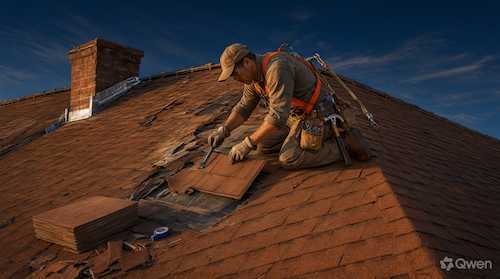
Most of the housing in this metro was built after 1960 and roofed in clay or concrete tile, which creates a specific economics: the tile itself can last decades, while the underlayment beneath it has a much shorter life and is the part that actually keeps water out. Once it dries out, tears at a valley or cooks under the tile, water passes straight through to the deck and the ceiling below — usually without a visible sign from the ground. Add the Santa Ana winds that rake these valleys, an ember exposure that insurers now ask about, and a climate with 9.4 inches of annual precipitation concentrated into a handful of winter storms, and the questions on a roofing estimate change completely.
Tile roofs fail from underneath
A tile roof is a rainscreen: the tile sheds the bulk of the water, and the underlayment is the actual waterproof layer. Heat and UV under the tile break the underlayment down long before the tile shows wear, which is why a 1980s tile roof can look perfect and leak into a bedroom every February. The standard remedy is a lift-and-relay: tile removed and stacked, new underlayment installed, broken tile replaced, tile reinstalled. Ask whether the estimate is a lift-and-relay or a new roof, what underlayment product and weight is specified, and how much breakage is allowed for in the tile count.
Santa Ana wind and edge details
The Santa Ana events push hot, dry air through the passes and canyons at speeds that find every weak point on a roof: ridge and hip caps, edge metal, the perimeter courses and anything already loose. Tile is heavy and generally stays put, but the caps and the flashings do not, and on shingled roofs the corners and the rake edges are where the damage starts. Ask what the perimeter and ridge detail looks like, how fasteners and tile attachments are specified, and whether the work is being done in a season when a wind event will not catch an open roof.
Ember exposure is now part of the conversation
The wildland-urban interface runs right through this metro — the foothills of the San Bernardino Mountains, the canyons above the valleys, the open ground between the newer subdivisions. Roofs are the most exposed surface in an ember-driven fire, and the details that matter are the ones that trap debris: the gap at the eave, the valley where leaves collect, the vent that lets an ember in. Ask how the design handles debris accumulation at valleys and eaves, what venting is specified, and whether the assembly meets the fire classification that insurers and local requirements now expect.
Attic heat, ventilation and the cool-roof question
Summer attic temperatures here are punishing, and a dark tile roof over a poorly vented attic turns the space into an oven that the air conditioning then has to fight. Roof color and material affect that load, and California's energy code has pushed reflective and ventilated assemblies for years. Ask whether ventilation is being evaluated as part of the roof replacement, what the reflective rating of the proposed material is, and whether the ducts running through the attic will be checked while the roof is open.
The handful of storms that matter
With 9.4 inches of rain a year, a roof here is tested rarely and then all at once. The failures show up in the winter storms: wind-driven rain pushed under the tile at a valley, water standing against a low edge because a drain or a scupper is blocked, and leaks that only appear when rain arrives at an angle it rarely takes. A roof that has survived several dry years has not been tested. Ask when the roof was last checked after a significant storm, and whether the valleys, low edges and roof-to-wall junctions were inspected then.
What to pin down in the estimate
Where this page stops
No prices are quoted and no roof is assessed here. Structural questions, fire-hardening requirements and insurance conditions all need inspection or confirmation from the authority or the insurer rather than a description on a page.
Riverside metro context
The 2024 ACS 5-year estimates describe about 4.68 million residents in 1,450,250 households and 1,613,300 housing units, with 65.8% owner-occupied and 69.2% single-family detached — one of the highest detached shares in this dataset, which is why almost all roofing work here is single-family. About 36.2% of units predate 1980. At the Riverside reference station, January averages 55.6°F and July 78.6°F, on 9.4 inches of annual precipitation with only 0.12 inches in July.
Riverside reference station and housing indicators
| Indicator | Value | Source |
|---|---|---|
| January mean temperature | 55.6°F | NOAA NCEI |
| July mean temperature | 78.6°F | NOAA NCEI |
| Annual precipitation | 9.4 in. | NOAA NCEI |
| Metro population | 4,675,704 | U.S. Census Bureau |
| Owner-occupied share | 65.8% | U.S. Census Bureau |
| Housing units built before 1980 | 36.2% | U.S. Census Bureau |
Station normals are historical averages for one location, not a forecast, and the metro spans coast-side valleys, the high desert and mountain communities well above the station. The rainfall total explains why roofs here fail from sun and heat rather than from snow.
Frequently Asked Questions
My tile looks fine — why is the ceiling stained?
Because the tile is not the waterproof layer. The underlayment under it degrades with heat and age and is usually what fails first, letting water through to the deck. A lift-and-relay with new underlayment is the standard answer.
How do Santa Ana winds damage a roof?
They attack the edges: ridge caps, hip caps, perimeter courses and loose flashings. Tile mass holds up well, but the small details do not, and once a cap lifts, water and debris get in below.
Does a tile roof need ventilation?
Yes, and it matters more here than in a mild climate. A hot, poorly vented attic raises the load on the air conditioning and shortens the life of anything stored or installed up there, including ductwork.
Should I choose a lighter-colored roof?
Color and reflectivity affect the attic heat load, which is significant in this climate. It is worth comparing the reflective rating of the options rather than choosing on appearance alone.
Is my roof a fire risk?
If the property sits near open ground or the foothills, roof details that trap embers and debris matter. Ask about venting, valley clean-out and the fire classification of the assembly, and check what the insurer expects.
Can a tile roof be replaced in stages?
It can be, but the underlayment is continuous, so phasing usually creates joints in the waterproof layer. If the roof is failing as a system, replacing it as a system is generally the sounder decision.
Sources and review date
- American Community Survey 2024 5-year estimates (CBSA tables) — U.S. Census Bureau, 2024 ACS 5-year estimates.
- 1991–2020 station normals — RIVERSIDE MUNI AP, CA US (USW00003171) — NOAA National Centers for Environmental Information, 1991–2020 climate normals.
Reviewed on 2026-11-18.
Other Home Services in Riverside–San Bernardino–Ontario
All guides for the Riverside–San Bernardino–Ontario metro area