
Riverside, CA · metro guide
Solar Panels in the Inland Empire: Irradiance, Tile Roofs and Storage
The resource is excellent and the roofs are the problem — tile, old underlayment, and a service that may not carry the inverter.
Metro snapshot
Riverside in numbers
Sources named below each block
- Population
- 4.7M
- Households
- 1.5M
- Housing units
- 1.6M
- People / household
- 3.22
- population ÷ households
Owner-occupied homes 66%
The rest are rented. Owners are the ones who commission most exterior work.
Single-family detached 69%
Detached houses carry their own roof, gutters and exterior walls.
Built before 1980 36%
Older housing stock shapes what fails first: gutters, flashing, pipe material.
Season
The year in Riverside
- Precipitation
- 9.4 in
- Snowfall
- —
Average temperature by month, °F — the shape of the year is what decides when exterior work gets done.
Precipitation by month, inches.
| Month | Average temperature (°F) | Precipitation (in) | Snowfall (in) |
|---|---|---|---|
| January | 55.6°F | 2.29 in | — |
| February | 56.3°F | 2.41 in | — |
| March | 59.5°F | 1.21 in | — |
| April | 62.9°F | 0.59 in | — |
| May | 67.6°F | 0.20 in | — |
| June | 73.0°F | 0.01 in | — |
| July | 78.6°F | 0.12 in | — |
| August | 79.8°F | 0.02 in | — |
| September | 76.6°F | 0.11 in | — |
| October | 68.9°F | 0.33 in | — |
| November | 61.0°F | 0.57 in | — |
| December | 54.8°F | 1.51 in | — |
NOAA 1991–2020 climate normals, station RIVERSIDE MUNI AP, CA US (USW00003171). Station observations, not a metro-wide average — a metro that spans a mountain range can differ by more than this record shows.
Population, households and housing shares: U.S. Census Bureau, American Community Survey 2024 5-year estimates, metropolitan statistical area.
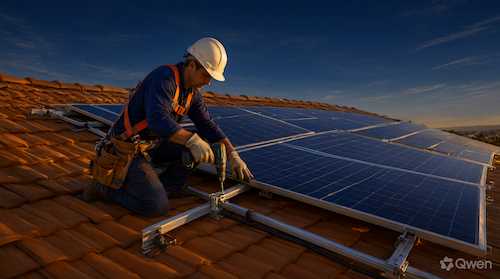
Few metros in the country have a better solar resource than this one: long, clear summers, high irradiance and a July that brings 0.12 inches of rain at the reference station. The constraint is not the sun, it is the roof and the service. Most of the housing is detached and much of it is tiled, which changes the mounting work entirely, and a 1970s or 1980s tract panel may not have the busbar capacity for the inverter. Add the shift in California's billing rules toward self-consumption rather than export, and the design question has moved from how many panels fit to how the energy is used on site.
Mounting on tile is a roofing job
Attaching an array to a tile roof means dealing with the tile, the underlayment beneath it and the attachment points that pass through both. Done badly, the result is a leak that appears two winters later and is very hard to trace. Done well, the mounting replaces tile with a proper flashing and restores the waterproof layer at every penetration. The bigger question is timing: if the underlayment is already near the end of its life, an array installed on top of it will have to be removed when the roof is relaid. Ask how the mounts are flashed, whether tiles are being replaced with compatible ones, and what the age of the underlayment is.
The service panel is still the gate
An inverter has to be connected through the service panel, and in a house with air conditioning, a pool pump and an EV charger, the available capacity may already be tight. The calculation is about the busbar allowance, and the answer decides whether the project needs a panel upgrade before the array. Because cooling loads here are heavy and pool equipment is common, this comes up more often than in milder metros. Ask what the existing service rating is, what the calculated allowance is for the solar breaker, and whether an upgrade is inside or outside the quoted price.
Self-consumption is the new design target
California's billing framework has moved away from paying retail rates for exported energy, which changes the economics: an array sized for maximum annual production is no longer automatically the best design. What matters now is how much of the production the house can use as it is generated, and whether a battery shifts the evening and night load — which in this climate includes a lot of air conditioning. Ask how the design accounts for the timing of consumption, whether storage is included and sized to the evening load, and what the expected self-consumption looks like rather than only annual production.
Heat, soiling and long-term output
High temperatures reduce module output, and a roof in full sun can be hot enough to matter. Dust and ash settle on arrays during dry, windy periods and after fires, and the loss accumulates quietly until the modules are cleaned. The practical questions are whether airflow under the array has been considered, how the system will be monitored, and what maintenance the owner is expected to do — because an array with no monitoring is an array nobody notices failing. Ask what monitoring is included, how it reports, and what servicing is recommended over the life of the system.
Permits, interconnection and the real timeline
The visible work of a solar installation takes a few days, and the project takes considerably longer. There is a building permit, an electrical permit in some jurisdictions, an inspection, and an interconnection application that the utility has to approve before the system can be energized. Delays usually sit in that last step rather than in the installation. Ask who files each application, what the current timeline is, and what happens to the schedule if the utility requests a change to the design.
What to pin down in the estimate
Where this page stops
No system sizes, prices or production figures are quoted here, and no roof or service is assessed. Tariffs, billing rules and interconnection requirements change, so the current terms should be confirmed with the utility rather than taken from any page.
Riverside metro context
The 2024 ACS 5-year estimates describe about 4.68 million residents in 1,450,250 households and 1,613,300 housing units, with 65.8% owner-occupied and 69.2% single-family detached — which means the great majority of roofs here are on a house someone owns. About 36.2% of units predate 1980. At the Riverside reference station July averages 78.6°F on 0.12 inches of rain, while January receives 2.29 inches.
Riverside reference station and housing indicators
| Indicator | Value | Source |
|---|---|---|
| January mean temperature | 55.6°F | NOAA NCEI |
| July mean temperature | 78.6°F | NOAA NCEI |
| Annual precipitation | 9.4 in. | NOAA NCEI |
| Metro population | 4,675,704 | U.S. Census Bureau |
| Owner-occupied share | 65.8% | U.S. Census Bureau |
| Housing units built before 1980 | 36.2% | U.S. Census Bureau |
Station normals are historical averages for one location, not a forecast. A dry summer means very few lost production days to cloud, and the desert communities east of the station see even more sun.
Frequently Asked Questions
Can panels be mounted on a tile roof without leaks?
Yes, if every penetration is flashed and the waterproof layer is restored at each mount. The failures come from mounts that rely on sealant alone, and they typically show up a season or two later.
Should the roof be replaced before the array?
If the underlayment is near the end of its life, yes. Removing and reinstalling an array later costs more than doing the roof first, and it puts the penetrations through a second cycle.
Is a battery worth it now?
It depends on how much of the production you can use on site and what the evening load looks like — and in this climate that load includes a lot of cooling. Storage is increasingly part of the design rather than an add-on.
Does the heat reduce output?
It does. Modules lose efficiency as they get hot, so a roof in full sun produces less at peak temperature than at cooler times. Mounting height and airflow can make a small difference.
How often do panels need cleaning?
In a dry, dusty environment with occasional ash, soiling accumulates and reduces output gradually. Monitoring is what tells you whether a cleaning is worth doing rather than guessing.
Do I need a panel upgrade to add solar?
Sometimes, and the check is the busbar allowance for the solar breaker. With cooling, a pool pump and an EV charger already on the service, the available capacity can be the deciding factor.
Sources and review date
- American Community Survey 2024 5-year estimates (CBSA tables) — U.S. Census Bureau, 2024 ACS 5-year estimates.
- 1991–2020 station normals — RIVERSIDE MUNI AP, CA US (USW00003171) — NOAA National Centers for Environmental Information, 1991–2020 climate normals.
Reviewed on 2026-11-18.
Other Home Services in Riverside–San Bernardino–Ontario
All guides for the Riverside–San Bernardino–Ontario metro area