
Riverside, CA · metro guide
Plumbing in the Inland Empire: Hard Water, Slab Leaks and Repipes
Almost all of the water is imported, most of it arrives mineral-heavy, and much of the housing is slab-on-grade — a combination that produces a predictable set of failures.
Metro snapshot
Riverside in numbers
Sources named below each block
- Population
- 4.7M
- Households
- 1.5M
- Housing units
- 1.6M
- People / household
- 3.22
- population ÷ households
Owner-occupied homes 66%
The rest are rented. Owners are the ones who commission most exterior work.
Single-family detached 69%
Detached houses carry their own roof, gutters and exterior walls.
Built before 1980 36%
Older housing stock shapes what fails first: gutters, flashing, pipe material.
Season
The year in Riverside
- Precipitation
- 9.4 in
- Snowfall
- —
Average temperature by month, °F — the shape of the year is what decides when exterior work gets done.
Precipitation by month, inches.
| Month | Average temperature (°F) | Precipitation (in) | Snowfall (in) |
|---|---|---|---|
| January | 55.6°F | 2.29 in | — |
| February | 56.3°F | 2.41 in | — |
| March | 59.5°F | 1.21 in | — |
| April | 62.9°F | 0.59 in | — |
| May | 67.6°F | 0.20 in | — |
| June | 73.0°F | 0.01 in | — |
| July | 78.6°F | 0.12 in | — |
| August | 79.8°F | 0.02 in | — |
| September | 76.6°F | 0.11 in | — |
| October | 68.9°F | 0.33 in | — |
| November | 61.0°F | 0.57 in | — |
| December | 54.8°F | 1.51 in | — |
NOAA 1991–2020 climate normals, station RIVERSIDE MUNI AP, CA US (USW00003171). Station observations, not a metro-wide average — a metro that spans a mountain range can differ by more than this record shows.
Population, households and housing shares: U.S. Census Bureau, American Community Survey 2024 5-year estimates, metropolitan statistical area.
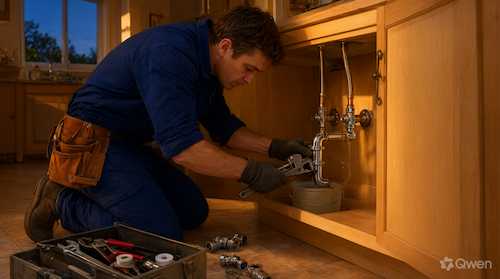
Water in this metro is largely imported and mineral-rich, and most of the housing is slab-on-grade construction from the post-war decades. Those two facts produce most of the plumbing work here. Scale builds inside water heaters, fixtures and aerators; copper under a slab eventually pinholes; and when it does, the leak announces itself as a hot spot on a tile floor or an unexplained jump in the bill rather than as water in a basement the house does not have. With 36.2% of the stock predating 1980 and a large share of it in tract developments of the 1970s and 1980s, the repipe versus spot-repair decision comes up constantly.
Hard water and what it costs
Mineral content shortens the life of a water heater, clogs aerators and shower heads, scales the inside of tankless units and leaves a film on fixtures that no amount of cleaning removes. It also compounds the other problems: a scaled heater runs hotter and fails sooner, and scale on valves makes shut-offs unreliable. Whether to soften is a real decision with trade-offs — a softener protects the equipment but adds salt discharge and maintenance. Ask what the measured hardness at the property is, what the softener would be sized to, and where it would discharge, since the brine line has to go somewhere legal.
Slab leaks and the repipe decision
Copper under a slab in this soil and water chemistry develops pinhole leaks, and once one appears the question is whether the pipe is failing as a system or in one spot. A single isolated leak on a line that is otherwise sound can be repaired; a second leak within a year or two usually signals that the run is going. The alternative to chasing slab leaks is an overhead repipe, which abandons the under-slab lines and rebuilds the distribution in the attic — disruptive for a few days, but it ends the cycle. Ask how many leaks the system has had, whether the line can be isolated and pressure-tested, and what an overhead repipe would involve in this specific house.
Polybutylene, galvanized and the 1970s legacy
Some houses of the late 1970s and 1980s were plumbed in polybutylene, a material that becomes brittle and fails at fittings, often without warning and usually inside a wall. Older pre-war properties may still have galvanized steel that has closed up with corrosion until the shower is a trickle. Both are repipe candidates rather than repair candidates, and both are the kind of thing a home inspector flags and an insurer asks about. Ask what material the existing piping is, where it is accessible, and whether the replacement will be run in the attic, in the walls, or a combination.
Pressure, regulators and the outdoor plumbing
Distribution systems here run at pressures that can be high enough to stress fittings and shorten the life of every appliance, and a pressure-reducing valve that has failed open is a common find. The outdoor side matters as much: irrigation lines, hose bibs and pool equipment all sit in sun and hard water. Ask for a static pressure reading, whether a regulator is fitted and set correctly, and whether the irrigation system has its own backflow protection — a requirement that also protects the drinking water in the house.
Water heaters and mineral scale
The water heater is where hard water shows up first: scale settles on the tank floor and the element, the recovery slows, and the tank eventually fails from the inside out. An expansion tank, a pan and a drain line are the cheap protections, and flushing is what buys time. Ask how old the tank is, whether it has been flushed, whether an expansion tank is fitted on a closed system, and whether it is strapped and located where a failure would not flood a finished room.
What to pin down in the estimate
Where this page stops
No prices are quoted and no system is diagnosed here. Water quality, discharge rules for softeners and backflow requirements belong to the local water agency, and any leak inside a slab has to be located by inspection rather than inferred.
Riverside metro context
The 2024 ACS 5-year estimates describe about 4.68 million residents in 1,450,250 households and 1,613,300 housing units, with 65.8% owner-occupied and 69.2% single-family detached. About 36.2% of units predate 1980. At the Riverside reference station, January averages 55.6°F and July 78.6°F, with 9.4 inches of annual precipitation — so the freeze risk that drives plumbing failures elsewhere is largely absent in the valleys, while the mountain communities sit in a different regime.
Riverside reference station and housing indicators
| Indicator | Value | Source |
|---|---|---|
| January mean temperature | 55.6°F | NOAA NCEI |
| July mean temperature | 78.6°F | NOAA NCEI |
| Annual precipitation | 9.4 in. | NOAA NCEI |
| Metro population | 4,675,704 | U.S. Census Bureau |
| Owner-occupied share | 65.8% | U.S. Census Bureau |
| Housing units built before 1980 | 36.2% | U.S. Census Bureau |
Station normals are averages for one location, not a metro-wide fact, and water chemistry varies by district across these two counties. Hardness should be measured at the property rather than assumed from the region.
Mapped in OpenStreetMap
Plumbing businesses mapped in the Riverside metro
OpenStreetMap contributors have mapped 30 plumbing entries inside the Riverside-San Bernardino-Ontario, CA CBSA; 30 have a name. This is a map-coverage indicator, not a count of all licensed plumbing businesses in the metro.
- Mapped entries
- 30
- OSM features
- Phone listed
- 77%
- 23 of 30
- Website listed
- 77%
- 23 of 30
- Street address
- 87%
- 26 of 30
OSM coverage varies by area: a low count can mean low mapping activity, not a small market. OpenStreetMap does not record contractor licenses. To check a license, use the California CSLB license lookup. CSLB licenses these trades by classification: C-39 roofing, C-36 plumbing, C-20 HVAC, C-10 electrical, C-46 solar, C-27 landscaping, C-33 painting.
Query: craft=plumber.
Snapshot: 2026-11-17. Data:
© OpenStreetMap contributors,
ODbL 1.0.
CBSA boundary:
U.S. Census Bureau, 2023.
Frequently Asked Questions
Why do I keep getting pinhole leaks in copper?
Combined water chemistry, temperature and slab contact cause localized corrosion in copper, and once a run starts failing it usually keeps failing. A single leak can be repaired; a pattern is a reason to discuss a repipe.
How do I know if I have a slab leak?
The usual signs are a hot spot on the floor, the sound of running water with everything off, or a water bill that jumps without explanation. Confirming it means isolating and pressure-testing the line rather than guessing.
Is an overhead repipe as good as under-slab?
It solves the same problem with different trade-offs: the pipe is accessible afterwards and leaks no longer destroy flooring, at the cost of running lines through the attic and some ceiling patching. In a hot attic the lines should be insulated.
Do I need a water softener?
It depends on measured hardness and what you are protecting. A softener extends the life of the heater and fixtures but adds salt and maintenance, and the brine discharge has to comply with local rules.
Is polybutylene a deal-breaker?
It is a known failure risk and insurers often ask about it. It is not something to repair at a fitting — the material itself is the problem — so the practical answer is a repipe.
Why is my water pressure so high?
Often a failed pressure-reducing valve letting street pressure straight through. High pressure stresses every fitting and appliance, so it is worth measuring rather than tolerating.
Sources and review date
- American Community Survey 2024 5-year estimates (CBSA tables) — U.S. Census Bureau, 2024 ACS 5-year estimates.
- 1991–2020 station normals — RIVERSIDE MUNI AP, CA US (USW00003171) — NOAA National Centers for Environmental Information, 1991–2020 climate normals.
- OpenStreetMap contributors — craft=plumber features in the Riverside-San Bernardino-Ontario, CA CBSA — OpenStreetMap contributors, Snapshot 2026-11-17.
Reviewed on 2026-11-18.
Other Home Services in Riverside–San Bernardino–Ontario
All guides for the Riverside–San Bernardino–Ontario metro area