
Sacramento, CA · metro guide
Roofing in Sacramento: Old Sheathing, Valley Heat and Winter Rain
The roof here is asked to do two opposite jobs — survive a long hot dry summer and then take a winter's rain in a few weeks.
Metro snapshot
Sacramento in numbers
Sources named below each block
- Population
- 2.4M
- Households
- 882K
- Housing units
- 955K
- People / household
- 2.75
- population ÷ households
Owner-occupied homes 63%
The rest are rented. Owners are the ones who commission most exterior work.
Single-family detached 68%
Detached houses carry their own roof, gutters and exterior walls.
Built before 1980 44%
Older housing stock shapes what fails first: gutters, flashing, pipe material.
Season
The year in Sacramento
- Precipitation
- 18.1 in
- Snowfall
- —
Average temperature by month, °F — the shape of the year is what decides when exterior work gets done.
Precipitation by month, inches.
| Month | Average temperature (°F) | Precipitation (in) | Snowfall (in) |
|---|---|---|---|
| January | 47.6°F | 3.66 in | — |
| February | 51.4°F | 3.49 in | — |
| March | 55.4°F | 2.68 in | — |
| April | 59.5°F | 1.26 in | — |
| May | 66.1°F | 0.75 in | — |
| June | 72.2°F | 0.23 in | — |
| July | 75.9°F | 0.00 in | — |
| August | 75.3°F | 0.04 in | — |
| September | 72.5°F | 0.09 in | — |
| October | 64.5°F | 0.85 in | — |
| November | 53.9°F | 1.66 in | — |
| December | 47.3°F | 3.43 in | — |
NOAA 1991–2020 climate normals, station SACRAMENTO EXECUTIVE AP, CA US (USW00023232). Station observations, not a metro-wide average — a metro that spans a mountain range can differ by more than this record shows.
Population, households and housing shares: U.S. Census Bureau, American Community Survey 2024 5-year estimates, metropolitan statistical area.
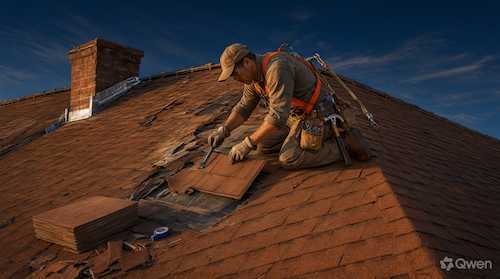
Sacramento's housing stock is older than the California average — 43.9% of units predate 1980 — and a large share of it is the ranch and bungalow construction of the 1950s and 1960s, much of it still carrying its original roof structure under later coverings. That matters because the visible shingle is only the last layer: beneath it are the boards, the flashings and whatever a previous owner did, and in this climate the summer does the aging while the winter does the leaking. Rain arrives concentrated into a few months, so a roof that has looked fine all summer is tested repeatedly and hard between November and March.
What is under the shingle
On older houses here the roof may sit on spaced boards rather than solid sheathing, and a second or third layer of shingles may have been applied over the first without anyone assessing what was underneath. When that stack is finally removed the deck can be soft from years of small leaks, and the fix is no longer a re-roof. Ask whether the estimate includes a full tear-off to the deck, what will happen if the boards are deteriorated, and whether a re-deck is a change order or included.
Valley heat and the attic
Summers here cook a dark shingle roof, and the attic beneath it becomes a hot box that the air conditioning has to fight all evening. Ventilation and roof color both matter, and so does the ductwork running through that space. Where an older house has a low attic with no ridge vent and blocked soffits, the roof replacement is the moment to fix it. Ask whether intake and exhaust ventilation will be balanced, what the reflective rating of the proposed shingle is, and whether the ducts will be inspected while the roof is open.
Concentrated winter rain
Almost all of the year's water arrives in a few months, and storms can be intense. The vulnerabilities are the ones that a long dry spell hides: a valley with a small gap, a pipe boot that has cracked in the sun, the wall-to-roof junction over an addition, and a gutter that has filled with leaf litter from the valley oaks and never been cleared. Ask how the valleys, boots and wall junctions are being detailed, and whether the gutters and downspouts are part of the scope or assumed to be fine.
The foothills are a different job
The metro runs from the valley floor up into Placer and El Dorado county foothill communities, where the fire exposure, the wind and occasionally the snow load are all different from the city. Roof coverings there face ember exposure and debris accumulation in a way that a midtown bungalow does not. Ask which fire classification the assembly meets, how valleys and eaves are detailed to shed debris, and whether the insurance or the local requirements impose conditions on the covering.
Gutters, drainage and the fascia behind them
The roof is only half of the water path. In the older neighborhoods the gutters are frequently full of leaf litter from the street trees, and an overflowing gutter rots the fascia board behind it and then the wall below. Downspouts that discharge against the foundation undo whatever the roof does well. Ask whether the gutters and downspouts are included or inspected, who clears them, and whether the discharge points can be moved away from the building.
What to pin down in the estimate
Where this page stops
No prices are quoted and no roof is assessed here. Deck condition, structural adequacy and fire-hardening requirements need inspection or confirmation from the local authority or the insurer, not a description on a page.
Sacramento metro context
The 2024 ACS 5-year estimates describe about 2.43 million residents in 881,889 households and 954,751 housing units, with 63.0% owner-occupied and 68.4% single-family detached. About 43.9% of units predate 1980, which is why original roof structures and layered coverings are so common. No climate station is reported for this metro in the site dataset, so no temperature or precipitation normals appear on this page.
Sacramento housing indicators
| Indicator | Value | Source |
|---|---|---|
| Housing units built before 1980 | 43.9% | U.S. Census Bureau |
| Single-family detached share | 68.4% | U.S. Census Bureau |
| Owner-occupied share | 63.0% | U.S. Census Bureau |
| Metro households | 881,889 | U.S. Census Bureau |
| Housing units | 954,751 | U.S. Census Bureau |
| Metro population | 2,426,388 | U.S. Census Bureau |
No climate normals are shown because no station record is held for this metro in the site dataset. Conditions differ sharply between the valley floor, where summer heat dominates, and the foothill communities, where fire exposure and winter weather do.
Frequently Asked Questions
Can a new layer go over the old shingles?
It is sometimes allowed, but it hides the deck and the flashings, adds weight to older framing, and doubles the tear-off next time. On a 1950s house with unknown boards underneath, removing to the deck is usually the more honest option.
Why does my roof only leak in winter?
Because this climate tests a roof in a few concentrated months. A small gap in a valley or a cracked pipe boot stays dry all summer and lets water in during the first real storm, which is also when it is hardest to get a repair scheduled.
Does the roof color matter in this heat?
It affects how much heat the attic takes in, which in turn affects the cooling bill and the life of the covering. Comparing the reflective rating of the options is worth more than choosing on appearance.
Why is ventilation such a big deal here?
A low, poorly vented attic in a hot valley traps heat and moisture, both of which shorten the roof's life. Blocked soffits and a missing ridge vent are common on older houses and are cheap to correct during a replacement.
Are gutters part of a roof job?
Often not, and they are frequently the reason water ends up against the foundation. With mature trees dropping debris, a gutter that is never cleared backs up and rots the fascia behind it.
Is fire hardening relevant in the valley?
For properties at the edge of the urban area and in the foothills, yes. Ember exposure and debris trapped in valleys are the mechanisms, and the assembly's fire classification is what insurers and local requirements look at.
Sources and review date
- American Community Survey 2024 5-year estimates (CBSA tables) — U.S. Census Bureau, 2024 ACS 5-year estimates.
Reviewed on 2026-11-18.