
Dallas, TX · metro guide
Roofing in Dallas–Fort Worth: Storms, Heat, and What to Compare
DFW roofs are judged twice: once by summer heat and once by storm season. The proposal should document both, not just the damaged shingles.
Metro snapshot
Dallas in numbers
Sources named below each block
- Population
- 8.0M
- Households
- 2.9M
- Housing units
- 3.1M
- People / household
- 2.76
- population ÷ households
Owner-occupied homes 60%
The rest are rented. Owners are the ones who commission most exterior work.
Single-family detached 63%
Detached houses carry their own roof, gutters and exterior walls.
Built before 1980 30%
Older housing stock shapes what fails first: gutters, flashing, pipe material.
Season
The year in Dallas
- Precipitation
- 37 in
- Snowfall
- 1.6 in
Average temperature by month, °F — the shape of the year is what decides when exterior work gets done.
Precipitation by month, inches.
Snowfall by month, inches.
| Month | Average temperature (°F) | Precipitation (in) | Snowfall (in) |
|---|---|---|---|
| January | 46.3°F | 2.53 in | 0.1 in |
| February | 50.5°F | 2.76 in | 1.0 in |
| March | 58.2°F | 3.30 in | 0.3 in |
| April | 65.6°F | 3.22 in | 0.0 in |
| May | 74.0°F | 4.78 in | 0.0 in |
| June | 81.9°F | 3.70 in | 0.0 in |
| July | 85.7°F | 2.08 in | 0.0 in |
| August | 85.7°F | 2.18 in | 0.0 in |
| September | 78.5°F | 2.72 in | 0.0 in |
| October | 67.7°F | 4.37 in | 0.0 in |
| November | 56.4°F | 2.53 in | 0.0 in |
| December | 48.1°F | 2.84 in | 0.2 in |
NOAA 1991–2020 climate normals, station DALLAS FT WORTH AP, TX US (USW00003927). Station observations, not a metro-wide average — a metro that spans a mountain range can differ by more than this record shows.
Population, households and housing shares: U.S. Census Bureau, American Community Survey 2024 5-year estimates, metropolitan statistical area.
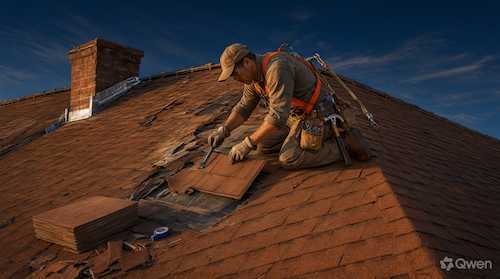
In Dallas–Fort Worth, a roof conversation usually starts after weather. July at the airport station averages 85.7°F, and storm seasons bring wind and hail that can mark a roof without breaking it. The question is not whether the roof looks damaged from the ground, but what was documented at the surface and what the proposal does about the parts that are already aged.
Storm evidence should be specific
Ask what was observed and where: bruised or fractured shingle mats, granule loss, lifted or creased tabs, damaged vents, or dented metal. A useful inspection describes locations and shows photos, because 'storm damage' is a conclusion, not a finding. If an insurance claim is involved, keep the dates and the report together.
Heat and the aging roof
Long, hot summers age sealants and underlayment even without a storm. Ask how old the covering is, what the attic conditions look like, and whether ventilation is part of the scope. A storm repair on a roof that is already near the end of its service life can be a short-term fix; that trade-off should be explicit rather than implied.
What the proposal should name
Compare the roof area, removal and installation scope, underlayment, flashing, vents, deck repair allowances, disposal, permit handling, and warranty terms. Ask how deck repair is priced if soft spots are found after removal. On a steep or complex roof, access and staging can matter as much as the material.
Comparing a repair with a replacement
A repair and a replacement are not alternatives unless both address the same condition. Ask each contractor to price the same area and scope, then compare what is included. A repair that restores the roof for a few seasons can be the right choice on a newer covering; on an older one, the better comparison may be replacement.
Questions to ask before approving work
Where this page stops
This page does not inspect a roof, determine insurance coverage, or publish local prices. Roof condition and permit requirements must be confirmed at the property and with the responsible authority.
Dallas–Fort Worth metro context
The 2024 ACS 5-year estimates put the metro at about 8.0 million residents and 2.9 million households. About 60.1% of occupied homes are owner-occupied, and about 62.6% of housing units are single-family detached. About 29.8% of housing units were built before 1980, so much of the stock is newer — but newer roofs still age, and storm damage can affect any of them. NOAA's station records January averaging 46.3°F, July 85.7°F, and about 37.0 inches of precipitation a year.
Dallas–Fort Worth reference station and housing indicators
| Indicator | Value | Source |
|---|---|---|
| January mean temperature | 46.3°F | NOAA NCEI |
| July mean temperature | 85.7°F | NOAA NCEI |
| Annual precipitation | 37.0 in. | NOAA NCEI |
| Metro population | 7,985,590 | U.S. Census Bureau |
| Owner-occupied share | 60.1% | U.S. Census Bureau |
| Single-family detached share | 62.6% | U.S. Census Bureau |
Station normals are historical averages for one location, not a forecast. Census values describe the metro area, not an individual property.
Mapped in OpenStreetMap
Roofing businesses mapped in the Dallas metro
OpenStreetMap contributors have mapped 63 roofing entries inside the Dallas-Fort Worth-Arlington, TX CBSA; 62 have a name. This is a map-coverage indicator, not a count of all licensed roofing businesses in the metro.
- Mapped entries
- 63
- OSM features
- Phone listed
- 75%
- 47 of 63
- Website listed
- 79%
- 50 of 63
- Street address
- 89%
- 56 of 63
OSM coverage varies by area: a low count can mean low mapping activity, not a small market. OpenStreetMap does not record contractor licenses. Texas does not license roofers statewide. Check the city or county where the contractor is based.
Query: craft=roofer.
Snapshot: 2026-11-17. Data:
© OpenStreetMap contributors,
ODbL 1.0.
CBSA boundary:
U.S. Census Bureau, 2023.
Frequently Asked Questions
How do I know if my roof has hail or wind damage?
A roof inspection should document specific findings at specific locations — bruised or fractured shingles, granule loss, lifted tabs, or damaged metal — with photos. A conclusion without findings is not enough to compare proposals or support a claim.
Should I repair or replace a storm-damaged roof?
It depends on the extent of the damage, the age and condition of the covering, and the cost of the repair relative to replacement. Ask each contractor to describe the same scope so the options are comparable.
What should a roofing proposal include in DFW?
The roof area, removal and installation scope, underlayment, flashing, vents, deck repair handling, disposal, permit responsibilities, schedule, and warranty terms.
How is deck repair priced?
Some proposals price it per sheet, others use an allowance. Ask before signing, because soft spots are often found only after the old covering is removed.
Does homeowners insurance cover roof damage?
Coverage depends on the policy, the cause, exclusions, the deductible, and the insurer's review. Keep dated photos and the inspection report, and ask the insurer about the specific policy.
What is the population of the Dallas–Fort Worth metro area?
The U.S. Census Bureau's 2024 ACS 5-year estimates report about 8.0 million residents in the metro area. The figure describes regional scale, not the number of homes or providers.
Sources and review date
- American Community Survey 2024 5-year estimates (CBSA tables) — U.S. Census Bureau, 2024 ACS 5-year estimates.
- 1991–2020 station normals — DALLAS FT WORTH AP, TX US (USW00003927) — NOAA National Centers for Environmental Information, 1991–2020 climate normals.
- OpenStreetMap contributors — craft=roofer features in the Dallas-Fort Worth-Arlington, TX CBSA — OpenStreetMap contributors, Snapshot 2026-11-17.
Reviewed on 2026-11-18.