
Chicago, IL-IN · metro guide
Roofing in Chicago: Snow, Freeze-Thaw, and What to Compare
Chicago roofs face snow, freeze-thaw cycles, and summer storms. The details that fail are often at edges, valleys, and ventilation.
Metro snapshot
Chicago in numbers
Sources named below each block
- Population
- 9.4M
- Households
- 3.6M
- Housing units
- 3.9M
- People / household
- 2.57
- population ÷ households
Owner-occupied homes 66%
The rest are rented. Owners are the ones who commission most exterior work.
Single-family detached 52%
Detached houses carry their own roof, gutters and exterior walls.
Built before 1980 63%
Older housing stock shapes what fails first: gutters, flashing, pipe material.
Season
The year in Chicago
- Precipitation
- 37.9 in
- Snowfall
- 38.4 in
Average temperature by month, °F — the shape of the year is what decides when exterior work gets done.
Precipitation by month, inches.
Snowfall by month, inches.
| Month | Average temperature (°F) | Precipitation (in) | Snowfall (in) |
|---|---|---|---|
| January | 25.2°F | 1.99 in | 11.3 in |
| February | 28.8°F | 1.97 in | 10.7 in |
| March | 39.0°F | 2.45 in | 5.5 in |
| April | 49.7°F | 3.75 in | 1.3 in |
| May | 60.6°F | 4.49 in | 0.0 in |
| June | 70.6°F | 4.10 in | 0.0 in |
| July | 75.4°F | 3.71 in | 0.0 in |
| August | 73.8°F | 4.25 in | 0.0 in |
| September | 66.3°F | 3.19 in | 0.0 in |
| October | 54.0°F | 3.43 in | 0.2 in |
| November | 41.3°F | 2.42 in | 1.8 in |
| December | 30.5°F | 2.11 in | 7.6 in |
NOAA 1991–2020 climate normals, station CHICAGO OHARE INTL AP, IL US (USW00094846). Station observations, not a metro-wide average — a metro that spans a mountain range can differ by more than this record shows.
Population, households and housing shares: U.S. Census Bureau, American Community Survey 2024 5-year estimates, metropolitan statistical area.
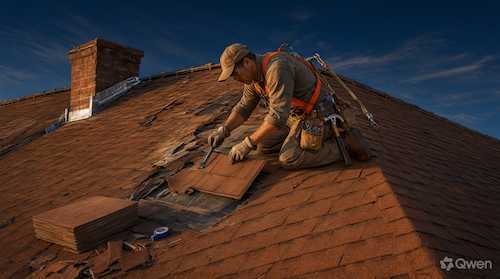
A Chicago roof has to survive four seasons in one year. January at O'Hare averages 25.2°F, the station records about 38.4 inches of snow and 37.9 inches of precipitation in a typical year, and freeze-thaw cycles work on every edge and sealant. By July the same roof is at 75.4°F and dealing with summer storms. About 62.7% of metro housing units were built before 1980, according to ACS estimates, so many roofs have already been repaired more than once.
Freeze-thaw and the details
Water that gets behind a flashing or into a seam expands when it freezes. Ask how the proposal handles edges, valleys, chimneys, and wall transitions, and whether flashing is replaced or reused. These details matter more in a freeze-thaw climate than the shingle brand, because the failure usually starts where water is redirected.
Flat and low-slope roofs
Many older Chicago buildings have flat or low-slope roofs, where seams, drains, scuppers, and parapets decide performance. Ask how drainage is addressed, what membrane or coating is proposed, and how ponding is handled. A flat-roof scope that does not mention drainage or parapet details is incomplete.
Ventilation and attic moisture
In a cold climate, warm, moist air that reaches the roof deck can condense and freeze. Ask whether the proposal includes ventilation or insulation improvements and how the attic will be checked for existing moisture. Ice-dam detailing and underlayment at the eaves are fair questions for a roof scope; the right answer depends on the assembly and the house.
Summer storms and documentation
Summer wind and hail can damage a roof that survived the winter. Ask for dated photos and a written description of the affected areas, and ask how the contractor separates storm repairs from maintenance. Keep the inspection report with any insurance claim number.
Questions to ask before approving work
Where this page stops
This page does not inspect a roof or publish local prices. Roof condition and permit requirements must be confirmed at the property and with the authority responsible for the address.
Chicago metro context
The 2024 ACS 5-year estimates put the metro at about 9.4 million residents and 3.6 million households. About 65.5% of occupied homes are owner-occupied, and about 51.5% of housing units are single-family detached. About 62.7% of housing units were built before 1980, so both older flat roofs and pitched residential roofs are common. NOAA's O'Hare station records January averaging 25.2°F, July 75.4°F, about 37.9 inches of precipitation, and 38.4 inches of snow in a typical year.
Chicago reference station and housing indicators
| Indicator | Value | Source |
|---|---|---|
| January mean temperature | 25.2°F | NOAA NCEI |
| July mean temperature | 75.4°F | NOAA NCEI |
| Annual precipitation | 37.9 in. | NOAA NCEI |
| Annual snowfall | 38.4 in. | NOAA NCEI |
| Metro population | 9,371,595 | U.S. Census Bureau |
| Housing units built before 1980 | 62.7% | U.S. Census Bureau |
Station normals are historical averages for one location, not a forecast. Census values describe the metro area, not an individual property.
Mapped in OpenStreetMap
Roofing businesses mapped in the Chicago metro
OpenStreetMap contributors have mapped 34 roofing entries inside the Chicago-Naperville-Elgin, IL-IN CBSA; 34 have a name. This is a map-coverage indicator, not a count of all licensed roofing businesses in the metro.
- Mapped entries
- 34
- OSM features
- Phone listed
- 59%
- 20 of 34
- Website listed
- 62%
- 21 of 34
- Street address
- 65%
- 22 of 34
OSM coverage varies by area: a low count can mean low mapping activity, not a small market. OpenStreetMap does not record contractor licenses. To check a license, use the City of Chicago contractor license lookup. Chicago issues trade contractor licenses through the Department of Buildings.
Query: craft=roofer.
Snapshot: 2026-11-17. Data:
© OpenStreetMap contributors,
ODbL 1.0.
CBSA boundary:
U.S. Census Bureau, 2023.
Frequently Asked Questions
What should a roofing proposal include in Chicago?
The roof area, removal and installation scope, underlayment, flashing, drainage, ventilation, disposal, permit responsibilities, schedule, and warranty terms. Ask for exclusions in writing as well.
Why does freeze-thaw matter for a roof?
Water that gets behind flashing or into a seam expands when it freezes, which can open the detail further. That is why edges, valleys, and penetrations deserve explicit attention in the scope.
How is a flat roof compared with a pitched roof?
They are different assemblies. Flat roofs depend on membranes, seams, drains, and parapets; pitched roofs depend on underlayment, flashing, and ventilation. Ask what system is on the roof and what replaces it.
Does attic ventilation matter in a cold climate?
Yes. Warm, moist air that reaches the roof deck can condense and freeze. Ask whether ventilation or insulation changes are included and how the attic will be checked for moisture.
How do I document storm damage?
Keep dated photos, the inspection report, and any insurance claim number with the proposal. Ask the contractor to separate storm repairs from maintenance items.
What is the population of the Chicago metro area?
The U.S. Census Bureau's 2024 ACS 5-year estimates report about 9.4 million residents in the metro area. The figure describes regional scale, not the number of homes or providers.
Sources and review date
- American Community Survey 2024 5-year estimates (CBSA tables) — U.S. Census Bureau, 2024 ACS 5-year estimates.
- 1991–2020 station normals — CHICAGO OHARE INTL AP, IL US (USW00094846) — NOAA National Centers for Environmental Information, 1991–2020 climate normals.
- OpenStreetMap contributors — craft=roofer features in the Chicago-Naperville-Elgin, IL-IN CBSA — OpenStreetMap contributors, Snapshot 2026-11-17.
Reviewed on 2026-11-18.