
Dallas, TX · metro guide
Water Damage Restoration in Dallas–Fort Worth: What to Compare
DFW has a younger housing stock than most large metros, but supply-line failures and storm intrusion still require the same documented drying process.
Metro snapshot
Dallas in numbers
Sources named below each block
- Population
- 8.0M
- Households
- 2.9M
- Housing units
- 3.1M
- People / household
- 2.76
- population ÷ households
Owner-occupied homes 60%
The rest are rented. Owners are the ones who commission most exterior work.
Single-family detached 63%
Detached houses carry their own roof, gutters and exterior walls.
Built before 1980 30%
Older housing stock shapes what fails first: gutters, flashing, pipe material.
Season
The year in Dallas
- Precipitation
- 37 in
- Snowfall
- 1.6 in
Average temperature by month, °F — the shape of the year is what decides when exterior work gets done.
Precipitation by month, inches.
Snowfall by month, inches.
| Month | Average temperature (°F) | Precipitation (in) | Snowfall (in) |
|---|---|---|---|
| January | 46.3°F | 2.53 in | 0.1 in |
| February | 50.5°F | 2.76 in | 1.0 in |
| March | 58.2°F | 3.30 in | 0.3 in |
| April | 65.6°F | 3.22 in | 0.0 in |
| May | 74.0°F | 4.78 in | 0.0 in |
| June | 81.9°F | 3.70 in | 0.0 in |
| July | 85.7°F | 2.08 in | 0.0 in |
| August | 85.7°F | 2.18 in | 0.0 in |
| September | 78.5°F | 2.72 in | 0.0 in |
| October | 67.7°F | 4.37 in | 0.0 in |
| November | 56.4°F | 2.53 in | 0.0 in |
| December | 48.1°F | 2.84 in | 0.2 in |
NOAA 1991–2020 climate normals, station DALLAS FT WORTH AP, TX US (USW00003927). Station observations, not a metro-wide average — a metro that spans a mountain range can differ by more than this record shows.
Population, households and housing shares: U.S. Census Bureau, American Community Survey 2024 5-year estimates, metropolitan statistical area.
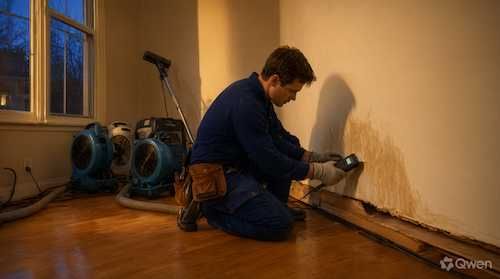
Water damage in Dallas–Fort Worth can come from a supply line under a slab, an appliance hose in a second-floor laundry room, or a storm that pushes water under a door. The source changes the scope, but the questions are consistent: what is wet, how will it be dried, and what record will exist when the job is closed. About 29.8% of metro housing units were built before 1980, according to ACS estimates — a younger stock than New York or Chicago, which changes the materials you are likely to find but not the need for documentation.
Find the source before removing anything
A restoration scope should identify where the water came from and whether it is still entering. A failed supply line, a backed-up drain, and a roof leak leave different evidence and require different follow-up. If the source is not controlled, drying equipment is treating a symptom. Ask how the source was confirmed and what repair is needed before reconstruction begins.
Drying needs a plan and a record
Ask for moisture readings with locations and dates, the equipment placement, and the dry standard used to finish the job. Readings taken once at the start are not a drying record. A useful plan shows daily or scheduled checks, explains what happens if a wall cavity stays wet, and states when equipment will be removed. This is also the evidence an insurer will ask for.
How to compare two restoration proposals
Compare the suspected source, affected rooms and materials, what is removed versus dried in place, containment, cleaning, monitoring, and completion records. Ask whether reconstruction — drywall, flooring, cabinets, paint — is included or separate. Two proposals can look similar on page one and diverge on what happens after the equipment leaves.
Insurance documentation
Photograph and date the affected areas before work starts, and keep an inventory of damaged items. Ask how the contractor documents the loss and whether they will share readings and photos with the insurer. Coverage depends on the policy, the cause, exclusions, and the deductible; the contractor's scope does not determine coverage, and this guide cannot either.
Questions worth asking before work begins
Where this page stops
This guide does not assess an active loss remotely and does not publish local prices. If water is still entering or there is an electrical safety concern, contact the appropriate emergency service. Coverage and remediation requirements depend on the property, the policy, and the responsible local authority.
Dallas–Fort Worth metro context
The 2024 ACS 5-year estimates put the metro at about 8.0 million residents and 2.9 million households. About 60.1% of occupied homes are owner-occupied, and about 62.6% of housing units are single-family detached. NOAA's 1991–2020 normals for the Dallas/Fort Worth airport station show July averaging 85.7°F, January 46.3°F, and about 37.0 inches of precipitation a year. These figures describe the metro and one station, not a specific home.
Dallas–Fort Worth reference station and housing indicators
| Indicator | Value | Source |
|---|---|---|
| January mean temperature | 46.3°F | NOAA NCEI |
| July mean temperature | 85.7°F | NOAA NCEI |
| Annual precipitation | 37.0 in. | NOAA NCEI |
| Metro population | 7,985,590 | U.S. Census Bureau |
| Households | 2,891,725 | U.S. Census Bureau |
| Housing units built before 1980 | 29.8% | U.S. Census Bureau |
| Single-family detached share | 62.6% | U.S. Census Bureau |
Station normals are historical averages for one location, not a forecast. Census values describe the metro area, not an individual property.
Frequently Asked Questions
What should I do first after discovering water damage?
Stop the source if it is safe to do so, keep people away from electrical hazards, and document the affected area with dated photos. Then arrange an assessment of the source and the wet materials.
How is drying verified?
Drying is normally checked with moisture readings taken at documented locations and compared over time, along with visual inspection. Ask for the readings and the dry standard used to close the job.
Does homeowners insurance cover water damage in Texas?
Coverage depends on the policy, the cause, exclusions, the deductible, and the insurer's review. Keep dated documentation of the loss and ask the insurer about the specific policy; this guide cannot determine coverage.
How long does water damage drying take?
Duration depends on the materials affected, the amount of water, humidity, and the drying equipment used. Ask for a written drying plan with monitoring checkpoints rather than a single estimate.
What is the difference between mitigation and reconstruction?
Mitigation covers extraction, removal of unsalvageable material, drying, and cleaning. Reconstruction restores the structure and finishes. Ask which parts are in the proposal and which are separate contracts.
What is the population of the Dallas–Fort Worth metro area?
The U.S. Census Bureau's 2024 ACS 5-year estimates report about 8.0 million residents in the metro area. The figure describes regional scale, not the number of homes or providers.
Sources and review date
- American Community Survey 2024 5-year estimates (CBSA tables) — U.S. Census Bureau, 2024 ACS 5-year estimates.
- 1991–2020 station normals — DALLAS FT WORTH AP, TX US (USW00003927) — NOAA National Centers for Environmental Information, 1991–2020 climate normals.
Reviewed on 2026-11-17.