
Austin, TX · metro guide
Roofing in Austin: Hail, Heat, and New Builds
Austin roofs are tested by hail in spring and sun all year, on housing that is younger than almost anywhere else.
Metro snapshot
Austin in numbers
Sources named below each block
- Population
- 2.4M
- Households
- 989K
- Housing units
- 1.0M
- People / household
- 2.45
- population ÷ households
Owner-occupied homes 58%
The rest are rented. Owners are the ones who commission most exterior work.
Single-family detached 59%
Detached houses carry their own roof, gutters and exterior walls.
Built before 1980 19%
Older housing stock shapes what fails first: gutters, flashing, pipe material.
Season
The year in Austin
- Precipitation
- 36.2 in
- Snowfall
- 0.2 in
Average temperature by month, °F — the shape of the year is what decides when exterior work gets done.
Precipitation by month, inches.
Snowfall by month, inches.
| Month | Average temperature (°F) | Precipitation (in) | Snowfall (in) |
|---|---|---|---|
| January | 52.2°F | 2.64 in | 0.0 in |
| February | 56.1°F | 1.89 in | 0.2 in |
| March | 62.8°F | 2.88 in | 0.0 in |
| April | 69.6°F | 2.42 in | 0.0 in |
| May | 76.8°F | 5.04 in | 0.0 in |
| June | 83.0°F | 3.68 in | 0.0 in |
| July | 85.8°F | 1.96 in | 0.0 in |
| August | 86.5°F | 2.74 in | 0.0 in |
| September | 80.8°F | 3.45 in | 0.0 in |
| October | 71.6°F | 3.91 in | 0.0 in |
| November | 61.0°F | 2.92 in | 0.0 in |
| December | 53.6°F | 2.72 in | 0.0 in |
NOAA 1991–2020 climate normals, station AUSTIN-CAMP MABRY, TX US (USW00013958). Station observations, not a metro-wide average — a metro that spans a mountain range can differ by more than this record shows.
Population, households and housing shares: U.S. Census Bureau, American Community Survey 2024 5-year estimates, metropolitan statistical area.
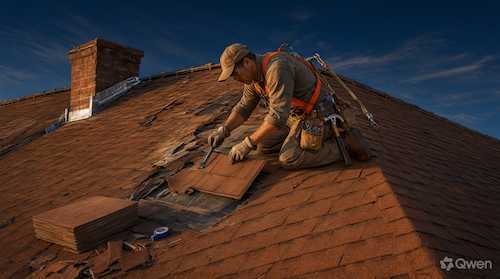
Only about 19.2% of Austin metro housing units were built before 1980, according to ACS estimates — the youngest stock in this set by a wide margin. That means few century-old assemblies and many roofs from the 1990s and 2000s approaching their first replacement. What they face is central Texas weather: hail in spring, July averaging 85.8°F, and about 36.2 inches of rain a year.
Hail and impact ratings
Ask what impact rating the proposed covering carries and what documentation supports it. Ratings describe performance under a standard test, not immunity. Ask how the contractor documents storm damage for an insurer — photographs, test squares, and a written scope that separates damage from wear — and whether they will meet the adjuster on site.
Heat, UV, and attic temperature
Ask how the roof assembly ventilates and whether intake and exhaust are balanced. An under-ventilated attic in this climate reaches temperatures that shorten the life of the covering and push the air conditioning harder. Ask whether ventilation corrections are part of the scope or an extra.
First replacement, and what it reveals
Ask whether the decking and flashing from the original build are sound, because the first replacement is when problems hidden since construction appear. Ask how decking damage is priced and approved, and whether the original details — valleys, wall junctions, and vent boots — meet current practice.
HOA rules and permits
Ask whether an association governs shingle color, profile, or material, and who prepares that approval. Ask who files the permit and schedules the inspection. A project that ignores either can stall after materials are ordered.
Questions to ask before signing
Where this page stops
This page does not inspect a roof, estimate cost, or interpret an insurance policy. Coverage and claim requirements depend on the policy and the insurer, and code and association requirements vary by address and should be confirmed with the responsible authority.
Austin metro context
The 2024 ACS 5-year estimates put the metro at about 2.4 million residents and 989,000 households. About 58.3% of occupied homes are owner-occupied, and about 59.0% of housing units are single-family detached. About 19.2% of housing units were built before 1980, so most of the stock is newer and roofs of similar age cluster in the same subdivisions. NOAA's Austin station records January averaging 52.2°F, July 85.8°F, and about 36.2 inches of precipitation a year.
Austin reference station and housing indicators
| Indicator | Value | Source |
|---|---|---|
| January mean temperature | 52.2°F | NOAA NCEI |
| July mean temperature | 85.8°F | NOAA NCEI |
| Annual precipitation | 36.2 in. | NOAA NCEI |
| Metro population | 2,426,592 | U.S. Census Bureau |
| Owner-occupied share | 58.3% | U.S. Census Bureau |
| Housing units built before 1980 | 19.2% | U.S. Census Bureau |
Station normals are historical averages for one location, not a forecast. Census values describe the metro area, not an individual property.
Mapped in OpenStreetMap
Roofing businesses mapped in the Austin metro
OpenStreetMap contributors have mapped 28 roofing entries inside the Austin-Round Rock-San Marcos, TX CBSA; 27 have a name. This is a map-coverage indicator, not a count of all licensed roofing businesses in the metro.
- Mapped entries
- 28
- OSM features
- Phone listed
- 89%
- 25 of 28
- Website listed
- 86%
- 24 of 28
- Street address
- 96%
- 27 of 28
OSM coverage varies by area: a low count can mean low mapping activity, not a small market. OpenStreetMap does not record contractor licenses. Texas does not license roofers statewide. Check the city or county where the contractor is based.
Query: craft=roofer.
Snapshot: 2026-11-17. Data:
© OpenStreetMap contributors,
ODbL 1.0.
CBSA boundary:
U.S. Census Bureau, 2023.
Frequently Asked Questions
How do I compare roofing estimates in Austin?
Compare the specified covering and impact rating, underlayment, flashing details, decking allowances, ventilation, permit handling, disposal, exclusions, and both workmanship and manufacturer warranties.
Should I choose impact-resistant shingles?
It depends on the cost difference, how your insurer treats ratings, and how long you plan to stay. Ask for documentation behind each class and what your insurer does with it.
How is hail damage documented?
Typically with photographs, test squares, and a written scope separating storm damage from normal wear. Ask whether the contractor will meet the adjuster on site.
Does attic heat really shorten roof life?
It can, and it also makes the air conditioning work harder. Ask how the attic is ventilated and whether corrections are included in the scope.
Does a roof replacement require a permit?
Requirements depend on the jurisdiction and the scope. Confirm with the authority responsible for the address and ask whether permit handling and inspection are included.
What is the population of the Austin metro area?
The U.S. Census Bureau's 2024 ACS 5-year estimates report about 2.4 million residents in the metro area. The figure describes regional scale, not the number of homes or providers.
Sources and review date
- American Community Survey 2024 5-year estimates (CBSA tables) — U.S. Census Bureau, 2024 ACS 5-year estimates.
- 1991–2020 station normals — AUSTIN-CAMP MABRY, TX US (USW00013958) — NOAA National Centers for Environmental Information, 1991–2020 climate normals.
- OpenStreetMap contributors — craft=roofer features in the Austin-Round Rock-San Marcos, TX CBSA — OpenStreetMap contributors, Snapshot 2026-11-17.
Reviewed on 2026-11-18.