
New York, NY-NJ · metro guide
Solar Panels in New York: Roofs, Approvals, and What to Compare
New York solar is less about sunshine than about roofs, shade from neighboring buildings, and who has the right to approve work on the roof.
Metro snapshot
New York in numbers
Sources named below each block
- Population
- 19.8M
- Households
- 7.4M
- Housing units
- 8.0M
- People / household
- 2.67
- population ÷ households
Owner-occupied homes 52%
The rest are rented. Owners are the ones who commission most exterior work.
Single-family detached 35%
Detached houses carry their own roof, gutters and exterior walls.
Built before 1980 73%
Older housing stock shapes what fails first: gutters, flashing, pipe material.
Season
The year in New York
- Precipitation
- 49.5 in
- Snowfall
- 29.8 in
Average temperature by month, °F — the shape of the year is what decides when exterior work gets done.
Precipitation by month, inches.
Snowfall by month, inches.
| Month | Average temperature (°F) | Precipitation (in) | Snowfall (in) |
|---|---|---|---|
| January | 33.7°F | 3.64 in | 8.8 in |
| February | 35.9°F | 3.19 in | 10.1 in |
| March | 42.8°F | 4.29 in | 5.0 in |
| April | 53.7°F | 4.09 in | 0.4 in |
| May | 63.2°F | 3.96 in | 0.0 in |
| June | 72.0°F | 4.54 in | 0.0 in |
| July | 77.5°F | 4.60 in | 0.0 in |
| August | 76.1°F | 4.56 in | 0.0 in |
| September | 69.2°F | 4.31 in | 0.0 in |
| October | 57.9°F | 4.38 in | 0.1 in |
| November | 48.0°F | 3.58 in | 0.5 in |
| December | 39.1°F | 4.38 in | 4.9 in |
NOAA 1991–2020 climate normals, station NEW YORK CNTRL PK TWR, NY US (USW00094728). Station observations, not a metro-wide average — a metro that spans a mountain range can differ by more than this record shows.
Population, households and housing shares: U.S. Census Bureau, American Community Survey 2024 5-year estimates, metropolitan statistical area.
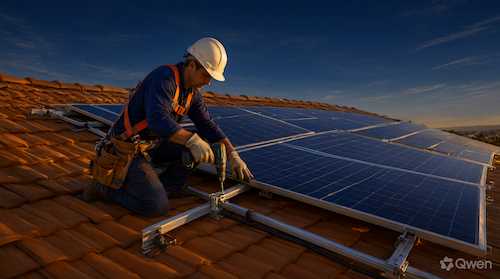
Solar in New York is a roof and permission project before it is an energy project. About 73% of metro housing units were built before 1980, according to ACS estimates, and only about 34.9% are single-family detached. That means many installations happen on rowhouses, co-ops, and apartment buildings where roof condition, shade from neighboring structures, and approval rights decide whether a proposal is realiztic.
The roof and the shade around it
Ask how the installer evaluated roof condition, how mounting will be sealed, and what happens if the roof needs work in the next decade. Shading is equally important in a dense city: parapets, water towers, and buildings next door can change production far more than the array design. A production estimate that ignores the urban skyline is optimiztic by default.
Approvals and roof rights
In a co-op or condo, the roof may be common property. Ask who owns the roof rights, whether board approval or an alteration agreement is required, and how insurance and access work. If you rent, the decision is not yours alone. These questions belong before a contract is signed, not after equipment is ordered.
Production assumptions
Ask which production model was used, what shading and soiling assumptions it contains, and whether it uses historical consumption or a standard profile. Compare estimated first-year production and the assumptions behind it rather than a single payback figure. A smaller, well-placed array can outperform a larger one with poor orientation.
Equipment, warranties, and interconnection
Compare module and inverter models, system size, monitoring, and the separate warranties for equipment, production, and workmanship. A project also involves a building permit, an electrical inspection, and a utility interconnection request. Ask which party prepares and files each item and who confirms permission to operate.
Questions to ask before signing
Where this page stops
This page does not estimate production, savings, or payback for a specific property and does not confirm which incentives apply. Those depend on the roof, shading, equipment, utility rules, and current tax law, which should be checked with the relevant official source.
New York metro context
The 2024 ACS 5-year estimates put the metro at about 19.8 million residents and 7.4 million households. About 51.5% of occupied homes are owner-occupied, and about 34.9% of housing units are single-family detached, so a large share of solar decisions involve a building or a board. About 73% of housing units were built before 1980, which makes roof age a standard part of the conversation. These figures describe the metro, not a specific building.
New York metro housing indicators
| Indicator | Value |
|---|---|
| Population | 19,798,537 |
| Households | 7,409,947 |
| Owner-occupied share | 51.5% |
| Housing units built before 1980 | 73.0% |
| Single-family detached share | 34.9% |
Metro-level estimates. Building age does not establish the condition of a specific roof or electrical service.
Frequently Asked Questions
Can you install solar on a New York rowhouse or apartment building?
It depends on roof condition, shading, structural and electrical capacity, and who controls the roof. In multi-unit buildings, board approval and roof rights usually come first. A site assessment at the property is the only way to answer the technical part.
What should I compare between two solar quotes?
Compare the gross cash price, system size, equipment models, estimated first-year production and its assumptions, included roof and electrical work, exclusions, and each warranty.
Does shading from other buildings matter?
Yes. In a dense city, parapets, water towers, and neighboring buildings can reduce output more than the array design. Ask how the production estimate models shade and whether optimizers or microinverters are proposed.
Who handles permits and utility interconnection?
It varies by contract. Ask which party prepares the building permit and the interconnection application, who schedules inspections, and who confirms permission to operate.
What happens if the roof needs replacement later?
Removal and reinstallation of the array is an extra cost and a coordination problem. Ask who is responsible and whether the contract addresses it before you sign.
What is the population of the New York metro area?
The U.S. Census Bureau's 2024 ACS 5-year estimates report about 19.8 million residents in the metro area. The figure describes regional scale, not the number of homes or providers.
Sources and review date
- American Community Survey 2024 5-year estimates (CBSA tables) — U.S. Census Bureau, 2024 ACS 5-year estimates.
Reviewed on 2026-11-17.