
Philadelphia, PA-NJ-DE-MD · metro guide
Water Damage Restoration in Philadelphia: Shared Walls and Old Pipes
In attached housing, water does not stay in one unit. The scope has to answer who else is affected and how the cause is traced.
Metro snapshot
Philadelphia in numbers
Sources named below each block
- Population
- 6.3M
- Households
- 2.5M
- Housing units
- 2.6M
- People / household
- 2.54
- population ÷ households
Owner-occupied homes 67%
The rest are rented. Owners are the ones who commission most exterior work.
Single-family detached 43%
Detached houses carry their own roof, gutters and exterior walls.
Built before 1980 67%
Older housing stock shapes what fails first: gutters, flashing, pipe material.
Season
The year in Philadelphia
- Precipitation
- 44.1 in
- Snowfall
- 23.1 in
Average temperature by month, °F — the shape of the year is what decides when exterior work gets done.
Precipitation by month, inches.
Snowfall by month, inches.
| Month | Average temperature (°F) | Precipitation (in) | Snowfall (in) |
|---|---|---|---|
| January | 33.7°F | 3.13 in | 7.1 in |
| February | 35.9°F | 2.75 in | 8.4 in |
| March | 43.6°F | 3.96 in | 3.6 in |
| April | 54.5°F | 3.47 in | 0.3 in |
| May | 64.3°F | 3.34 in | 0.0 in |
| June | 73.5°F | 4.04 in | 0.0 in |
| July | 78.7°F | 4.38 in | 0.0 in |
| August | 76.8°F | 4.29 in | 0.0 in |
| September | 69.9°F | 4.40 in | 0.0 in |
| October | 58.2°F | 3.47 in | 0.0 in |
| November | 47.4°F | 2.91 in | 0.2 in |
| December | 38.6°F | 3.97 in | 3.5 in |
NOAA 1991–2020 climate normals, station PHILADELPHIA INTL AP, PA US (USW00013739). Station observations, not a metro-wide average — a metro that spans a mountain range can differ by more than this record shows.
Population, households and housing shares: U.S. Census Bureau, American Community Survey 2024 5-year estimates, metropolitan statistical area.
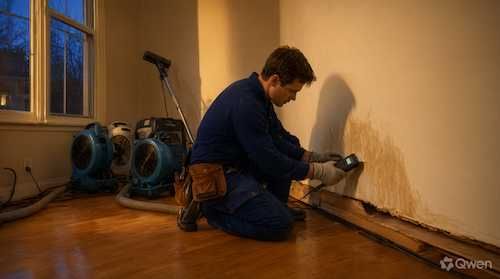
Philadelphia water damage often arrives from somewhere other than where it shows. About 66.6% of metro housing units were built before 1980, according to ACS estimates, and only about 43.4% are single-family detached, so a wet ceiling may be fed by a pipe two floors up or in the neighboring unit. The first job is finding the source; the second is agreeing who pays for what.
Trace the source before drying
A scope should identify whether the water came from a supply line, a drain, a roof, a window, a basement, or an adjacent unit, and whether it is still entering. Ask how the source was confirmed. If the source is not controlled, drying equipment is treating a symptom.
Shared walls and access
Ask how the contractor will inspect the shared wall or ceiling and what access is needed on the other side. In rowhouses, drying one side of a party wall may not be enough. Ask who authorizes work in a neighboring unit and how the building or association is informed.
Basements and repeated water
Basement water is common here, and the cause matters: a failed sump pump, a blocked drain, a gutter discharging at the foundation, or groundwater. Ask whether the assessment distinguishes between a one-time event and a recurring condition, because the fix is different and restoration alone will not prevent the next one.
Drying records and materials
Ask for moisture readings with locations and dates, equipment placement, and the dry standard used to close the job. Ask which materials will be removed rather than dried — plaster, insulation, and saturated finishes behave differently, and a scope that promises to dry everything is worth questioning.
Questions worth asking before work begins
Where this page stops
This guide does not assess an active loss remotely and does not publish local prices, and it does not determine responsibility between owners, tenants, or insurers. If water is still entering or there is an electrical safety concern, contact the appropriate emergency service.
Philadelphia metro context
The 2024 ACS 5-year estimates put the metro at about 6.3 million residents and 2.5 million households. About 66.8% of occupied homes are owner-occupied, and about 43.4% of housing units are single-family detached, so most households live where a loss can affect a neighbor. About 66.6% of housing units were built before 1980.
Philadelphia metro housing indicators
| Indicator | Value | Source |
|---|---|---|
| Metro population | 6,272,014 | U.S. Census Bureau |
| Households | 2,467,761 | U.S. Census Bureau |
| Owner-occupied share | 66.8% | U.S. Census Bureau |
| Single-family detached share | 43.4% | U.S. Census Bureau |
| Housing units built before 1980 | 66.6% | U.S. Census Bureau |
Census values describe the metro area, not an individual property. A climate station is not reported for this metro in the site dataset.
Frequently Asked Questions
What should I do first after discovering water damage?
Stop the source if it is safe to do so, keep people away from electrical hazards, and document the affected area with dated photos. Then arrange an assessment of the source and the wet materials.
What if the water came from a neighboring unit?
Document everything, notify the neighbor and, where applicable, the building or association, and ask the contractor to record where the water entered. Responsibility between owners and insurers is a separate question from the restoration scope.
How is drying verified?
Drying is normally checked with moisture readings taken at documented locations and compared over time, along with visual inspection. Ask for the readings and the dry standard used to close the job.
Will my insurance cover a burst pipe?
Coverage depends on the policy, the cause, exclusions, the deductible, and the insurer's review, and maintenance-related causes are often treated differently from sudden failures. Keep dated documentation and ask the insurer about the specific policy.
What is the difference between mitigation and reconstruction?
Mitigation covers extraction, removal of unsalvageable material, drying, and cleaning. Reconstruction restores the structure and finishes. Ask which parts are included and which are separate.
What is the population of the Philadelphia metro area?
The U.S. Census Bureau's 2024 ACS 5-year estimates report about 6.3 million residents in the metro area. The figure describes regional scale, not the number of homes or providers.
Sources and review date
- American Community Survey 2024 5-year estimates (CBSA tables) — U.S. Census Bureau, 2024 ACS 5-year estimates.
Reviewed on 2026-11-17.
Other Home Services in Philadelphia–Camden–Wilmington
All guides for the Philadelphia–Camden–Wilmington metro area