
Pittsburgh, PA · metro guide
Solar Panels in Pittsburgh: Trees, Slopes, and Snow
In a city built on hills under a heavy canopy, finding a genuinely unshaded roof plane is the first task.
Metro snapshot
Pittsburgh in numbers
Sources named below each block
- Population
- 2.4M
- Households
- 1.1M
- Housing units
- 1.2M
- People / household
- 2.30
- population ÷ households
Owner-occupied homes 71%
The rest are rented. Owners are the ones who commission most exterior work.
Single-family detached 68%
Detached houses carry their own roof, gutters and exterior walls.
Built before 1980 73%
Older housing stock shapes what fails first: gutters, flashing, pipe material.
Season
The year in Pittsburgh
- Precipitation
- 39.6 in
- Snowfall
- 44.1 in
Average temperature by month, °F — the shape of the year is what decides when exterior work gets done.
Precipitation by month, inches.
Snowfall by month, inches.
| Month | Average temperature (°F) | Precipitation (in) | Snowfall (in) |
|---|---|---|---|
| January | 28.8°F | 2.96 in | 13.3 in |
| February | 31.4°F | 2.62 in | 11.7 in |
| March | 39.7°F | 3.15 in | 7.6 in |
| April | 51.5°F | 3.32 in | 1.0 in |
| May | 61.2°F | 3.83 in | 0.0 in |
| June | 69.4°F | 4.12 in | 0.0 in |
| July | 73.2°F | 4.26 in | 0.0 in |
| August | 71.8°F | 3.52 in | 0.0 in |
| September | 64.9°F | 3.30 in | 0.0 in |
| October | 53.4°F | 2.83 in | 0.4 in |
| November | 42.6°F | 2.86 in | 2.4 in |
| December | 33.7°F | 2.84 in | 7.7 in |
NOAA 1991–2020 climate normals, station PITTSBURGH INTL AP, PA US (USW00094823). Station observations, not a metro-wide average — a metro that spans a mountain range can differ by more than this record shows.
Population, households and housing shares: U.S. Census Bureau, American Community Survey 2024 5-year estimates, metropolitan statistical area.
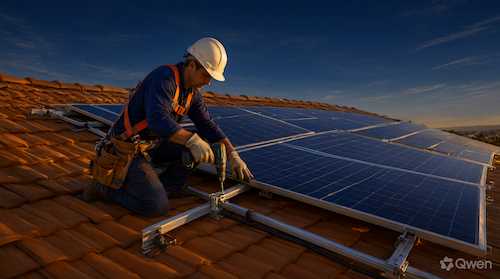
Pittsburgh is a workable solar market with two local obstacles that are easy to underestimate. The first is shade: the region is heavily wooded, the city is built on hills where a neighbor's roof or a slope itself can block the low winter sun, and many properties have a tree canopy that only partly clears during the day. The second is the age of the roofs. With 73.1% of housing built before 1980 — the oldest stock on this site — the covering under a proposed array often needs assessing as seriously as the array itself.
Shade from hills and canopy, not just trees
On flat ground the shade question is about vegetation. Here it can be the terrain, a neighboring building on higher ground, or a tree that belongs to someone else. The winter sun sits low, so an obstruction that is irrelevant in June can be decisive in December and January — the months when production is already at its floor. Ask which hours of the year were modelled, whether the study accounts for the low winter sun, whether per-panel electronics are used, and what happens to production if a neighboring tree grows.
Snow, pitch and the winter floor
Forty-four inches of snow falls in a typical year, and snow on glass blocks production entirely until it leaves. On a steeper roof it slides; on a shallow one it can sit for days. Ask whether the production estimate deducts for snow cover, what pitch the array is on, and whether the design assumes the homeowner will clear panels. Climbing a snowy roof is dangerous work, and a plan that depends on it is not really a plan.
Roof condition on the oldest stock here
Ask how old the covering is, how many layers are present, what the remaining service life is judged to be, and whether the installer will put that in writing. On a slate roof, mounting is a specializt problem and the slate itself may be worth preserving. On older houses the deck and attic ventilation deserve attention at the same time, because a hot or moist attic shortens the life of the covering with or without solar.
Heat and seasonal shape
Module output falls as cell temperature rises, and while July here averages 73.2°F rather than a desert figure, cells on a sunlit roof still run well above air temperature. Ask what cell temperature the estimate assumes, whether the mounting leaves an air gap, and for a monthly production profile compared with household consumption. A proposal showing flat output year-round is not modelling this latitude.
The credit terms carry the economics
Ask who files the interconnection request, what the expected review window is, how exported energy is credited under the current rules, what fixed charges remain, and what happens to accumulated credits at the end of a period. Confirm it with the utility rather than relying on an installer's summary. Where exports are credited below retail, the value shifts toward what the household consumes while the array is producing, which changes how the system should be sized.
What to ask a Pittsburgh installer
Where this page stops
No prices, incentives or production figures are published here, because none can be produced honestly without a site assessment. Roof condition and structural capacity require inspection, and financial and regulatory questions belong to a qualified adviser and the utility.
Pittsburgh metro context
The 2024 ACS 5-year estimates count about 2.44 million residents in 1,061,705 households across 1,174,149 housing units, with 70.7% owner-occupied and 68.0% single-family detached. About 73.1% of units were built before 1980, which is why roof condition leads this page. NOAA's station records January at 28.8°F, July at 73.2°F and 44.1 inches of snow a year.
Pittsburgh seasonal conditions and housing age
| Indicator | Value | Source |
|---|---|---|
| January mean temperature | 28.8°F | NOAA NCEI |
| July mean temperature | 73.2°F | NOAA NCEI |
| Annual snowfall | 44.1 in. | NOAA NCEI |
| Annual precipitation | 39.6 in. | NOAA NCEI |
| Housing units built before 1980 | 73.1% | U.S. Census Bureau |
| Owner-occupied share | 70.7% | U.S. Census Bureau |
Monthly means are 30-year station averages. Shade from terrain and canopy is property-specific and cannot be inferred from climate figures.
Frequently Asked Questions
Is solar viable in a city this hilly and wooded?
Yes on some properties and not on others, which is why a seasonal shade study is the first step rather than a quote. A roof plane that clears the low winter sun for most of the day can work well; one that is shaded from mid-afternoon will disappoint.
Does snow make winter production zero?
Effectively zero while the glass is covered. Snow usually clears between storms rather than sitting all season, and a steeper pitch sheds more readily. Never plan on clearing panels from a snowy roof.
Can panels go on a slate roof?
Sometimes, with mounting designed for slate and an installer who has done it. Slate is expensive to damage and worth preserving, so the roof should be assessed by someone experienced with the material before an array is specified.
How much does shade cost in production?
It depends entirely on when the shade falls. Afternoon shade in summer costs less than shade during the few strong hours of a winter day, and a string inverter can be disproportionately affected by one shaded panel.
Should I replace the roof first?
If it is near the end of its life, yes. Removing and reinstalling an array is a real cost that is usually not covered by a roofing claim, and the housing stock here is old enough for that to be a live question.
How will I know the system is performing?
Monitoring at the inverter or per panel compared against the modelled estimate month by month. Ask what is monitored, how underperformance is detected, and who investigates it.
Sources and review date
- American Community Survey 2024 5-year estimates (CBSA tables) — U.S. Census Bureau, 2024 ACS 5-year estimates.
- 1991–2020 station normals — PITTSBURGH INTL AP, PA US (USW00094823) — NOAA National Centers for Environmental Information, 1991–2020 climate normals.
Reviewed on 2026-11-18.