
Baltimore, MD · metro guide
Window Cleaning in Baltimore: Rowhouse Geometry, Brick Run-Off and Harbor Damp
A city of narrow brick facades where the glass is easy to reach and the run-off above it never stops.
Metro snapshot
Baltimore in numbers
Sources named below each block
- Population
- 2.8M
- Households
- 1.1M
- Housing units
- 1.2M
- People / household
- 2.54
- population ÷ households
Owner-occupied homes 67%
The rest are rented. Owners are the ones who commission most exterior work.
Single-family detached 45%
Detached houses carry their own roof, gutters and exterior walls.
Built before 1980 56%
Older housing stock shapes what fails first: gutters, flashing, pipe material.
Season
The year in Baltimore
- Precipitation
- 45 in
- Snowfall
- 19.3 in
Average temperature by month, °F — the shape of the year is what decides when exterior work gets done.
Precipitation by month, inches.
Snowfall by month, inches.
| Month | Average temperature (°F) | Precipitation (in) | Snowfall (in) |
|---|---|---|---|
| January | 34.3°F | 3.08 in | 6.4 in |
| February | 36.6°F | 2.90 in | 7.5 in |
| March | 44.3°F | 4.01 in | 2.8 in |
| April | 55.0°F | 3.39 in | 0.0 in |
| May | 64.4°F | 3.85 in | 0.0 in |
| June | 73.5°F | 3.98 in | 0.0 in |
| July | 78.3°F | 4.48 in | 0.0 in |
| August | 76.2°F | 4.09 in | 0.0 in |
| September | 69.2°F | 4.44 in | 0.0 in |
| October | 57.4°F | 3.94 in | 0.0 in |
| November | 46.9°F | 3.13 in | 0.1 in |
| December | 38.6°F | 3.71 in | 2.5 in |
NOAA 1991–2020 climate normals, station BALTIMORE WASH INTL AP, MD US (USW00093721). Station observations, not a metro-wide average — a metro that spans a mountain range can differ by more than this record shows.
Population, households and housing shares: U.S. Census Bureau, American Community Survey 2024 5-year estimates, metropolitan statistical area.
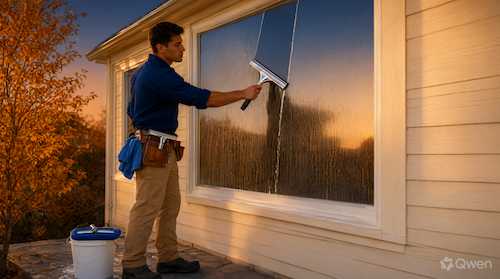
Baltimore's housing is unusually tall and narrow: only 45.4% of units are detached and 55.7% predate 1980, which in practice means rows of two- and three-storey brick facades with party walls and no gap between neighbors. That geometry decides how the work is done — every elevation above the ground floor is reached from the front or the back, never from the side — and the brick itself is the other factor, because rain carries mortar and soot dust out of the masonry and down onto sills and glass.
Rowhouse geometry and where a ladder can go
In a continuous row there is no side elevation and no side access, so upper glass is reached from the front pavement or through the house to the rear yard. Narrow frontages and bay windows change the reach, and a neighboring property's condition can affect where equipment may stand. Ask how the upper floors are reached at your address specifically, not in general.
Run-off from brick and mortar
Older Baltimore brickwork sheds mortar dust and accumulated soot whenever it rains, and that material lands on the sills and glass directly below. A window cleaned on a dry week can be dirty again after the next storm, and no cleaning method fixes the source above it. Ask whether the contractor accounts for run-off when quoting a first visit.
Harbor humidity and shaded growth
The Patapsco keeps the air damp, and narrow streets between tall rows mean much of the glass is in shade for most of the day. Damp shaded surfaces are where algae and mildew establish on frames and in tracks. Glass-only cleaning leaves that in place. Ask whether frames, sills and tracks are in scope.
Old sashes and painted shut
More than half the stock predates 1980, and original wood sashes with many coats of paint are normal — often painted shut, with putty that has been failing for years. Soaking a frame in that condition does damage, and forcing a painted sash open is not a cleaning task. Ask how the contractor handles loose putty and whether paint removal is in scope at all.
Street grit and the dry wipe
Between traffic, road wear and winter grit, the lower panes collect abrasive material, and wiping it dry drags it across the glass. That is how scratches appear on windows that were only grimy. Ask whether the glass is flushed before anything is wiped, especially on the ground floor.
What to pin down in the estimate
Where this page stops
No prices are quoted and no property is assessed here. Rot, failed putty, lead paint and brickwork condition are findings that need inspection, and masonry repair belongs to a different trade.
Baltimore metro context
The 2024 ACS 5-year estimates describe about 2.85 million residents in 1,120,269 households and 1,201,675 housing units, with 66.9% owner-occupied and 45.4% single-family detached. About 55.7% of units predate 1980. No climate station is reported for this metro in the site dataset, so no temperature or precipitation normals appear on this page.
Baltimore housing indicators
| Indicator | Value | Source |
|---|---|---|
| Housing units built before 1980 | 55.7% | U.S. Census Bureau |
| Single-family detached share | 45.4% | U.S. Census Bureau |
| Owner-occupied share | 66.9% | U.S. Census Bureau |
| Metro households | 1,120,269 | U.S. Census Bureau |
| Housing units | 1,201,675 | U.S. Census Bureau |
| Metro population | 2,849,436 | U.S. Census Bureau |
Station normals are historical averages for one location, not a forecast. Glass condition depends on how often the surface is wetted and what the water carries.
Frequently Asked Questions
Why are my sills dirty again a week after cleaning?
Run-off from the brickwork above carries mortar dust and soot down onto the sill. The window is clean; the wall is not.
How do you reach the top floor of a rowhouse?
From the front pavement or through to the rear yard, because there is no side elevation. The method depends on the reach and on where equipment can safely stand.
Can painted-shut windows be opened during cleaning?
That is a repair rather than a cleaning task, and forcing an old sash can crack glass or split the frame. It should be raised before the visit.
Why does the shaded side grow algae?
Narrow streets keep that glass out of the sun, and damp shade is where growth establishes on frames and in tracks.
Is older glass easy to scratch?
It scratches if abrasive grit is wiped dry. Flushing first is what separates cleaning from sanding.
What about lead paint on old sashes?
On pre-1978 windows it is a lead-safety question rather than a cleaning one, and it needs a contractor working to the right practice.
Sources and review date
- American Community Survey 2024 5-year estimates (CBSA tables) — U.S. Census Bureau, 2024 ACS 5-year estimates.
Reviewed on 2026-11-18.