
Los Angeles, CA · metro guide
Window Cleaning in Los Angeles: Basin Film, Hillside Access and Old Glass
A film that is not dust and not salt, on the largest stock of pre-1980 glass in the state.
Metro snapshot
Los Angeles in numbers
Sources named below each block
- Population
- 13.0M
- Households
- 4.5M
- Housing units
- 4.8M
- People / household
- 2.88
- population ÷ households
Owner-occupied homes 48%
The rest are rented. Owners are the ones who commission most exterior work.
Single-family detached 48%
Detached houses carry their own roof, gutters and exterior walls.
Built before 1980 67%
Older housing stock shapes what fails first: gutters, flashing, pipe material.
Season
The year in Los Angeles
- Precipitation
- 14.2 in
- Snowfall
- —
Average temperature by month, °F — the shape of the year is what decides when exterior work gets done.
Precipitation by month, inches.
| Month | Average temperature (°F) | Precipitation (in) | Snowfall (in) |
|---|---|---|---|
| January | 58.4°F | 3.29 in | — |
| February | 59.0°F | 3.64 in | — |
| March | 61.1°F | 2.23 in | — |
| April | 63.6°F | 0.69 in | — |
| May | 65.9°F | 0.32 in | — |
| June | 69.3°F | 0.09 in | — |
| July | 73.3°F | 0.02 in | — |
| August | 74.7°F | 0.00 in | — |
| September | 73.6°F | 0.13 in | — |
| October | 69.3°F | 0.58 in | — |
| November | 63.0°F | 0.78 in | — |
| December | 57.8°F | 2.48 in | — |
NOAA 1991–2020 climate normals, station LOS ANGELES DWTN USC CAMPUS, CA US (USW00093134). Station observations, not a metro-wide average — a metro that spans a mountain range can differ by more than this record shows.
Population, households and housing shares: U.S. Census Bureau, American Community Survey 2024 5-year estimates, metropolitan statistical area.
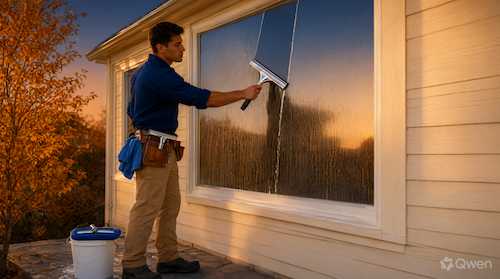
Los Angeles gets 14.2 inches of rain and a July mean of 73.3°F, and its glass problem is largely airborne: a fine film from traffic, construction and the basin's trapped air settles on every surface and is only removed when someone removes it. Two-thirds of the housing — 67.1% — predates 1980, so a lot of the glass is original single glazing in aluminum sliders, and much of the metro is built on hillsides and canyon rims where access decides the method.
Basin film is not dust and not salt
The characteriztic Los Angeles deposit is a fine gray-brown film from vehicle and construction emissions that settles evenly and holds moisture against the glass. It is not removed by rain and not removed by water alone, so a clean that only rinses will leave it in place. Ask what the contractor uses on the film specifically and how they judge whether it is gone.
Coastal strip versus inland basin
Long Beach and the coastal edge get salt on top of the film, which attacks frames and fixings, while inland neighborhoods see almost none. The same city can need two different intervals. Ask which zone the property is in and whether frames are being rinsed of salt rather than only the glass.
Hillsides, canyons and rear elevations
The metro is full of houses where the rear sits far above or below the street, and where a ladder has no safe footing. Water-fed poles from the ground handle most of it, but the access has to be assessed per elevation. Ask how each side is reached and whether the quote assumed only the front.
Original single glazing and aluminum sliders
With 67.1% of the stock predating 1980, original single glazing in aluminum frames and sliders is the norm, and decades of cleaning have left many panes lightly etched and quick to show spotting. Also expect painted shut and worn seals. Ask whether the final rinse is purified and whether frames are part of the scope.
Drought rules and water use
Restrictions on outdoor water use are a normal part of operating here, and some methods use far more water than others. Water-fed pole work and purified rinse systems use less than hose-and-bucket methods. Ask how much water the job involves and whether the method is compliant with current restrictions.
What to pin down in the estimate
Where this page stops
No prices are quoted and no property is assessed here. Etched glass, failed seals and hillside access are property-level findings that need inspection.
Los Angeles metro context
The 2024 ACS 5-year estimates describe about 12.97 million residents in 4,499,409 households and 4,796,635 housing units, with 48.4% owner-occupied and 47.8% single-family detached. About 67.1% of units predate 1980. At the Los Angeles Dwtn Usc Campus reference station January averages 58.4°F and July 73.3°F, on 14.2 inches of annual precipitation.
Los Angeles reference station and housing indicators
| Indicator | Value | Source |
|---|---|---|
| January mean temperature | 58.4°F | NOAA NCEI |
| July mean temperature | 73.3°F | NOAA NCEI |
| Annual precipitation | 14.2 in. | NOAA NCEI |
| Metro population | 12,974,487 | U.S. Census Bureau |
| Owner-occupied share | 48.4% | U.S. Census Bureau |
| Housing units built before 1980 | 67.1% | U.S. Census Bureau |
Station normals are historical averages for one location, not a forecast. Glass condition depends on how often the surface is wetted and what the water carries.
Frequently Asked Questions
Why does the glass go gray again so fast?
The basin film settles continuously and nothing washes it off. It is a fresh deposit rather than a failure of the last clean.
Does rain clean the windows here?
No. 14.2 inches a year is not enough, and what falls carries whatever was on the surface.
Why do older windows spot so easily?
Decades of cleaning leave single glazing lightly etched, and a mineral film shows up on a roughened surface far more than on new glass.
Can hillside windows be reached safely?
Usually from the ground with a water-fed pole, because a ladder may have no footing on a slope. It has to be assessed per elevation.
Is water use restricted?
Outdoor use is commonly restricted, and pole and purified-rinse methods use far less than hose-and-bucket work. Confirm the method before the visit.
How often should windows be cleaned in Los Angeles?
Set by how fast the film returns on your street. A busy road facing is a very different interval from a quiet hillside.
Sources and review date
- American Community Survey 2024 5-year estimates (CBSA tables) — U.S. Census Bureau, 2024 ACS 5-year estimates.
- 1991–2020 station normals — LOS ANGELES DWTN USC CAMPUS, CA US (USW00093134) — NOAA National Centers for Environmental Information, 1991–2020 climate normals.
Reviewed on 2026-11-18.
Other Home Services in Los Angeles-Long Beach-Anaheim
All guides for the Los Angeles-Long Beach-Anaheim metro area