
Riverside, CA · metro guide
Window Cleaning in Riverside: Santa Ana Winds, Hard Water and Desert Sun
Nine inches of rain, wind that arrives from the desert, and water hard enough to leave a permanent mark.
Metro snapshot
Riverside in numbers
Sources named below each block
- Population
- 4.7M
- Households
- 1.5M
- Housing units
- 1.6M
- People / household
- 3.22
- population ÷ households
Owner-occupied homes 66%
The rest are rented. Owners are the ones who commission most exterior work.
Single-family detached 69%
Detached houses carry their own roof, gutters and exterior walls.
Built before 1980 36%
Older housing stock shapes what fails first: gutters, flashing, pipe material.
Season
The year in Riverside
- Precipitation
- 9.4 in
- Snowfall
- —
Average temperature by month, °F — the shape of the year is what decides when exterior work gets done.
Precipitation by month, inches.
| Month | Average temperature (°F) | Precipitation (in) | Snowfall (in) |
|---|---|---|---|
| January | 55.6°F | 2.29 in | — |
| February | 56.3°F | 2.41 in | — |
| March | 59.5°F | 1.21 in | — |
| April | 62.9°F | 0.59 in | — |
| May | 67.6°F | 0.20 in | — |
| June | 73.0°F | 0.01 in | — |
| July | 78.6°F | 0.12 in | — |
| August | 79.8°F | 0.02 in | — |
| September | 76.6°F | 0.11 in | — |
| October | 68.9°F | 0.33 in | — |
| November | 61.0°F | 0.57 in | — |
| December | 54.8°F | 1.51 in | — |
NOAA 1991–2020 climate normals, station RIVERSIDE MUNI AP, CA US (USW00003171). Station observations, not a metro-wide average — a metro that spans a mountain range can differ by more than this record shows.
Population, households and housing shares: U.S. Census Bureau, American Community Survey 2024 5-year estimates, metropolitan statistical area.
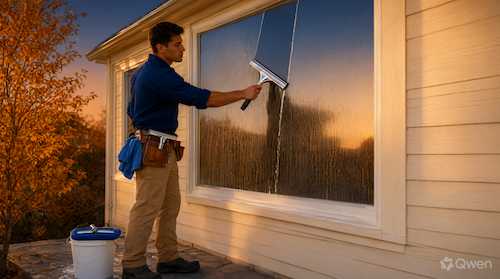
The Inland Empire gets 9.4 inches of rain a year and a January mean of 55.6°F, with July at 78.6°F and almost no summer rain at all — 0.12 inches in July. Nothing rinses the glass, and twice a year the Santa Ana winds push desert air and dust through the valleys at speed. That makes the film on the glass a wind-deposited one, and the hard local water makes every sprinkler cycle a deposit rather than a rinse. Only 36.2% of the housing predates 1980, so the stock is largely newer and coated.
Santa Ana winds and desert dust
The Santa Anas arrive from the interior, hot and dry, and carry fine desert dust through the valleys. It arrives in a day and settles on every windward surface, and it is abrasive once it is on a pane. Ask which elevations catch it and how the glass is flushed before anything is wiped.
Nine inches of rain and no rinsing
Rain is too sparse to clean anything and much of it arrives in a few winter storms, which means the glass goes months without a rinse. The dust accumulates in layers rather than being reset. Ask how the interval is set for a house that gets no weather assistance.
Very hard water and irrigation scale
Local water is hard, and irrigation runs constantly in this climate. Overspray dries on glass and deposits minerals at the same spot every cycle, which is how a cleanable film becomes permanent etching. Ask whether heads can be adjusted and whether the final rinse is purified water.
Inland heat and drying speed
With July averaging 78.6°F and glass in direct sun much hotter, solution dries before it can be worked, and coated glass is both common here and sensitive to abrasives and ammonia. Ask how the elevations are sequenced through the day.
New-build dust in a growing corridor
The corridor keeps building, and graded desert ground produces a fine pale dust that lifts with any wind. In a new subdivision that is continuous for a season or two. Ask where the nearest active site is.
What to pin down in the estimate
Where this page stops
No prices are quoted and no property is assessed here. Etched glass, coating damage and irrigation layout are property-level matters that need inspection or a specializt.
Riverside metro context
The 2024 ACS 5-year estimates describe about 4.68 million residents in 1,450,250 households and 1,613,300 housing units, with 65.8% owner-occupied and 69.2% single-family detached. About 36.2% of units predate 1980. At the Riverside Muni Ap reference station January averages 55.6°F and July 78.6°F, on 9.4 inches of annual precipitation.
Riverside reference station and housing indicators
| Indicator | Value | Source |
|---|---|---|
| January mean temperature | 55.6°F | NOAA NCEI |
| July mean temperature | 78.6°F | NOAA NCEI |
| Annual precipitation | 9.4 in. | NOAA NCEI |
| Metro population | 4,675,704 | U.S. Census Bureau |
| Owner-occupied share | 65.8% | U.S. Census Bureau |
| Housing units built before 1980 | 36.2% | U.S. Census Bureau |
Station normals are historical averages for one location, not a forecast. Glass condition depends on how often the surface is wetted and what the water carries.
Frequently Asked Questions
Why does the glass go gray again within weeks?
Wind-deposited dust and no rain to rinse it. The interval here is set by wind events rather than by the season.
Can sprinkler marks be removed?
Fresh deposits usually can. Deposits baked on across seasons may have etched the glass, and that cannot be reversed.
What are the Santa Ana winds?
Hot, dry winds from the interior that carry desert dust through the valleys. They coat the windward elevations in a day.
Is cleaning safe for coated windows?
With the coating in mind. Abrasives and ammonia can damage a soft low-emissivity coating permanently.
Does rain help at all here?
Barely. Nine inches a year is not enough to rinse a surface, and much of it falls in a few winter storms.
How often should windows be cleaned in the Inland Empire?
As often as the dust returns on your street. For a windward elevation that is more often than most homeowners expect.
Sources and review date
- American Community Survey 2024 5-year estimates (CBSA tables) — U.S. Census Bureau, 2024 ACS 5-year estimates.
- 1991–2020 station normals — RIVERSIDE MUNI AP, CA US (USW00003171) — NOAA National Centers for Environmental Information, 1991–2020 climate normals.
Reviewed on 2026-11-18.
Other Home Services in Riverside–San Bernardino–Ontario
All guides for the Riverside–San Bernardino–Ontario metro area