
San Francisco, CA · metro guide
Window Cleaning in San Francisco: Fog, Hillside Access and Victorian Sashes
The lowest ownership rate of any metro here, on the steepest terrain, with fog that never quite dries.
Metro snapshot
San Francisco in numbers
Sources named below each block
- Population
- 4.6M
- Households
- 1.7M
- Housing units
- 1.9M
- People / household
- 2.66
- population ÷ households
Owner-occupied homes 56%
The rest are rented. Owners are the ones who commission most exterior work.
Single-family detached 49%
Detached houses carry their own roof, gutters and exterior walls.
Built before 1980 67%
Older housing stock shapes what fails first: gutters, flashing, pipe material.
Season
The year in San Francisco
- Precipitation
- 19.6 in
- Snowfall
- —
Average temperature by month, °F — the shape of the year is what decides when exterior work gets done.
Precipitation by month, inches.
| Month | Average temperature (°F) | Precipitation (in) | Snowfall (in) |
|---|---|---|---|
| January | 51.3°F | 3.89 in | — |
| February | 53.5°F | 3.96 in | — |
| March | 55.5°F | 2.73 in | — |
| April | 57.3°F | 1.36 in | — |
| May | 59.9°F | 0.48 in | — |
| June | 62.5°F | 0.14 in | — |
| July | 64.0°F | 0.00 in | — |
| August | 64.9°F | 0.04 in | — |
| September | 65.3°F | 0.07 in | — |
| October | 62.9°F | 0.79 in | — |
| November | 56.4°F | 2.04 in | — |
| December | 51.4°F | 4.14 in | — |
NOAA 1991–2020 climate normals, station SAN FRANCISCO INTL AP, CA US (USW00023234). Station observations, not a metro-wide average — a metro that spans a mountain range can differ by more than this record shows.
Population, households and housing shares: U.S. Census Bureau, American Community Survey 2024 5-year estimates, metropolitan statistical area.
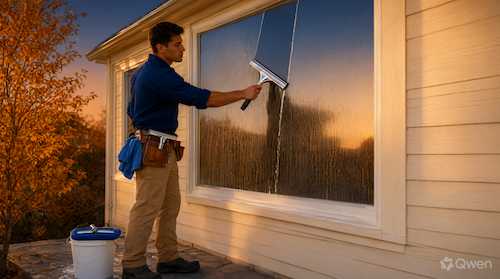
San Francisco has the lowest owner-occupancy in this set at 55.5% and 66.7% of its housing built before 1980, so the work is mostly done on old buildings where the occupant is not the owner and the exterior wall may not be the unit's responsibility. Marine fog is the defining condition: it condenses on cool glass overnight, evaporates in the morning and leaves whatever the air carried, and shaded north-facing glass may barely dry at all. The terrain does the rest — many rear elevations are reached over a neighbor's roof or from a stair that is not on the street.
Fog condensation and the marks it leaves
Marine air condenses on cool glass overnight and evaporates the next morning, depositing whatever it carried. On shaded glass that cycle repeats daily, which is why north-facing windows haze even though they never get dirty in the ordinary sense. Ask whether frames and tracks are included, because that is where the growth lives.
Hills, stairs and rear elevations
Much of the housing sits on slopes where the rear of the building is far above or below the street, reached by stairs, over a garage roof or through a neighbor's property. Ladder work is often impossible and pole work from the ground is the practical answer. Ask how each elevation is reached and whether access needs anyone else's permission.
Salt air and metal
Coastal fog carries salt, and it holds moisture against frames, hardware and metal windows. Corrosion appears before the glass looks bad. Ask whether frames and hardware are rinsed as well as the panes.
Victorian sashes and lead paint
With two-thirds of the stock predating 1980, double-hung wood sashes, many with old putty and many painted long after 1978 but built long before it, are standard. Those frames do not tolerate being soaked or scraped. Ask how the contractor handles soft wood and flaking paint.
Rentals, approvals and who pays
With 55.5% owner-occupancy, a lot of the glass belongs to a landlord, and in a multi-unit building the exterior may be the building's responsibility rather than the tenant's or even the owner's. Ask who authorizes the work and whether interior and exterior are priced separately, because they usually are.
What to pin down in the estimate
Where this page stops
No prices are quoted and no property is assessed here. Rot, lead paint, hillside access and building responsibility are matters that need inspection or written agreement.
San Francisco metro context
The 2024 ACS 5-year estimates describe about 4.65 million residents in 1,744,070 households and 1,880,374 housing units, with 55.5% owner-occupied and 48.9% single-family detached. About 66.7% of units predate 1980. No climate station is reported for this metro in the site dataset, so no temperature or precipitation normals appear on this page.
San Francisco housing indicators
| Indicator | Value | Source |
|---|---|---|
| Housing units built before 1980 | 66.7% | U.S. Census Bureau |
| Single-family detached share | 48.9% | U.S. Census Bureau |
| Owner-occupied share | 55.5% | U.S. Census Bureau |
| Metro households | 1,744,070 | U.S. Census Bureau |
| Housing units | 1,880,374 | U.S. Census Bureau |
| Metro population | 4,645,029 | U.S. Census Bureau |
Station normals are historical averages for one location, not a forecast. Glass condition depends on how often the surface is wetted and what the water carries.
Frequently Asked Questions
Why does north-facing glass haze over?
Fog condenses on it and barely dries, so each cycle leaves a little more behind. It is a different problem from ordinary dirt.
How do you clean windows on a steep lot?
Usually from the ground with a pole, because a ladder may have no safe footing. Each elevation has to be assessed separately.
Can you clean one unit in a building?
Yes, but the access is external and the exterior may be the building's responsibility. Confirm who is authorizing the work.
Is salt a problem if I am not on the water?
Less than on the coast, but fog carries it inland and uphill, and metal frames show it first.
Is cleaning safe for old wooden sashes?
Only without soaking or scraping. Soft wood and flaking putty are repair questions rather than cleaning ones.
Do I have to be there?
Exterior work can often be done with agreed access. Interior work needs someone present to clear sills and floors.
Sources and review date
- American Community Survey 2024 5-year estimates (CBSA tables) — U.S. Census Bureau, 2024 ACS 5-year estimates.
Reviewed on 2026-11-18.