
Fresno, CA · metro guide
Window Cleaning in Fresno: Farm Dust, Heat and Hard Water
A valley floor ringed by mountains: dust settles in, heat bakes it on, and the water leaves its own marks.
Metro snapshot
Fresno in numbers
Sources named below each block
- Population
- 1.2M
- Households
- 370K
- Housing units
- 396K
- People / household
- 3.18
- population ÷ households
Owner-occupied homes 57%
The rest are rented. Owners are the ones who commission most exterior work.
Single-family detached 69%
Detached houses carry their own roof, gutters and exterior walls.
Built before 1980 46%
Older housing stock shapes what fails first: gutters, flashing, pipe material.
Season
The year in Fresno
- Precipitation
- 11 in
- Snowfall
- 0 in
Average temperature by month, °F — the shape of the year is what decides when exterior work gets done.
Precipitation by month, inches.
| Month | Average temperature (°F) | Precipitation (in) | Snowfall (in) |
|---|---|---|---|
| January | 48.0°F | 2.16 in | 0.0 in |
| February | 52.3°F | 1.93 in | 0.0 in |
| March | 57.4°F | 1.90 in | 0.0 in |
| April | 62.3°F | 1.04 in | 0.0 in |
| May | 70.2°F | 0.42 in | 0.0 in |
| June | 77.6°F | 0.24 in | 0.0 in |
| July | 83.5°F | 0.03 in | 0.0 in |
| August | 82.2°F | 0.00 in | 0.0 in |
| September | 77.1°F | 0.05 in | 0.0 in |
| October | 66.7°F | 0.56 in | 0.0 in |
| November | 55.1°F | 0.87 in | 0.0 in |
| December | 47.5°F | 1.79 in | 0.0 in |
NOAA 1991–2020 climate normals, station FRESNO YOSEMITE INTL AP, CA US (USW00093193). Station observations, not a metro-wide average — a metro that spans a mountain range can differ by more than this record shows.
Population, households and housing shares: U.S. Census Bureau, American Community Survey 2024 5-year estimates, metropolitan statistical area.
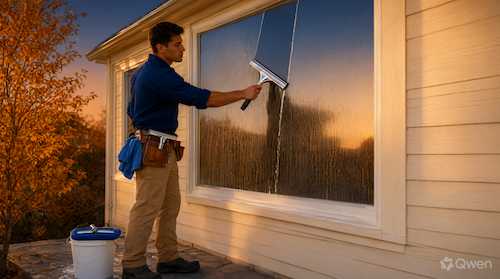
Fresno sits in a valley that traps what the air carries. Agricultural dust from surrounding fields, soil from construction and the film that comes with valley air all settle on glass and stay there, because rain is sparse and the summer heat dries any moisture almost immediately. Nearly half of the housing predates 1980 — 46.0% — so a large share of the glass is original single glazing in older frames, which is more forgiving of method than a modern coated unit but far less forgiving of a dry wipe.
Valley dust does not leave on its own
The surrounding land is farmed and worked, and the valley holds what becomes airborne. That produces an even film that darkens gradually, and because rainfall is low nothing rinses it off. The glass is only cleaned when someone cleans it, so the interval here is set by what accumulates rather than by the calendar.
Heat that bakes deposits on
Summer temperatures in the valley are extreme and glass in direct sun is hotter still. Anything on the surface — dust, pollen, sprinkler minerals — dries and bonds rather than rinsing away, which is why a film that would wash off elsewhere needs real removal here. Ask how the work is sequenced around the sun.
Hard water and irrigation
Water in the valley carries minerals, and both agricultural and residential irrigation throws it onto glass regularly. The deposits that result are the main reason windows end up permanently marked rather than merely dirty. Ask whether the final rinse uses purified water and whether irrigation heads can be moved away from the house.
Abrasive grit and the dry wipe
Dust here includes soil particles, and wiping a dry pane drags them across the glass. That is how scratches appear on windows that were only dusty to begin with. Ask whether the glass is flushed before anything is wiped, because that single step separates cleaning from sanding.
Smoke season and the summer film
Late summer brings smoke from surrounding wildland and agricultural burning, which settles as a fine film and combines with dust. It is not dirt that rinses off, and it arrives exactly when the heat makes the glass hardest to work. Ask how the contractor handles a smoked film and whether the visit should wait until the air clears.
What to pin down in the estimate
Where this page stops
No prices are quoted and no property is assessed here. Etched glass, failed seals and coating damage are findings that require inspection at the window.
Fresno metro context
The 2024 ACS 5-year estimates describe about 1.18 million residents in 370,081 households and 395,909 housing units, with 57.0% owner-occupied and 69.1% single-family detached. About 46.0% of units predate 1980. No climate station is reported for this metro in the site dataset, so no temperature or precipitation normals appear on this page.
Fresno housing indicators
| Indicator | Value | Source |
|---|---|---|
| Housing units built before 1980 | 46.0% | U.S. Census Bureau |
| Single-family detached share | 69.1% | U.S. Census Bureau |
| Owner-occupied share | 57.0% | U.S. Census Bureau |
| Metro households | 370,081 | U.S. Census Bureau |
| Housing units | 395,909 | U.S. Census Bureau |
| Metro population | 1,177,665 | U.S. Census Bureau |
Station normals are historical averages for one location, not a forecast. Glass condition depends on how often the surface is wetted and what the water carries.
Frequently Asked Questions
Why does dust stay on the glass for months?
Because very little rain falls and the heat dries moisture quickly. Nothing rinses the glass between visits, so accumulation is continuous.
Can the marks from irrigation be removed?
Fresh mineral deposits usually respond to the right cleaner. Deposits baked on across seasons may have etched the glass, and that cannot be reversed.
Why do windows get worse in summer?
Heat bakes whatever is on the surface onto it. The same deposit that would rinse off in a wet climate bonds to the glass here.
Is old single glazing easier to clean?
It tolerates more than a modern coated unit, but it scratches if abrasive grit is wiped dry. Flushing first matters on both.
How often should windows be cleaned here?
Often enough that the film never gets the chance to bake on. Look at the glass after a month and set the interval from what you see.
Does smoke season affect the schedule?
It can. A smoked film arrives when the heat makes the glass hardest to work, and it is often better to wait for clearer air than to clean into it.
Sources and review date
- American Community Survey 2024 5-year estimates (CBSA tables) — U.S. Census Bureau, 2024 ACS 5-year estimates.
Reviewed on 2026-11-18.