
Dallas, TX · metro guide
Window Cleaning in Dallas: Clay Dust, Hail and Hard Afternoon Sun
A fast-growing metro built on clay: the dust is red, the sun is hard, and hail is a normal annual event.
Metro snapshot
Dallas in numbers
Sources named below each block
- Population
- 8.0M
- Households
- 2.9M
- Housing units
- 3.1M
- People / household
- 2.76
- population ÷ households
Owner-occupied homes 60%
The rest are rented. Owners are the ones who commission most exterior work.
Single-family detached 63%
Detached houses carry their own roof, gutters and exterior walls.
Built before 1980 30%
Older housing stock shapes what fails first: gutters, flashing, pipe material.
Season
The year in Dallas
- Precipitation
- 37 in
- Snowfall
- 1.6 in
Average temperature by month, °F — the shape of the year is what decides when exterior work gets done.
Precipitation by month, inches.
Snowfall by month, inches.
| Month | Average temperature (°F) | Precipitation (in) | Snowfall (in) |
|---|---|---|---|
| January | 46.3°F | 2.53 in | 0.1 in |
| February | 50.5°F | 2.76 in | 1.0 in |
| March | 58.2°F | 3.30 in | 0.3 in |
| April | 65.6°F | 3.22 in | 0.0 in |
| May | 74.0°F | 4.78 in | 0.0 in |
| June | 81.9°F | 3.70 in | 0.0 in |
| July | 85.7°F | 2.08 in | 0.0 in |
| August | 85.7°F | 2.18 in | 0.0 in |
| September | 78.5°F | 2.72 in | 0.0 in |
| October | 67.7°F | 4.37 in | 0.0 in |
| November | 56.4°F | 2.53 in | 0.0 in |
| December | 48.1°F | 2.84 in | 0.2 in |
NOAA 1991–2020 climate normals, station DALLAS FT WORTH AP, TX US (USW00003927). Station observations, not a metro-wide average — a metro that spans a mountain range can differ by more than this record shows.
Population, households and housing shares: U.S. Census Bureau, American Community Survey 2024 5-year estimates, metropolitan statistical area.
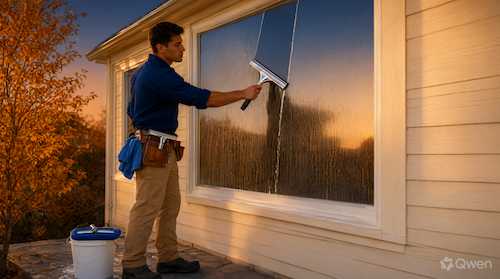
Dallas–Fort Worth has 37.0 inches of rain and a July mean of 85.7°F, but the condition of the glass is decided by two things the weather figures do not show: the clay soil that turns to airborne dust wherever ground is broken, and the hail that arrives most years. Only 29.8% of the housing predates 1980, so much of the glass is modern and coated, in subdivisions where construction dust is a continuous presence rather than an occasional event.
Red clay dust is the default film
North Texas clay is fine when it dries and lifts easily on wind, and the metro is building continuously, so there is always disturbed ground nearby. The film it leaves is reddish and even, and on glass it can bake into a haze in the sun. Ask where the dust comes from on your street — a site, a field or a stockpile — because that decides whether the interval can be long.
Hail, screens and pre-existing damage
Hail is a recurring event here rather than an exception, and it damages window screens and can pit older glass. Cleaning before the season leaves the glass clean and the pitting attributable; cleaning after means the evidence may be gone. Ask the contractor to record screen and glass condition before work starts, particularly in spring.
Heat and the drying race
At 85.7°F in July a west-facing wall can be hot enough that solution evaporates before it is squeegeed off, which is the source of most streaking complaints on otherwise competent work. Ask how the elevations are sequenced through the day, because the answer determines whether the finish is even.
Mineral water and sprinkler spotting
Water here carries dissolved minerals, and automatic irrigation that overshoots onto windows leaves deposits on every cycle. Over a season those deposits can etch the surface, which no cleaning then reverses. Ask whether heads can be adjusted before the next visit, and whether the final rinse uses purified water.
Trees, shade and the damp side
Mature oak and pecan canopies keep the north and east elevations shaded and slower to dry, so those faces collect pollen, sap and biological growth while the sunny faces stay comparatively clean. Ask which elevations are shaded and whether frames and tracks are in scope, because that is where growth establishes.
What to pin down in the estimate
Where this page stops
No prices are quoted and no property is assessed here. Hail damage, failed seals and coating degradation are property-level findings that need inspection, and insurance questions belong to the insurer.
Dallas metro context
The 2024 ACS 5-year estimates describe about 7.99 million residents in 2,891,725 households and 3,096,731 housing units, with 60.1% owner-occupied and 62.6% single-family detached. About 29.8% of units predate 1980. At the Dallas Ft Worth Ap reference station January averages 46.3°F and July 85.7°F, on 37.0 inches of annual precipitation.
Dallas reference station and housing indicators
| Indicator | Value | Source |
|---|---|---|
| January mean temperature | 46.3°F | NOAA NCEI |
| July mean temperature | 85.7°F | NOAA NCEI |
| Annual precipitation | 37.0 in. | NOAA NCEI |
| Metro population | 7,985,590 | U.S. Census Bureau |
| Owner-occupied share | 60.1% | U.S. Census Bureau |
| Housing units built before 1980 | 29.8% | U.S. Census Bureau |
Station normals are historical averages for one location, not a forecast. Glass condition depends on how often the surface is wetted and what the water carries.
Frequently Asked Questions
Why is everything covered in red dust?
Because the soil is clay and the metro is growing. Wherever ground is broken, fine clay lifts and settles, and on glass it forms an even film that the sun can bake into a haze.
Do screens protect windows from hail?
Partly, and they take the damage themselves. A torn screen should be recorded before cleaning so it is not attributed to the visit.
Why do my west windows streak when others do not?
Afternoon sun on a west wall dries the solution before it can be removed. It is a sequencing problem, and the fix is working those elevations at a different time of day.
Can sprinkler spots be removed?
Fresh deposits usually can. Deposits that have baked on across seasons may have etched the glass, and that mark cannot be cleaned out.
How often should windows be cleaned in a new subdivision?
More often while construction continues nearby. Once the ground around the house is landscaped and stable, the interval usually lengthens.
Is cleaning safe for newer coated glass?
It has to be done with the coating in mind. Abrasives and ammonia can permanently damage a soft coating, so the chemistry should be chosen for modern glazing.
Sources and review date
- American Community Survey 2024 5-year estimates (CBSA tables) — U.S. Census Bureau, 2024 ACS 5-year estimates.
- 1991–2020 station normals — DALLAS FT WORTH AP, TX US (USW00003927) — NOAA National Centers for Environmental Information, 1991–2020 climate normals.
Reviewed on 2026-11-18.