
Houston, TX · metro guide
Window Cleaning in Houston: 51.8 Inches of Rain, Mold and Gulf Humidity
The wettest large metro in the country, where the problem is rarely dust and almost always growth.
Metro snapshot
Houston in numbers
Sources named below each block
- Population
- 7.4M
- Households
- 2.7M
- Housing units
- 2.9M
- People / household
- 2.80
- population ÷ households
Owner-occupied homes 61%
The rest are rented. Owners are the ones who commission most exterior work.
Single-family detached 62%
Detached houses carry their own roof, gutters and exterior walls.
Built before 1980 32%
Older housing stock shapes what fails first: gutters, flashing, pipe material.
Season
The year in Houston
- Precipitation
- 51.8 in
- Snowfall
- 0.1 in
Average temperature by month, °F — the shape of the year is what decides when exterior work gets done.
Precipitation by month, inches.
Snowfall by month, inches.
| Month | Average temperature (°F) | Precipitation (in) | Snowfall (in) |
|---|---|---|---|
| January | 53.8°F | 3.76 in | 0.0 in |
| February | 57.7°F | 2.97 in | 0.0 in |
| March | 63.8°F | 3.47 in | 0.0 in |
| April | 70.0°F | 3.95 in | 0.0 in |
| May | 77.4°F | 5.01 in | 0.0 in |
| June | 83.0°F | 6.00 in | 0.0 in |
| July | 85.1°F | 3.77 in | 0.0 in |
| August | 85.2°F | 4.84 in | 0.0 in |
| September | 80.5°F | 4.71 in | 0.0 in |
| October | 71.8°F | 5.46 in | 0.0 in |
| November | 62.0°F | 3.87 in | 0.0 in |
| December | 55.4°F | 4.03 in | 0.1 in |
NOAA 1991–2020 climate normals, station HOUSTON INTERCONT AP, TX US (USW00012960). Station observations, not a metro-wide average — a metro that spans a mountain range can differ by more than this record shows.
Population, households and housing shares: U.S. Census Bureau, American Community Survey 2024 5-year estimates, metropolitan statistical area.
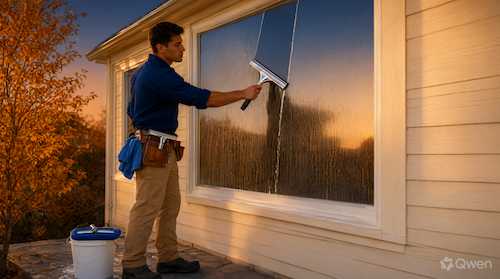
Houston gets 51.8 inches of rain, 3.92 of them in June alone, and a July mean of 85.1°F. That is a climate for growth: algae and mold establish on frames, tracks and north-facing glass, and the humidity keeps surfaces damp long enough that cleaning one side of the house can leave the other already colonized. The metro's stock is overwhelmingly suburban and recent — 63.0% detached, only 22.3% predating 1980 — so the glass is largely modern and coated, sitting under a canopy that stays wet.
Algae and mold are the main event
With this much rain and this much humidity, the growth appears on frames, sills and tracks rather than only on the glass, and on the north elevation where the sun does not dry it. Wiping glass over growth leaves the source in place and the growth returns within weeks. Ask whether frames, tracks and sills are in scope and whether a treatment is included, because glass-only cleaning is the wrong product here.
Rain that redistributes rather than cleans
With 51.8 inches a year, showers are frequent, but each one carries whatever was on the surface and the heat dries it in place. That is why glass here can look worse after a wet spell. Ask how the contractor handles the film rather than relying on rain to remove it.
Soaked ground and long drying times
Water on glass and ladders takes far longer to dry in a Gulf summer, and residual moisture in a track is what starts the next round of growth. Ask whether the tracks are dried rather than merely rinsed, because that single step determines how long the clean lasts.
Hurricane season and pre-storm clean
Houston sits in hurricane country, and a common request is to clean before a storm so glass is at its best if shutters go up. Storm-prep is a different priority from maintenance: exterior glass and tracks first, since that is what gets covered. Ask whether the two can be scheduled separately.
Coated glass and clay dust
Most of the housing postdates 1980, and recent windows carry low-emissivity coatings that react badly to ammonia, abrasives and dry scraping. Clay dust from the blackland soil is alkaline and sticks to damp glass, so the chemistry matters twice over. Ask whether the glass is coated before work begins.
What to pin down in the estimate
Where this page stops
No prices are quoted and no property is assessed here. Mold remediation, rot in wooden frames and coating damage are findings that need inspection, and some of them belong to a specializt rather than a window cleaner.
Houston metro context
The 2024 ACS 5-year estimates describe about 7.44 million residents in 2,661,739 households and 2,906,364 housing units, with 61.2% owner-occupied and 62.4% single-family detached. About 31.5% of units predate 1980. At the Houston Intercont Ap reference station January averages 53.8°F and July 85.1°F, on 51.8 inches of annual precipitation.
Houston reference station and housing indicators
| Indicator | Value | Source |
|---|---|---|
| January mean temperature | 53.8°F | NOAA NCEI |
| July mean temperature | 85.1°F | NOAA NCEI |
| Annual precipitation | 51.8 in. | NOAA NCEI |
| Metro population | 7,442,788 | U.S. Census Bureau |
| Owner-occupied share | 61.2% | U.S. Census Bureau |
| Housing units built before 1980 | 31.5% | U.S. Census Bureau |
Station normals are historical averages for one location, not a forecast. Glass condition depends on how often the surface is wetted and what the water carries.
Frequently Asked Questions
Why does mold come back so quickly?
Because humidity keeps surfaces damp and the growth is in the tracks and frames rather than only on the glass. Cleaning the glass alone leaves the reservoir.
Is mold on window frames a health issue?
It can be, and it is not something a window cleaner is qualified to judge. Substantial growth in a living space belongs to a remediation specializt.
Why do windows look worse after rain here?
Rain wets the film and the heat dries it in place. Frequent storms move the dirt around rather than removing it.
Should I clean before hurricane season?
Many households do, so exterior glass and tracks are at their best if shutters go up. It is a different scope from a maintenance clean.
Is cleaning safe for newer windows?
With the coating in mind. Ammonia and abrasives can damage low-emissivity glass permanently.
How often should windows be cleaned in Houston?
Often enough that growth never establishes in the tracks. In this humidity that usually means a shorter interval than in a dry climate.
Sources and review date
- American Community Survey 2024 5-year estimates (CBSA tables) — U.S. Census Bureau, 2024 ACS 5-year estimates.
- 1991–2020 station normals — HOUSTON INTERCONT AP, TX US (USW00012960) — NOAA National Centers for Environmental Information, 1991–2020 climate normals.
Reviewed on 2026-11-18.
Other Home Services in Houston–Pasadena–The Woodlands
All guides for the Houston–Pasadena–The Woodlands metro area