
Birmingham, AL · metro guide
Landscaping in Birmingham: Red Clay, Slopes and a Shaded Lawn
Red clay and hills: the two things that decide whether a Birmingham garden works or washes away.
Metro snapshot
Birmingham in numbers
Sources named below each block
- Population
- 1.2M
- Households
- 465K
- Housing units
- 526K
- People / household
- 2.55
- population ÷ households
Owner-occupied homes 71%
The rest are rented. Owners are the ones who commission most exterior work.
Single-family detached 70%
Detached houses carry their own roof, gutters and exterior walls.
Built before 1980 46%
Older housing stock shapes what fails first: gutters, flashing, pipe material.
Season
The year in Birmingham
- Precipitation
- 56.6 in
- Snowfall
- 1.4 in
Average temperature by month, °F — the shape of the year is what decides when exterior work gets done.
Precipitation by month, inches.
Snowfall by month, inches.
| Month | Average temperature (°F) | Precipitation (in) | Snowfall (in) |
|---|---|---|---|
| January | 44.7°F | 5.03 in | 0.4 in |
| February | 48.8°F | 4.95 in | 0.3 in |
| March | 56.0°F | 5.66 in | 0.5 in |
| April | 63.6°F | 5.08 in | 0.0 in |
| May | 71.5°F | 4.91 in | 0.0 in |
| June | 78.3°F | 4.78 in | 0.0 in |
| July | 81.5°F | 5.42 in | 0.0 in |
| August | 80.9°F | 4.35 in | 0.0 in |
| September | 75.6°F | 4.00 in | 0.0 in |
| October | 64.9°F | 3.34 in | 0.0 in |
| November | 54.0°F | 4.23 in | 0.0 in |
| December | 47.4°F | 4.87 in | 0.2 in |
NOAA 1991–2020 climate normals, station BIRMINGHAM AP, AL US (USW00013876). Station observations, not a metro-wide average — a metro that spans a mountain range can differ by more than this record shows.
Population, households and housing shares: U.S. Census Bureau, American Community Survey 2024 5-year estimates, metropolitan statistical area.
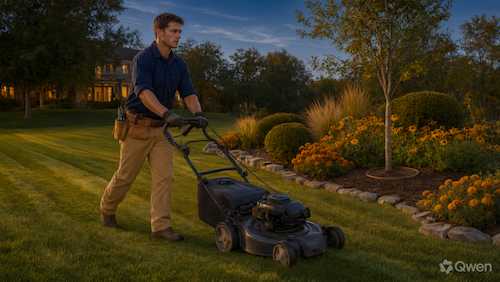
Birmingham's gardens are shaped by two features that show up on almost every property: iron-rich red clay, and a slope. The clay is sticky and heavy when wet and close to brick when dry, so it holds water where it is low and sheds it where it is steep. The hills that give the metro its neighborhoods — Red Mountain, Shades Mountain, the ridges running out toward Vestavia and Homewood — turn that into runoff, erosion and retaining walls. With 45.9% of housing predating 1980 and nearly seven in ten units single-family detached, most of this work is in established gardens under mature pines and oaks.
Red clay is a soil-engineering problem
Clay particles are small enough that water moves through them very slowly, which means a planting hole dug into them behaves like a pot with no drainage hole. Roots stay in the amended pocket, water sits in it, and the plant drowns in a wet winter then cooks in a dry August. The response is a wide prepared area rather than a deep narrow hole, planting slightly high, and mulch that keeps the surface from baking. Ask how the soil was assessed, how wide the amendment goes, and what happens to water that collects in the bed.
Slopes, runoff and retaining walls
On a hillside lot, water arrives from above and leaves fast, and the damage shows up as rills in the mulch, exposed roots and a wall that starts to lean. A retaining wall has to be designed for the water behind it as well as the soil, with drainage and backfill that let it release pressure. Ask how the wall is engineered, whether drainage is behind it, where the water discharges, and whether the work needs a permit or an engineer's input at this height.
Fescue in the shade, warm-season grass in the sun
The metro sits in the transition zone, where cool-season fescue and warm-season Bermuda and zoysia both have a claim. In practice fescue is used where there is shade, because the warm-season grasses need sun, and it then has to survive a hot summer under trees. That combination is the hardest turf situation in the region. Ask which grass is established and where, what mowing height is used, and whether the plan separates the sunny and shaded areas rather than treating the lawn as one surface.
Pines, oaks and pine straw
Pine and oak canopies produce acidic litter, deep shade and the pine straw mulch that is standard practice here. That is fine — pine straw is a reasonable mulch — but it also means the soil underneath is shaded, root-dense and often dry at depth while the surface stays damp. Planting under established pines means working around surface roots rather than cutting through them. Ask whether the canopy was assessed, how the planting avoids damaging roots, and whether the mulch is being renewed for appearance or for soil.
Irrigation on clay and slope
Watering here is a compromise: clay takes water slowly, so a short cycle runs off before it soaks in, and a slope moves it downhill before it lands where it was aimed. Short repeated cycles, drip on separate zones and a controller that adjusts with the season do more than a longer schedule on the same spray heads. Ask how the zones are split between beds, lawn and slope, whether the controller adjusts, and where the runoff ends up.
What to pin down in the design
Where this page stops
No prices are quoted and no site is assessed here. Retaining walls, grading and drainage need site inspection and, where required, an engineer or the local authority rather than a description on a page.
Birmingham metro context
The 2024 ACS 5-year estimates describe about 1.18 million residents in 465,003 households and 526,287 housing units, with 70.8% owner-occupied — the highest owner share in this dataset — and 69.7% single-family detached. About 45.9% of units predate 1980, so many gardens here are long established around mature trees. No climate station is reported for this metro in the site dataset, so no temperature or precipitation normals appear on this page.
Birmingham housing indicators
| Indicator | Value | Source |
|---|---|---|
| Housing units built before 1980 | 45.9% | U.S. Census Bureau |
| Single-family detached share | 69.7% | U.S. Census Bureau |
| Owner-occupied share | 70.8% | U.S. Census Bureau |
| Metro households | 465,003 | U.S. Census Bureau |
| Housing units | 526,287 | U.S. Census Bureau |
| Metro population | 1,184,613 | U.S. Census Bureau |
No climate normals are shown because no station record is held for this metro in the site dataset. The high owner-occupied share is the reason most of this work is a household decision made around an established garden rather than a new installation.
Frequently Asked Questions
Why do plants struggle in red clay?
Because clay holds water and roots cannot spread through it easily. A narrow amended hole becomes a bathtub, so the plant drowns in wet weather and dries out in drought. A wide bed and planting slightly high are the practical fixes.
What does a retaining wall need besides blocks and backfill?
Drainage. Water builds pressure behind a wall, and a wall built without a way to release it will lean or fail. The discharge point matters as much as the wall itself.
Should I use fescue or Bermuda?
It depends on sun and shade rather than preference. Fescue tolerates shade but struggles in summer heat; Bermuda needs sun and goes dormant in winter. Many properties end up with both, in different areas.
Is pine straw a good mulch?
It is standard practice here and works well, provided it is renewed and kept away from the foundation and from anything that should not stay damp. It also acidifies slowly, which matters for what you plant underneath.
Can I plant under mature pines?
Carefully. Pines have shallow, wide-spreading roots and compete hard for water. Working around them with small plants and mulch is possible; digging into the root plate is not.
How do I stop erosion on a slope?
By slowing the water before it concentrates: grading, a defined path for runoff, dense planting or groundcover, and where needed a structure designed for the load. Mulch alone washes away in a heavy storm.
Sources and review date
- American Community Survey 2024 5-year estimates (CBSA tables) — U.S. Census Bureau, 2024 ACS 5-year estimates.
Reviewed on 2026-11-18.