
Charlotte, NC-SC · metro guide
Gutter Cleaning in Charlotte: Pine Straw, Summer Downpours and Red Clay
Pine straw that behaves like a thatch roof, over clay that will not take the water away.
Metro snapshot
Charlotte in numbers
Sources named below each block
- Population
- 2.8M
- Households
- 1.1M
- Housing units
- 1.2M
- People / household
- 2.57
- population ÷ households
Owner-occupied homes 66%
The rest are rented. Owners are the ones who commission most exterior work.
Single-family detached 66%
Detached houses carry their own roof, gutters and exterior walls.
Built before 1980 29%
Older housing stock shapes what fails first: gutters, flashing, pipe material.
Season
The year in Charlotte
- Precipitation
- 43.6 in
- Snowfall
- 3.5 in
Average temperature by month, °F — the shape of the year is what decides when exterior work gets done.
Precipitation by month, inches.
Snowfall by month, inches.
| Month | Average temperature (°F) | Precipitation (in) | Snowfall (in) |
|---|---|---|---|
| January | 42.1°F | 3.49 in | 1.6 in |
| February | 45.7°F | 3.13 in | 1.1 in |
| March | 52.7°F | 3.95 in | 0.3 in |
| April | 61.1°F | 3.84 in | 0.0 in |
| May | 69.0°F | 3.36 in | 0.0 in |
| June | 76.6°F | 3.99 in | 0.0 in |
| July | 80.1°F | 3.74 in | 0.0 in |
| August | 78.6°F | 4.35 in | 0.0 in |
| September | 72.7°F | 3.71 in | 0.0 in |
| October | 61.9°F | 3.16 in | 0.0 in |
| November | 51.4°F | 3.31 in | 0.1 in |
| December | 44.7°F | 3.57 in | 0.4 in |
NOAA 1991–2020 climate normals, station CHARLOTTE DOUGLAS AP, NC US (USW00013881). Station observations, not a metro-wide average — a metro that spans a mountain range can differ by more than this record shows.
Population, households and housing shares: U.S. Census Bureau, American Community Survey 2024 5-year estimates, metropolitan statistical area.
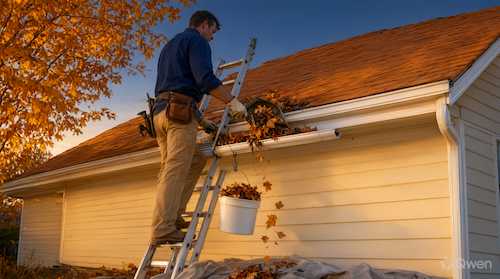
Charlotte gets 43.6 inches of rain with 3.74 of it in July, and it sits on red clay that sheds water rather than absorbing it. The debris load comes mostly from pines: loblolly and shortleaf drop straw continuously, and pine straw does not blow out of a gutter — it packs, holds water and keeps the channel wet. Only 29.1% of the housing predates 1980, so most runs are relatively modern, which shifts the problem from capacity to maintenance and discharge.
Pine straw packs instead of blowing away
Broad leaves tend to slide or blow off a roof; pine straw does the opposite. It catches on hangers and outlets, packs down and forms a mat that keeps the channel permanently damp. Ask how the contractor clears straw and whether the outlets are cleared first, because packing straw down onto a blocked outlet makes the problem worse.
Summer downpours and overflow
July alone brings 3.74 inches, usually in short heavy bursts that exceed what a partially blocked run can carry. Overflow at the fascia in a storm is the first visible symptom. Ask whether the runs are checked for capacity as well as cleared.
Red clay will not absorb the discharge
The soil here is clay, and water that leaves a downspout onto it runs rather than soaks, which is why discharge points matter more than they would on sandy ground. Ask where each downspout ends and whether the water has a path away from the house.
Algae and streaking on the fascia
The humid summers leave dark streaks on fascia and soffit wherever a run has overflowed, and the streaks are often the only evidence visible from the ground that the gutter has been failing. Ask whether the contractor reports streaking and what it means at your roofline.
Pollen and fine debris between the big events
Spring pine pollen coats the roof and washes into the runs, where it mixes with straw into a sludge that is harder to clear than either alone. That is why one clean a year often is not enough here. Ask how the interval accounts for pollen as well as leaf fall.
What to pin down in the estimate
Where this page stops
No prices are quoted and no property is assessed here. Fascia rot, soffit damage and drainage grading need inspection, and roof or siding repair belongs to another trade.
Charlotte metro context
The 2024 ACS 5-year estimates describe about 2.77 million residents in 1,076,260 households and 1,165,208 housing units, with 65.9% owner-occupied and 65.9% single-family detached. About 29.1% of units predate 1980. At the Charlotte Douglas Ap reference station January averages 42.1°F and July 80.1°F, on 43.6 inches of annual precipitation.
Charlotte reference station and housing indicators
| Indicator | Value | Source |
|---|---|---|
| January mean temperature | 42.1°F | NOAA NCEI |
| July mean temperature | 80.1°F | NOAA NCEI |
| Annual precipitation | 43.6 in. | NOAA NCEI |
| Metro population | 2,768,407 | U.S. Census Bureau |
| Owner-occupied share | 65.9% | U.S. Census Bureau |
| Housing units built before 1980 | 29.1% | U.S. Census Bureau |
Station normals are historical averages for one location, not a forecast. What a gutter has to carry depends on roof area, pitch, the debris the surrounding trees drop and whether downspouts discharge where the water can leave.
Frequently Asked Questions
Why is pine straw worse than leaves?
It packs and mats instead of sliding out, and it holds water. A straw-filled run stops draining long before it looks full.
Can I just hose the gutters out?
Hosing a packed run usually drives the material onto the outlet and makes the blockage worse. It has to be removed.
Why does water pool next to the house?
The soil is clay and sheds rather than absorbs. Downspout discharge needs a defined path away from the foundation.
What are the dark streaks on my fascia?
They are usually algae and staining from repeated overflow, and they are a sign the run has been failing rather than a cosmetic issue.
How often should gutters be cleared in Charlotte?
Usually twice a year, and more under pines, because pollen and straw combine into a sludge that returns quickly.
Do gutter guards work with pine straw?
They keep straw out of the channel but it collects on top, and fine material still gets through. The frequency drops, the need does not go away.
Sources and review date
- American Community Survey 2024 5-year estimates (CBSA tables) — U.S. Census Bureau, 2024 ACS 5-year estimates.
- 1991–2020 station normals — CHARLOTTE DOUGLAS AP, NC US (USW00013881) — NOAA National Centers for Environmental Information, 1991–2020 climate normals.
Reviewed on 2026-11-18.