
Houston, TX · metro guide
Gutter Cleaning in Houston: 51.8 Inches of Rain, Overflow and Standing Water
The wettest large metro in the country, where a gutter's job is to survive events it cannot fully carry.
Metro snapshot
Houston in numbers
Sources named below each block
- Population
- 7.4M
- Households
- 2.7M
- Housing units
- 2.9M
- People / household
- 2.80
- population ÷ households
Owner-occupied homes 61%
The rest are rented. Owners are the ones who commission most exterior work.
Single-family detached 62%
Detached houses carry their own roof, gutters and exterior walls.
Built before 1980 32%
Older housing stock shapes what fails first: gutters, flashing, pipe material.
Season
The year in Houston
- Precipitation
- 51.8 in
- Snowfall
- 0.1 in
Average temperature by month, °F — the shape of the year is what decides when exterior work gets done.
Precipitation by month, inches.
Snowfall by month, inches.
| Month | Average temperature (°F) | Precipitation (in) | Snowfall (in) |
|---|---|---|---|
| January | 53.8°F | 3.76 in | 0.0 in |
| February | 57.7°F | 2.97 in | 0.0 in |
| March | 63.8°F | 3.47 in | 0.0 in |
| April | 70.0°F | 3.95 in | 0.0 in |
| May | 77.4°F | 5.01 in | 0.0 in |
| June | 83.0°F | 6.00 in | 0.0 in |
| July | 85.1°F | 3.77 in | 0.0 in |
| August | 85.2°F | 4.84 in | 0.0 in |
| September | 80.5°F | 4.71 in | 0.0 in |
| October | 71.8°F | 5.46 in | 0.0 in |
| November | 62.0°F | 3.87 in | 0.0 in |
| December | 55.4°F | 4.03 in | 0.1 in |
NOAA 1991–2020 climate normals, station HOUSTON INTERCONT AP, TX US (USW00012960). Station observations, not a metro-wide average — a metro that spans a mountain range can differ by more than this record shows.
Population, households and housing shares: U.S. Census Bureau, American Community Survey 2024 5-year estimates, metropolitan statistical area.
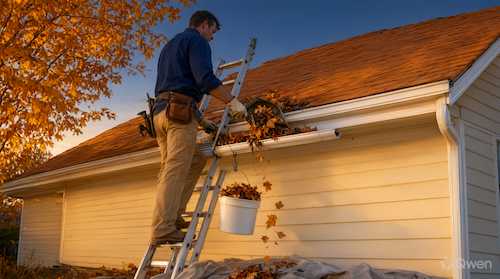
Houston gets 51.8 inches of rain, with 3.92 of it in June, and the storms that deliver it can exceed any residential gutter system. That changes what cleaning is for: the aim is not to make the run carry a hurricane, it is to make sure the run is doing everything it can when the event arrives, and that the water it cannot carry goes where it will do least harm. The heat and humidity make the aftermath the other half of the problem.
Runs that cannot carry the peak
No residential gutter carries a tropical downpour, so the question is what happens to the overflow. If the run is clear, most of the water reaches the outlet and the excess goes over the front edge; if it is blocked, all of it goes down the fascia and into the soffit. Ask whether the visit confirms the outlets flow.
Standing water and mosquitoes
After a storm, water held in a blocked run or a sagging section stands for days, and in this climate that is where mosquitoes breed. Clearing the run properly is the simplest control there is. Ask whether the contractor empties the low points rather than just the visible channel.
Mold on soffit and fascia
Overflow keeps the soffit wet, and in Gulf humidity that is where mold appears and spreads. Once it is established the evidence stays visible long after the run is cleared. Ask whether soffit and fascia are reported.
Older bungalows and original profiles
With 31.5% of the housing predating 1980 and much of it early single-storey stock, half-round and four-inch runs with few downspouts are still common, and they were sized for a smaller roof than the house now has. Ask what profile is fitted and whether the downspout count is adequate.
Storm season and timing
June to November sets the calendar, and the useful visit is the one before the season rather than the one after the first flood. Ask whether a pre-season clean can be scheduled deliberately.
What to pin down in the estimate
Where this page stops
No prices are quoted and no property is assessed here. Mold in living spaces, flood damage and roof work are separate matters, and no gutter system is designed here.
Houston metro context
The 2024 ACS 5-year estimates describe about 7.44 million residents in 2,661,739 households and 2,906,364 housing units, with 61.2% owner-occupied and 62.4% single-family detached. About 31.5% of units predate 1980. At the Houston Intercont Ap reference station January averages 53.8°F and July 85.1°F, on 51.8 inches of annual precipitation.
Houston reference station and housing indicators
| Indicator | Value | Source |
|---|---|---|
| January mean temperature | 53.8°F | NOAA NCEI |
| July mean temperature | 85.1°F | NOAA NCEI |
| Annual precipitation | 51.8 in. | NOAA NCEI |
| Metro population | 7,442,788 | U.S. Census Bureau |
| Owner-occupied share | 61.2% | U.S. Census Bureau |
| Housing units built before 1980 | 31.5% | U.S. Census Bureau |
Station normals are historical averages for one location, not a forecast. What a gutter has to carry depends on roof area, pitch, the debris the surrounding trees drop and whether downspouts discharge where the water can leave.
Frequently Asked Questions
Will clear gutters stop my house flooding?
No. They make sure the run works as well as it can, but a tropical downpour exceeds residential capacity regardless.
Why does water stand in my gutter?
A sag, a blocked outlet or debris holding water. Standing water in this climate also breeds mosquitoes.
What are the dark patches on my soffit?
Usually mold that established while the run was overflowing. Clearing the gutter does not remove it.
How often do gutters need clearing here?
At least twice a year, and always before storm season rather than after it.
Is a four-inch run a problem?
It holds less than a modern run and fills sooner, which in this rainfall means clearing more often and checking the outlets.
Can I clean them myself?
You can, but height and the frequency of the job are the usual reasons people stop. The outlet check is the part most people miss.
Sources and review date
- American Community Survey 2024 5-year estimates (CBSA tables) — U.S. Census Bureau, 2024 ACS 5-year estimates.
- 1991–2020 station normals — HOUSTON INTERCONT AP, TX US (USW00012960) — NOAA National Centers for Environmental Information, 1991–2020 climate normals.
Reviewed on 2026-11-18.
Other Home Services in Houston–Pasadena–The Woodlands
All guides for the Houston–Pasadena–The Woodlands metro area