
San Antonio, TX · metro guide
Gutter Cleaning in San Antonio: Live Oak Load, Caliche and Aquifer Rules
The hard part here is not the debris but what the ground does with the discharge.
Metro snapshot
San Antonio in numbers
Sources named below each block
- Population
- 2.7M
- Households
- 967K
- Housing units
- 1.1M
- People / household
- 2.75
- population ÷ households
Owner-occupied homes 63%
The rest are rented. Owners are the ones who commission most exterior work.
Single-family detached 66%
Detached houses carry their own roof, gutters and exterior walls.
Built before 1980 33%
Older housing stock shapes what fails first: gutters, flashing, pipe material.
Season
The year in San Antonio
- Precipitation
- 32.4 in
- Snowfall
- 0.2 in
Average temperature by month, °F — the shape of the year is what decides when exterior work gets done.
Precipitation by month, inches.
Snowfall by month, inches.
| Month | Average temperature (°F) | Precipitation (in) | Snowfall (in) |
|---|---|---|---|
| January | 52.2°F | 1.96 in | 0.0 in |
| February | 56.3°F | 1.74 in | 0.1 in |
| March | 62.8°F | 2.31 in | 0.0 in |
| April | 69.4°F | 2.42 in | 0.0 in |
| May | 76.5°F | 4.40 in | 0.0 in |
| June | 82.6°F | 3.28 in | 0.0 in |
| July | 84.8°F | 2.41 in | 0.0 in |
| August | 85.5°F | 2.15 in | 0.0 in |
| September | 79.9°F | 3.88 in | 0.0 in |
| October | 71.3°F | 3.75 in | 0.0 in |
| November | 60.7°F | 2.08 in | 0.0 in |
| December | 53.5°F | 2.00 in | 0.1 in |
NOAA 1991–2020 climate normals, station SAN ANTONIO INTL AP, TX US (USW00012921). Station observations, not a metro-wide average — a metro that spans a mountain range can differ by more than this record shows.
Population, households and housing shares: U.S. Census Bureau, American Community Survey 2024 5-year estimates, metropolitan statistical area.
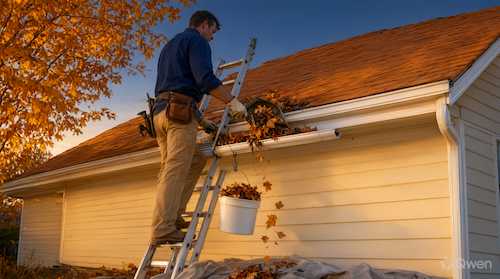
San Antonio gets 32.4 inches of rain, mostly in bursts, under live oaks that drop leaves and twigs year round. The ground is caliche over limestone, and much of it sits over the Edwards aquifer's recharge and contributing zones — which is why where a downspout discharges is a real question here rather than a detail. Hard water also means the channel and the fascia carry mineral staining as well as algae.
Evergreen oaks and continuous debris
Live oaks drop throughout the year, so there is no autumn to schedule around and the channel reloads between visits. Ask how many visits the trees over the roof justify, rather than accepting a fixed annual number.
Caliche dust and silt
Caliche produces a pale dust that settles on roofs and washes into the runs, where it sets at low points and in outlets. It is fine enough to look like part of the gutter bottom. Ask whether the outlets are cleared of silt.
Recharge ground and discharge
Much of the metro sits over sensitive recharge ground, and what happens to roof water there is regulated and studied rather than improvised. Ask where the discharge goes and whether it is being directed into a defined system rather than into a hole or a swale.
Hard water staining
The water is hard, and splash and overflow leave mineral stains on fascia, siding and masonry that survive long after the run is cleared. Ask whether staining is reported, because it is a record of failure.
Burst rainfall and overflow
Rain arrives in storms rather than steady falls, and a restricted run overflows at the fascia rather than the outlet. Ask whether the visit includes checking that water reaches the end of the run.
What to pin down in the estimate
Where this page stops
No prices are quoted and no property is assessed here. Recharge-zone rules, grading and structural movement need an engineer or the local authority, and this page gives no drainage advice.
San Antonio metro context
The 2024 ACS 5-year estimates describe about 2.66 million residents in 967,488 households and 1,057,823 housing units, with 63.3% owner-occupied and 66.1% single-family detached. About 32.7% of units predate 1980. At the San Antonio Intl Ap reference station January averages 52.2°F and July 84.8°F, on 32.4 inches of annual precipitation.
San Antonio reference station and housing indicators
| Indicator | Value | Source |
|---|---|---|
| January mean temperature | 52.2°F | NOAA NCEI |
| July mean temperature | 84.8°F | NOAA NCEI |
| Annual precipitation | 32.4 in. | NOAA NCEI |
| Metro population | 2,662,733 | U.S. Census Bureau |
| Owner-occupied share | 63.3% | U.S. Census Bureau |
| Housing units built before 1980 | 32.7% | U.S. Census Bureau |
Station normals are historical averages for one location, not a forecast. What a gutter has to carry depends on roof area, pitch, the debris the surrounding trees drop and whether downspouts discharge where the water can leave.
Frequently Asked Questions
Why do the gutters fill up outside leaf season?
Live oaks are evergreen. They drop leaves, catkins and twigs continuously, so there is no season in which the roof stops shedding.
What is the pale dust in the channel?
Caliche. It washes off the roof as fine silt and settles at the low points and outlets.
Can I discharge roof water into the ground here?
That is a question for the local rules on recharge ground, not a decision to improvise. Where the water goes matters beyond the property line.
Why are there white marks on my fascia?
Hard water. Splash and overflow leave mineral staining that stays after the gutter is cleared.
How often should gutters be cleared in San Antonio?
At least twice a year under oaks, and more where the roof is fully covered.
Does a new house need this?
Yes, and the first storm season usually shows whether the downspout count matches the roof.
Sources and review date
- American Community Survey 2024 5-year estimates (CBSA tables) — U.S. Census Bureau, 2024 ACS 5-year estimates.
- 1991–2020 station normals — SAN ANTONIO INTL AP, TX US (USW00012921) — NOAA National Centers for Environmental Information, 1991–2020 climate normals.
Reviewed on 2026-11-18.