
Los Angeles, CA · metro guide
Gutter Cleaning in Los Angeles: Dry-Season Build-Up and the First Storm
Nine dry months load the gutter, and the first storm of winter is when it matters.
Metro snapshot
Los Angeles in numbers
Sources named below each block
- Population
- 13.0M
- Households
- 4.5M
- Housing units
- 4.8M
- People / household
- 2.88
- population ÷ households
Owner-occupied homes 48%
The rest are rented. Owners are the ones who commission most exterior work.
Single-family detached 48%
Detached houses carry their own roof, gutters and exterior walls.
Built before 1980 67%
Older housing stock shapes what fails first: gutters, flashing, pipe material.
Season
The year in Los Angeles
- Precipitation
- 14.2 in
- Snowfall
- —
Average temperature by month, °F — the shape of the year is what decides when exterior work gets done.
Precipitation by month, inches.
| Month | Average temperature (°F) | Precipitation (in) | Snowfall (in) |
|---|---|---|---|
| January | 58.4°F | 3.29 in | — |
| February | 59.0°F | 3.64 in | — |
| March | 61.1°F | 2.23 in | — |
| April | 63.6°F | 0.69 in | — |
| May | 65.9°F | 0.32 in | — |
| June | 69.3°F | 0.09 in | — |
| July | 73.3°F | 0.02 in | — |
| August | 74.7°F | 0.00 in | — |
| September | 73.6°F | 0.13 in | — |
| October | 69.3°F | 0.58 in | — |
| November | 63.0°F | 0.78 in | — |
| December | 57.8°F | 2.48 in | — |
NOAA 1991–2020 climate normals, station LOS ANGELES DWTN USC CAMPUS, CA US (USW00093134). Station observations, not a metro-wide average — a metro that spans a mountain range can differ by more than this record shows.
Population, households and housing shares: U.S. Census Bureau, American Community Survey 2024 5-year estimates, metropolitan statistical area.
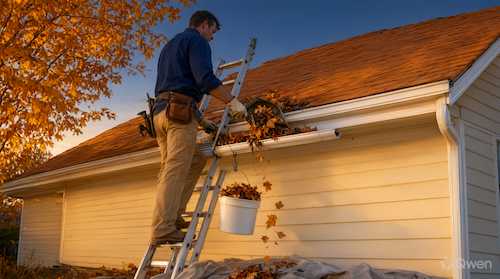
Los Angeles gets 14.2 inches of rain, almost all of it between November and March. That means the gutter is loaded for months by dust, leaves and grit that never get rinsed, and then tested by a handful of winter storms that arrive with real intensity. On hillside lots the consequences are larger than a wet wall: blocked drainage on a slope sends water where it was not designed to go.
Nine months of accumulation
Through the dry season, dust, leaves, palm fronds and grit collect in the channel with nothing to flush them. By the time the first storm arrives the run can be full without ever having flowed. Ask whether the visit is scheduled before the rains rather than after them.
The first storm is the test
The first significant storm of the season is when blocked runs overflow, and it is also when the accumulation of the dry season is most concentrated. A clean scheduled after that storm has already missed the event it was for.
Hillside lots and where the water goes
Much of the metro is built on slopes and canyon rims, and on those lots a blocked run or a failed downspout sends water down a slope rather than around a foundation. Ask how each elevation is reached and where the discharge ends up.
Mature trees, palms and their debris
The area's mature trees and palms drop material that behaves differently: palm fronds bridge a channel rather than filling it, and fine leaves mat over outlets. Ask whether the contractor clears the outlet and the run rather than sweeping the top.
Older runs on older houses
With 67.1% of the stock predating 1980, original runs in steel and early aluminum are common, and many are rusted at the base seam where damp debris has sat. Ask whether the material and condition are assessed, not only the debris.
What to pin down in the estimate
Where this page stops
No prices are quoted and no property is assessed here. Hillside stability, debris-flow risk after fire and structural damage are matters for an engineer or the local authority.
Los Angeles metro context
The 2024 ACS 5-year estimates describe about 12.97 million residents in 4,499,409 households and 4,796,635 housing units, with 48.4% owner-occupied and 47.8% single-family detached. About 67.1% of units predate 1980. At the Los Angeles Dwtn Usc Campus reference station January averages 58.4°F and July 73.3°F, on 14.2 inches of annual precipitation.
Los Angeles reference station and housing indicators
| Indicator | Value | Source |
|---|---|---|
| January mean temperature | 58.4°F | NOAA NCEI |
| July mean temperature | 73.3°F | NOAA NCEI |
| Annual precipitation | 14.2 in. | NOAA NCEI |
| Metro population | 12,974,487 | U.S. Census Bureau |
| Owner-occupied share | 48.4% | U.S. Census Bureau |
| Housing units built before 1980 | 67.1% | U.S. Census Bureau |
Station normals are historical averages for one location, not a forecast. What a gutter has to carry depends on roof area, pitch, the debris the surrounding trees drop and whether downspouts discharge where the water can leave.
Frequently Asked Questions
When should gutters be cleaned in Los Angeles?
Before the winter rains. The dry season loads the run and nothing flushes it, so a clean after the first storm has already missed the point.
Why do my gutters overflow in the first rain?
They are full of dry-season accumulation. The first storm is the test, and it is the one a pre-season clean is for.
Do palms cause problems?
Fronds bridge the channel and fine debris mats over outlets, so the blockage is not where you would expect.
How do you reach gutters on a hillside house?
From the ground or from an accessible roof plane. Each elevation has to be assessed, and some cannot be reached with a ladder.
Where should water go on a slope?
Into a defined path that carries it away from the structure. On a canyon lot the consequence of getting that wrong is larger.
Is an old steel run worth clearing?
Usually, but the condition matters. A rusted seam will not hold water however clean the channel is.
Sources and review date
- American Community Survey 2024 5-year estimates (CBSA tables) — U.S. Census Bureau, 2024 ACS 5-year estimates.
- 1991–2020 station normals — LOS ANGELES DWTN USC CAMPUS, CA US (USW00093134) — NOAA National Centers for Environmental Information, 1991–2020 climate normals.
Reviewed on 2026-11-18.
Other Home Services in Los Angeles-Long Beach-Anaheim
All guides for the Los Angeles-Long Beach-Anaheim metro area