
Sacramento, CA · metro guide
Gutter Cleaning in Sacramento: Oak Leaf Load, Valley Silt and Dry Summers
A long dry season that lets debris set, then a wet season that tests it.
Metro snapshot
Sacramento in numbers
Sources named below each block
- Population
- 2.4M
- Households
- 882K
- Housing units
- 955K
- People / household
- 2.75
- population ÷ households
Owner-occupied homes 63%
The rest are rented. Owners are the ones who commission most exterior work.
Single-family detached 68%
Detached houses carry their own roof, gutters and exterior walls.
Built before 1980 44%
Older housing stock shapes what fails first: gutters, flashing, pipe material.
Season
The year in Sacramento
- Precipitation
- 18.1 in
- Snowfall
- —
Average temperature by month, °F — the shape of the year is what decides when exterior work gets done.
Precipitation by month, inches.
| Month | Average temperature (°F) | Precipitation (in) | Snowfall (in) |
|---|---|---|---|
| January | 47.6°F | 3.66 in | — |
| February | 51.4°F | 3.49 in | — |
| March | 55.4°F | 2.68 in | — |
| April | 59.5°F | 1.26 in | — |
| May | 66.1°F | 0.75 in | — |
| June | 72.2°F | 0.23 in | — |
| July | 75.9°F | 0.00 in | — |
| August | 75.3°F | 0.04 in | — |
| September | 72.5°F | 0.09 in | — |
| October | 64.5°F | 0.85 in | — |
| November | 53.9°F | 1.66 in | — |
| December | 47.3°F | 3.43 in | — |
NOAA 1991–2020 climate normals, station SACRAMENTO EXECUTIVE AP, CA US (USW00023232). Station observations, not a metro-wide average — a metro that spans a mountain range can differ by more than this record shows.
Population, households and housing shares: U.S. Census Bureau, American Community Survey 2024 5-year estimates, metropolitan statistical area.
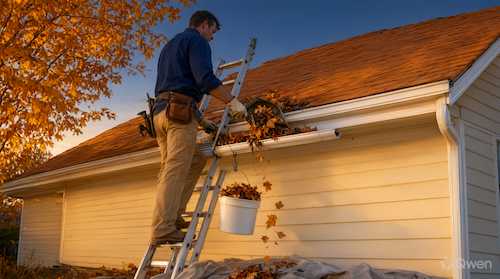
Sacramento gets its rain in a short wet season and spends the rest of the year dry, so whatever falls into a gutter sits there and sets. The debris load is substantial: the region's oaks and the olive trees in older neighborhoods drop heavily, and many houses have gutter screens that fill with fine material and stop passing water. Valley silt from surrounding farmland adds a layer that behaves like sediment rather than litter.
Oak and olive debris
Oaks drop heavily in a short period and olives add fine leaf litter over a longer one, so a run can be blocked twice in a season for different reasons. Ask whether the autumn visit is timed after the oak drop.
Screens that fill and stop passing water
Gutter screens are common here and they trap fine material rather than letting it wash through, so they end up holding a layer of silt that blinds the run entirely. Ask whether screens are lifted and the channel cleared underneath.
Valley silt that sets
Farmland dust settles on roofs and washes in as fine sediment, which sets hard in the heat and then holds water against the metal. Ask whether the outlets are cleared of silt.
A long dry season and a short wet one
With months of no rain, the run is loaded before it is ever tested, and the first storms of the wet season are when failures appear. Ask whether the clean happens before that season.
Older runs and added roof area
With 43.9% of the stock predating 1980, narrow runs sized for the original roof are common and additions have usually increased the area. Ask what profile is fitted.
What to pin down in the estimate
Where this page stops
No prices are quoted and no property is assessed here. Roof condition, fascia rot and drainage design belong to a roofer or a contractor.
Sacramento metro context
The 2024 ACS 5-year estimates describe about 2.43 million residents in 881,889 households and 954,751 housing units, with 63.0% owner-occupied and 68.4% single-family detached. About 43.9% of units predate 1980. No climate station is reported for this metro in the site dataset, so no temperature or precipitation normals appear on this page.
Sacramento housing indicators
| Indicator | Value | Source |
|---|---|---|
| Housing units built before 1980 | 43.9% | U.S. Census Bureau |
| Single-family detached share | 68.4% | U.S. Census Bureau |
| Owner-occupied share | 63.0% | U.S. Census Bureau |
| Metro households | 881,889 | U.S. Census Bureau |
| Housing units | 954,751 | U.S. Census Bureau |
| Metro population | 2,426,388 | U.S. Census Bureau |
Station normals are historical averages for one location, not a forecast. What a gutter has to carry depends on roof area, pitch, the debris the surrounding trees drop and whether downspouts discharge where the water can leave.
Frequently Asked Questions
Why do my screens seem to make it worse?
They trap fine material instead of passing it, so they blind the run. The channel underneath needs clearing too.
When should gutters be cleaned here?
After the oak drop and before the wet season, so the run is clear when it is finally tested.
What is the sediment in my gutter?
Valley dust. It sets in the heat and blocks outlets without looking like debris.
How often do gutters need clearing?
Usually once a year, twice under olives or heavy oaks.
Is a four-inch run a problem?
It holds less, and additions have usually increased the roof area it drains.
Do I need to be home?
Exterior work can be done with agreed access. Nothing inside the house is involved.
Sources and review date
- American Community Survey 2024 5-year estimates (CBSA tables) — U.S. Census Bureau, 2024 ACS 5-year estimates.
Reviewed on 2026-11-18.