
San Francisco, CA · metro guide
Gutter Cleaning in San Francisco: Narrow Lots, Cornices and Fog Damp
Victorian buildings that drain through cornices and leader heads, on lots with no side access at all.
Metro snapshot
San Francisco in numbers
Sources named below each block
- Population
- 4.6M
- Households
- 1.7M
- Housing units
- 1.9M
- People / household
- 2.66
- population ÷ households
Owner-occupied homes 56%
The rest are rented. Owners are the ones who commission most exterior work.
Single-family detached 49%
Detached houses carry their own roof, gutters and exterior walls.
Built before 1980 67%
Older housing stock shapes what fails first: gutters, flashing, pipe material.
Season
The year in San Francisco
- Precipitation
- 19.6 in
- Snowfall
- —
Average temperature by month, °F — the shape of the year is what decides when exterior work gets done.
Precipitation by month, inches.
| Month | Average temperature (°F) | Precipitation (in) | Snowfall (in) |
|---|---|---|---|
| January | 51.3°F | 3.89 in | — |
| February | 53.5°F | 3.96 in | — |
| March | 55.5°F | 2.73 in | — |
| April | 57.3°F | 1.36 in | — |
| May | 59.9°F | 0.48 in | — |
| June | 62.5°F | 0.14 in | — |
| July | 64.0°F | 0.00 in | — |
| August | 64.9°F | 0.04 in | — |
| September | 65.3°F | 0.07 in | — |
| October | 62.9°F | 0.79 in | — |
| November | 56.4°F | 2.04 in | — |
| December | 51.4°F | 4.14 in | — |
NOAA 1991–2020 climate normals, station SAN FRANCISCO INTL AP, CA US (USW00023234). Station observations, not a metro-wide average — a metro that spans a mountain range can differ by more than this record shows.
Population, households and housing shares: U.S. Census Bureau, American Community Survey 2024 5-year estimates, metropolitan statistical area.
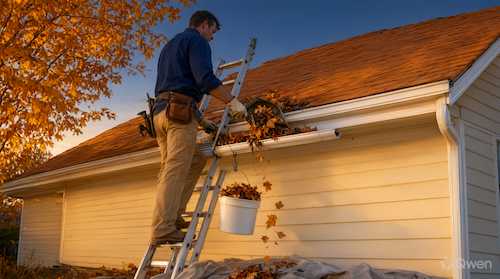
San Francisco's older buildings often do not have a conventional gutter at the front. The roof drains into a leader head set into the cornice, or into a channel behind a parapet, and the downspout runs down the wall or between buildings. With 66.7% of the housing predating 1980 and a great deal of it on narrow lots with no side access, reaching those runs is the main difficulty, and the fog keeps whatever is in them damp.
Cornices, leader heads and parapets
On Victorian and Edwardian buildings the drainage detail is often a leader head in the cornice or a channel behind a parapet rather than an eaves gutter, and these block like any other run but are far harder to see. Ask whether the contractor is familiar with that detail and what is actually up there.
Narrow lots and no side access
On a 25-foot lot there is no side yard to work from, so the rear is reached through the building or over the roof, and the downspout between two buildings may be genuinely unreachable. Ask how each run is accessed before assuming it can be cleaned.
Fog that keeps runs damp
Marine air keeps the channel and the fascia damp for long stretches, which accelerates corrosion and keeps debris wet enough to mat. Ask whether the run's condition and the fascia are assessed.
Rentals, approvals and responsibility
With 55.5% owner-occupancy, many of these buildings are rented, and in a multi-unit building the roof and exterior belong to the owner or the association rather than the occupant. Ask who authorizes the work and who is responsible for the drainage.
Salt and metal
Fog carries salt, and it holds moisture against metal runs, fasteners and leader heads. Ask whether the run's condition is assessed rather than only cleared.
What to pin down in the estimate
Where this page stops
No prices are quoted and no property is assessed here. Cornice and parapet condition, structural repair and building responsibility need a contractor or a written answer, not a cleaning opinion.
San Francisco metro context
The 2024 ACS 5-year estimates describe about 4.65 million residents in 1,744,070 households and 1,880,374 housing units, with 55.5% owner-occupied and 48.9% single-family detached. About 66.7% of units predate 1980. No climate station is reported for this metro in the site dataset, so no temperature or precipitation normals appear on this page.
San Francisco housing indicators
| Indicator | Value | Source |
|---|---|---|
| Housing units built before 1980 | 66.7% | U.S. Census Bureau |
| Single-family detached share | 48.9% | U.S. Census Bureau |
| Owner-occupied share | 55.5% | U.S. Census Bureau |
| Metro households | 1,744,070 | U.S. Census Bureau |
| Housing units | 1,880,374 | U.S. Census Bureau |
| Metro population | 4,645,029 | U.S. Census Bureau |
Station normals are historical averages for one location, not a forecast. What a gutter has to carry depends on roof area, pitch, the debris the surrounding trees drop and whether downspouts discharge where the water can leave.
Frequently Asked Questions
My building has no visible gutter — is that normal here?
On older San Francisco buildings it can be. Roof water often goes into a leader head in the cornice or a channel behind a parapet.
How do you reach the rear on a narrow lot?
Through the building or over the roof. Some runs between buildings are effectively unreachable and that should be said rather than assumed.
Does fog damage gutters?
It keeps the channel and fascia damp, which speeds corrosion and keeps debris wet enough to mat.
Do I need the owner's permission?
Yes, in a rented or multi-unit building the roof and exterior are usually the owner's or the association's responsibility.
How often should these runs be cleared?
Once a year is often enough for debris, with the condition check being the important part on old metal.
Do I need to be home?
Exterior work can be done with agreed access. In a multi-unit building, access may need arranging.
Sources and review date
- American Community Survey 2024 5-year estimates (CBSA tables) — U.S. Census Bureau, 2024 ACS 5-year estimates.
Reviewed on 2026-11-18.