
Atlanta, GA · metro guide
Gutter Cleaning in Atlanta: Canopy Debris, 50 Inches of Rain and Clay
One of the most heavily canopied metros in the country, dropping debris into the smallest gutters on the oldest houses.
Metro snapshot
Atlanta in numbers
Sources named below each block
- Population
- 6.3M
- Households
- 2.3M
- Housing units
- 2.5M
- People / household
- 2.70
- population ÷ households
Owner-occupied homes 66%
The rest are rented. Owners are the ones who commission most exterior work.
Single-family detached 66%
Detached houses carry their own roof, gutters and exterior walls.
Built before 1980 26%
Older housing stock shapes what fails first: gutters, flashing, pipe material.
Season
The year in Atlanta
- Precipitation
- 50.4 in
- Snowfall
- 2.2 in
Average temperature by month, °F — the shape of the year is what decides when exterior work gets done.
Precipitation by month, inches.
Snowfall by month, inches.
| Month | Average temperature (°F) | Precipitation (in) | Snowfall (in) |
|---|---|---|---|
| January | 44.8°F | 4.59 in | 1.0 in |
| February | 48.5°F | 4.55 in | 0.4 in |
| March | 55.6°F | 4.68 in | 0.4 in |
| April | 63.2°F | 3.81 in | 0.0 in |
| May | 71.2°F | 3.56 in | 0.0 in |
| June | 77.9°F | 4.54 in | 0.0 in |
| July | 80.9°F | 4.75 in | 0.0 in |
| August | 80.2°F | 4.30 in | 0.0 in |
| September | 74.9°F | 3.82 in | 0.0 in |
| October | 64.7°F | 3.28 in | 0.0 in |
| November | 54.2°F | 3.98 in | 0.0 in |
| December | 47.3°F | 4.57 in | 0.4 in |
NOAA 1991–2020 climate normals, station ATLANTA HARTSFIELD INTL AP, GA US (USW00013874). Station observations, not a metro-wide average — a metro that spans a mountain range can differ by more than this record shows.
Population, households and housing shares: U.S. Census Bureau, American Community Survey 2024 5-year estimates, metropolitan statistical area.
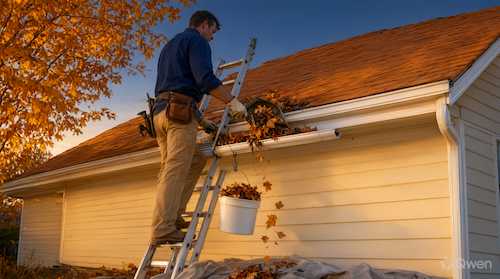
Atlanta gets 50.4 inches of rain under a canopy dense enough that many roofs are never fully dry. The debris load is a mixture rather than one thing: pine straw from the pines, leaves from the hardwoods, and pollen in spring that turns both into a sludge. Intown bungalows from before 1980 often carry four-inch runs with a single downspout, while newer suburban houses have larger runs and longer roof planes, and the two fail in different ways.
Canopy that never stops dropping
With this much tree cover, debris arrives almost year round: pollen in spring, straw and small branches through summer, leaves in autumn. A single annual clean leaves the run loaded for months. Ask how many visits the property actually needs given the trees over the roof, not given the season.
Straw and leaves behave differently
Straw packs and mats, leaves slide, and together they form a layer that holds water and blocks the outlet. Clearing one without the other leaves the run effectively blocked. Ask whether the contractor clears the channel and the outlet separately.
Red clay and discharge
The soil is clay and sheds water, so a downspout ending near the wall sends the roof's water along the foundation. Ask where each downspout ends and whether the water has a defined path away.
Intown bungalows and narrow runs
Atlanta's intown stock includes many pre-1980 houses with four-inch gutters and one downspout per elevation, sized for a smaller roof than the house now has after additions. Those overflow at the low point in any storm. Ask what profile is fitted and whether the downspout count is adequate.
Streaking and what it shows
Overflow leaves dark streaks on fascia and soffit, and on brick it leaves a wash line that is visible from the street. Those marks are usually the first evidence of a failing run. Ask whether the contractor reports them.
What to pin down in the estimate
Where this page stops
No prices are quoted and no property is assessed here. Rot, failed hangers, drainage grading and tree work are separate matters, and removing limbs over a roof belongs to a tree contractor.
Atlanta metro context
The 2024 ACS 5-year estimates describe about 6.26 million residents in 2,313,055 households and 2,497,322 housing units, with 66.1% owner-occupied and 66.3% single-family detached. About 26.2% of units predate 1980. At the Atlanta Hartsfield Intl Ap reference station January averages 44.8°F and July 80.9°F, on 50.4 inches of annual precipitation.
Atlanta reference station and housing indicators
| Indicator | Value | Source |
|---|---|---|
| January mean temperature | 44.8°F | NOAA NCEI |
| July mean temperature | 80.9°F | NOAA NCEI |
| Annual precipitation | 50.4 in. | NOAA NCEI |
| Metro population | 6,256,377 | U.S. Census Bureau |
| Owner-occupied share | 66.1% | U.S. Census Bureau |
| Housing units built before 1980 | 26.2% | U.S. Census Bureau |
Station normals are historical averages for one location, not a forecast. What a gutter has to carry depends on roof area, pitch, the debris the surrounding trees drop and whether downspouts discharge where the water can leave.
Frequently Asked Questions
How often do gutters need clearing under this much canopy?
Often more than twice a year. Pine straw and summer debris mean the run reloads between the usual spring and autumn visits.
Why does water run over the front of the gutter?
Either the outlet is blocked or the run is too small for the roof area. On older intown houses it is often both.
Does pine straw clog gutters faster than leaves?
It mats and holds water rather than sliding out, so yes, it tends to block more effectively.
Where should downspouts discharge on clay soil?
Away from the foundation with a defined path. Clay will not absorb what a roof delivers.
What are the dark lines on the brick below my gutter?
Overflow wash lines. They indicate the run has been failing in storms.
Do guards solve it?
They reduce how often the channel fills, but straw and pollen still get through and still need clearing.
Sources and review date
- American Community Survey 2024 5-year estimates (CBSA tables) — U.S. Census Bureau, 2024 ACS 5-year estimates.
- 1991–2020 station normals — ATLANTA HARTSFIELD INTL AP, GA US (USW00013874) — NOAA National Centers for Environmental Information, 1991–2020 climate normals.
Reviewed on 2026-11-18.