
Washington, DC-VA-MD-WV · metro guide
Gutter Cleaning in Washington DC: Pollen Mat, Historic Roofs and Condo Drains
A pollen season heavy enough to blind an outlet in a week, on roofs that often drain through the building.
Metro snapshot
Washington in numbers
Sources named below each block
- Population
- 6.3M
- Households
- 2.4M
- Housing units
- 2.5M
- People / household
- 2.66
- population ÷ households
Owner-occupied homes 64%
The rest are rented. Owners are the ones who commission most exterior work.
Single-family detached 44%
Detached houses carry their own roof, gutters and exterior walls.
Built before 1980 46%
Older housing stock shapes what fails first: gutters, flashing, pipe material.
Season
The year in Washington
- Precipitation
- 41.8 in
- Snowfall
- 13.7 in
Average temperature by month, °F — the shape of the year is what decides when exterior work gets done.
Precipitation by month, inches.
Snowfall by month, inches.
| Month | Average temperature (°F) | Precipitation (in) | Snowfall (in) |
|---|---|---|---|
| January | 37.5°F | 2.86 in | 4.9 in |
| February | 40.0°F | 2.62 in | 5.0 in |
| March | 47.6°F | 3.50 in | 2.0 in |
| April | 58.2°F | 3.21 in | 0.0 in |
| May | 67.2°F | 3.94 in | 0.0 in |
| June | 76.3°F | 4.20 in | 0.0 in |
| July | 81.0°F | 4.33 in | 0.0 in |
| August | 79.4°F | 3.25 in | 0.0 in |
| September | 72.4°F | 3.93 in | 0.0 in |
| October | 60.8°F | 3.66 in | 0.0 in |
| November | 49.9°F | 2.91 in | 0.1 in |
| December | 41.7°F | 3.41 in | 1.7 in |
NOAA 1991–2020 climate normals, station WASHINGTON REAGAN AP, VA US (USW00013743). Station observations, not a metro-wide average — a metro that spans a mountain range can differ by more than this record shows.
Population, households and housing shares: U.S. Census Bureau, American Community Survey 2024 5-year estimates, metropolitan statistical area.
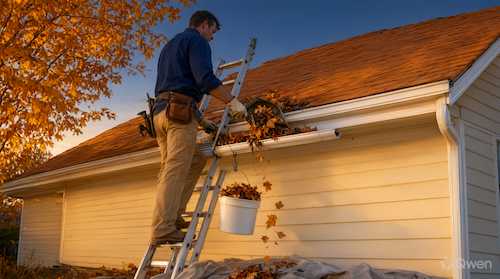
Washington's spring pollen is intense enough to be a local event, and it does something specific to gutters: it mats over outlets and screens in a way that leaf debris does not. With 45.5% of the housing predating 1980 and a large share of it attached, the region also has a lot of flat and low-slope roofs drained through internal conductors, where a blockage is invisible until water appears inside.
Pollen that blinds an outlet
The pollen load arrives in a short burst, coats the roof and washes into the runs, where it mats over outlets and screens. A run that was clear in March can be blind by May. Ask whether the outlet is checked after the pollen season specifically.
Flat roofs and internal drains
On the region's flat-roofed and low-slope buildings, water leaves through roof drains and internal conductors rather than eaves gutters, and a blockage appears as a ceiling stain rather than an overflow. Ask whether roof drainage is included in the service.
Older roofs and district rules
With 45.5% of the stock predating 1980, half-round runs and older roof profiles are common, and in historic districts access and equipment may be restricted. Ask what the district requires and whether the contractor works half-round runs.
Condominiums and who is responsible
Only 44.2% of units are detached, so a large share of the drainage belongs to an association. Exterior glass and roof drainage may be the building's responsibility while interior damage is the unit's. Ask which is which in writing.
Winter freeze and the outlet
Winters here oscillate around freezing, so a blocked outlet can freeze and stay frozen long enough to back water up under the roof edge. Ask when the late-autumn visit falls.
What to pin down in the estimate
Where this page stops
No prices are quoted and no property is assessed here. Roof drainage repair, district approvals and association responsibility need a roofer or a written answer from the building.
Washington metro context
The 2024 ACS 5-year estimates describe about 6.32 million residents in 2,373,022 households and 2,506,631 housing units, with 63.7% owner-occupied and 44.2% single-family detached. About 45.5% of units predate 1980. No climate station is reported for this metro in the site dataset, so no temperature or precipitation normals appear on this page.
Washington housing indicators
| Indicator | Value | Source |
|---|---|---|
| Housing units built before 1980 | 45.5% | U.S. Census Bureau |
| Single-family detached share | 44.2% | U.S. Census Bureau |
| Owner-occupied share | 63.7% | U.S. Census Bureau |
| Metro households | 2,373,022 | U.S. Census Bureau |
| Housing units | 2,506,631 | U.S. Census Bureau |
| Metro population | 6,318,377 | U.S. Census Bureau |
Station normals are historical averages for one location, not a forecast. What a gutter has to carry depends on roof area, pitch, the debris the surrounding trees drop and whether downspouts discharge where the water can leave.
Frequently Asked Questions
Why does my gutter block in spring with no leaves?
Pollen. It mats over outlets and screens in a way leaf litter does not, and the season is short and intense here.
What is an internal conductor?
A drain running inside the building from a flat roof. When it blocks, water appears inside rather than overflowing outside.
Who is responsible in a condominium?
Usually the association for the roof and exterior. Confirm in writing before booking.
Do historic districts affect gutter work?
Sometimes, on access or equipment. Confirm before the visit rather than at the door.
When should gutters be cleaned here?
After the pollen season, in later spring, and again in late autumn before the freeze.
Do I need to be home?
Exterior work can be done with agreed access. Nothing inside the house is involved.
Sources and review date
- American Community Survey 2024 5-year estimates (CBSA tables) — U.S. Census Bureau, 2024 ACS 5-year estimates.
Reviewed on 2026-11-18.
Other Home Services in Washington–Arlington–Alexandria
All guides for the Washington–Arlington–Alexandria metro area