
Richmond, VA · metro guide
Gutter Cleaning in Richmond: Slate Roofs, Half-Round Runs and Brick Foundations
Old brick houses with cellars, where the downspout discharges within a few feet of the wall.
Metro snapshot
Richmond in numbers
Sources named below each block
- Population
- 1.3M
- Households
- 533K
- Housing units
- 570K
- People / household
- 2.51
- population ÷ households
Owner-occupied homes 67%
The rest are rented. Owners are the ones who commission most exterior work.
Single-family detached 68%
Detached houses carry their own roof, gutters and exterior walls.
Built before 1980 44%
Older housing stock shapes what fails first: gutters, flashing, pipe material.
Season
The year in Richmond
- Precipitation
- 45.5 in
- Snowfall
- 8.8 in
Average temperature by month, °F — the shape of the year is what decides when exterior work gets done.
Precipitation by month, inches.
Snowfall by month, inches.
| Month | Average temperature (°F) | Precipitation (in) | Snowfall (in) |
|---|---|---|---|
| January | 38.3°F | 3.23 in | 3.7 in |
| February | 41.0°F | 2.61 in | 2.2 in |
| March | 48.4°F | 4.00 in | 1.1 in |
| April | 58.4°F | 3.18 in | 0.0 in |
| May | 66.7°F | 4.00 in | 0.0 in |
| June | 75.0°F | 4.64 in | 0.0 in |
| July | 79.4°F | 4.37 in | 0.0 in |
| August | 77.5°F | 4.90 in | 0.0 in |
| September | 71.2°F | 4.61 in | 0.0 in |
| October | 60.0°F | 3.39 in | 0.0 in |
| November | 49.6°F | 3.06 in | 0.0 in |
| December | 41.8°F | 3.51 in | 1.8 in |
NOAA 1991–2020 climate normals, station RICHMOND INTL AP, VA US (USW00013740). Station observations, not a metro-wide average — a metro that spans a mountain range can differ by more than this record shows.
Population, households and housing shares: U.S. Census Bureau, American Community Survey 2024 5-year estimates, metropolitan statistical area.
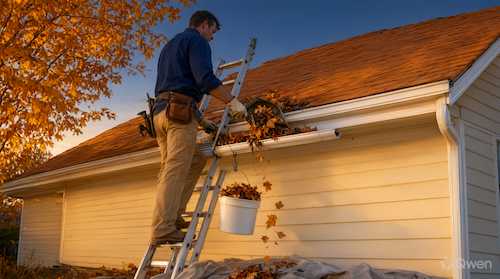
Richmond gets 43.6% of its housing from before 1980, and much of the older stock has slate roofs drained by half-round gutters into downspouts that end close to a brick foundation and a cellar. That is the local failure mode: not a dramatic overflow but a slow wetting of brick and mortar at the base of the wall, which shows up as damp in a cellar long before anyone looks at the gutter.
Brick foundations and cellar damp
Brick and mortar take up water and hold it, so a downspout ending near the wall keeps the foundation damp and the cellar below it humid. Ask where each downspout ends and whether there is a path away from the wall.
Slate roofs and half-round runs
Half-round channels carry less than K-style of the same width and depend on hangers holding their shape, and slate roofs shed grit into them for decades. Ask whether the contractor works half-round runs and clears without distorting the profile.
Spring pollen and matting
The pollen season here is heavy enough to mat over outlets and screens, so a run that was clear in March can be blind by May. Ask whether the outlet is checked after the season.
River humidity and a damp channel
The James keeps the air damp, so the run stays wet between rains, which accelerates corrosion and keeps the fascia damp. Ask whether the run's condition and the fascia are assessed.
Older runs and added roof area
With 43.6% of the stock predating 1980, runs sized for the original roof are common, and rear additions usually added area they never drained. Ask what profile is fitted.
What to pin down in the estimate
Where this page stops
No prices are quoted and no property is assessed here. Cellar damp, brick and mortar condition and foundation repair need inspection by the right trade.
Richmond metro context
The 2024 ACS 5-year estimates describe about 1.34 million residents in 533,430 households and 569,714 housing units, with 67.0% owner-occupied and 67.9% single-family detached. About 43.6% of units predate 1980. No climate station is reported for this metro in the site dataset, so no temperature or precipitation normals appear on this page.
Richmond housing indicators
| Indicator | Value | Source |
|---|---|---|
| Housing units built before 1980 | 43.6% | U.S. Census Bureau |
| Single-family detached share | 67.9% | U.S. Census Bureau |
| Owner-occupied share | 67.0% | U.S. Census Bureau |
| Metro households | 533,430 | U.S. Census Bureau |
| Housing units | 569,714 | U.S. Census Bureau |
| Metro population | 1,341,248 | U.S. Census Bureau |
Station normals are historical averages for one location, not a forecast. What a gutter has to carry depends on roof area, pitch, the debris the surrounding trees drop and whether downspouts discharge where the water can leave.
Frequently Asked Questions
Why is my cellar damp?
Often the downspout. Water released near a brick foundation keeps the wall damp and the cellar humid.
Is half-round harder to clean?
It holds less water and its hangers are easier to distort, so it needs a method that does not bend the profile.
When does pollen block gutters here?
In spring, when pollen mats over outlets and screens. A run clear in March can be blind by May.
How often should gutters be cleared?
Twice a year, after the pollen season and again in autumn.
Does humidity affect the gutter?
It keeps the channel wet, which speeds corrosion and keeps the fascia damp.
Do I need to be home?
Exterior work can be done with agreed access. Nothing inside the house is involved.
Sources and review date
- American Community Survey 2024 5-year estimates (CBSA tables) — U.S. Census Bureau, 2024 ACS 5-year estimates.
Reviewed on 2026-11-18.