
Raleigh, NC · metro guide
Gutter Cleaning in Raleigh: New Roofs, Undersized Downspouts and Clay
The newest housing of any metro here, where the gutters are often the part nobody specified properly.
Metro snapshot
Raleigh in numbers
Sources named below each block
- Population
- 1.5M
- Households
- 574K
- Housing units
- 619K
- People / household
- 2.59
- population ÷ households
Owner-occupied homes 67%
The rest are rented. Owners are the ones who commission most exterior work.
Single-family detached 62%
Detached houses carry their own roof, gutters and exterior walls.
Built before 1980 19%
Older housing stock shapes what fails first: gutters, flashing, pipe material.
Season
The year in Raleigh
- Precipitation
- 46.1 in
- Snowfall
- 5.2 in
Average temperature by month, °F — the shape of the year is what decides when exterior work gets done.
Precipitation by month, inches.
Snowfall by month, inches.
| Month | Average temperature (°F) | Precipitation (in) | Snowfall (in) |
|---|---|---|---|
| January | 41.9°F | 3.43 in | 2.6 in |
| February | 45.0°F | 2.78 in | 1.4 in |
| March | 51.8°F | 4.10 in | 0.3 in |
| April | 60.8°F | 3.53 in | 0.0 in |
| May | 68.8°F | 3.38 in | 0.0 in |
| June | 76.7°F | 3.89 in | 0.0 in |
| July | 80.5°F | 5.02 in | 0.0 in |
| August | 78.8°F | 4.71 in | 0.0 in |
| September | 72.6°F | 5.15 in | 0.0 in |
| October | 61.7°F | 3.37 in | 0.0 in |
| November | 51.5°F | 3.32 in | 0.1 in |
| December | 44.6°F | 3.39 in | 0.8 in |
NOAA 1991–2020 climate normals, station RALEIGH DURHAM INTL AP, NC US (USW00013722). Station observations, not a metro-wide average — a metro that spans a mountain range can differ by more than this record shows.
Population, households and housing shares: U.S. Census Bureau, American Community Survey 2024 5-year estimates, metropolitan statistical area.
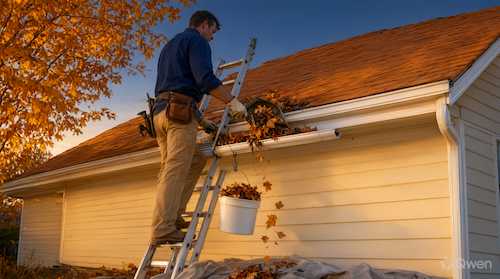
Only 18.6% of Raleigh's housing predates 1980, so most of the stock is recent and most of the gutters are original to the house. That sounds like an advantage, and often it is — until the first real storm shows that the downspout count was chosen for appearance rather than for roof area, or that the discharge point was never given a path across clay. The debris load here is dominated by pine pollen and needles from the tree lines that were left standing around new subdivisions.
Downspout count and roof area
In newer subdivisions the gutter run is often continuous around several roof planes with only two or three downspouts, and any blockage sends water over the front edge rather than into the outlet. Capacity is the thing to check on a house this age. Ask how many downspouts serve each run and whether that matches the roof area.
Pine pollen that turns to sludge
Spring pollen coats the roof and washes into the runs, where it mixes with needles into a dense sludge that sets in the channel. It is not the same as leaf litter and does not clear the same way. Ask whether the contractor flushes the runs or only removes what they can reach.
Discharge onto clay
The soil is red clay and does not absorb, so a downspout that ends at the foundation effectively directs the roof's water along the wall. Ask where each downspout ends and whether extensions or a defined path are part of the work.
46.1 inches with summer bursts
The rain arrives heavily enough in summer storms that a partially blocked run overflows visibly. Streaking on the fascia after a storm is the usual first sign. Ask whether the fascia is checked as part of the visit.
Tree lines left around new houses
Subdivisions built into existing pine stands leave mature trees close to the roofline, and those drop needles onto the roof continuously rather than seasonally. Ask whether the interval reflects the trees actually over the roof.
What to pin down in the estimate
Where this page stops
No prices are quoted and no property is assessed here. Adding downspouts, re-grading a yard and repairing fascia are separate jobs that need a contractor or an inspector.
Raleigh metro context
The 2024 ACS 5-year estimates describe about 1.49 million residents in 574,295 households and 619,032 housing units, with 66.6% owner-occupied and 61.5% single-family detached. About 18.6% of units predate 1980. At the Raleigh Durham Intl Ap reference station January averages 41.9°F and July 80.5°F, on 46.1 inches of annual precipitation.
Raleigh reference station and housing indicators
| Indicator | Value | Source |
|---|---|---|
| January mean temperature | 41.9°F | NOAA NCEI |
| July mean temperature | 80.5°F | NOAA NCEI |
| Annual precipitation | 46.1 in. | NOAA NCEI |
| Metro population | 1,487,302 | U.S. Census Bureau |
| Owner-occupied share | 66.6% | U.S. Census Bureau |
| Housing units built before 1980 | 18.6% | U.S. Census Bureau |
Station normals are historical averages for one location, not a forecast. What a gutter has to carry depends on roof area, pitch, the debris the surrounding trees drop and whether downspouts discharge where the water can leave.
Frequently Asked Questions
My house is only a few years old — why does it overflow?
Capacity. Many newer runs have fewer downspouts than the roof area needs, so any partial blockage takes the water over the edge.
What is the sludge in my gutters?
Pine pollen mixed with needles. It sets in the channel and does not wash out on its own.
Why does water pool at the foundation?
Clay soil does not absorb, so a downspout ending at the wall sends water along it. It needs a path away.
How often should new gutters be cleared?
As often as the trees above demand. Under pines that can be more than twice a year even on a new house.
Does a gutter guard fix a capacity problem?
No. A guard keeps debris out; it does not make an undersized run carry more water.
What are the marks on my fascia after storms?
Usually overflow staining. It means the run could not carry the storm, not that the paint failed first.
Sources and review date
- American Community Survey 2024 5-year estimates (CBSA tables) — U.S. Census Bureau, 2024 ACS 5-year estimates.
- 1991–2020 station normals — RALEIGH DURHAM INTL AP, NC US (USW00013722) — NOAA National Centers for Environmental Information, 1991–2020 climate normals.
Reviewed on 2026-11-18.