
Raleigh, NC · metro guide
Solar Panels in Raleigh: Long Summers, Pine Shade, and Storm Season
The sun is good and the roof is young. The trees are the variable that decides the project.
Metro snapshot
Raleigh in numbers
Sources named below each block
- Population
- 1.5M
- Households
- 574K
- Housing units
- 619K
- People / household
- 2.59
- population ÷ households
Owner-occupied homes 67%
The rest are rented. Owners are the ones who commission most exterior work.
Single-family detached 62%
Detached houses carry their own roof, gutters and exterior walls.
Built before 1980 19%
Older housing stock shapes what fails first: gutters, flashing, pipe material.
Season
The year in Raleigh
- Precipitation
- 46.1 in
- Snowfall
- 5.2 in
Average temperature by month, °F — the shape of the year is what decides when exterior work gets done.
Precipitation by month, inches.
Snowfall by month, inches.
| Month | Average temperature (°F) | Precipitation (in) | Snowfall (in) |
|---|---|---|---|
| January | 41.9°F | 3.43 in | 2.6 in |
| February | 45.0°F | 2.78 in | 1.4 in |
| March | 51.8°F | 4.10 in | 0.3 in |
| April | 60.8°F | 3.53 in | 0.0 in |
| May | 68.8°F | 3.38 in | 0.0 in |
| June | 76.7°F | 3.89 in | 0.0 in |
| July | 80.5°F | 5.02 in | 0.0 in |
| August | 78.8°F | 4.71 in | 0.0 in |
| September | 72.6°F | 5.15 in | 0.0 in |
| October | 61.7°F | 3.37 in | 0.0 in |
| November | 51.5°F | 3.32 in | 0.1 in |
| December | 44.6°F | 3.39 in | 0.8 in |
NOAA 1991–2020 climate normals, station RALEIGH DURHAM INTL AP, NC US (USW00013722). Station observations, not a metro-wide average — a metro that spans a mountain range can differ by more than this record shows.
Population, households and housing shares: U.S. Census Bureau, American Community Survey 2024 5-year estimates, metropolitan statistical area.
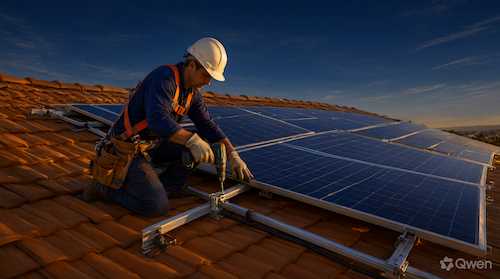
Raleigh sits in a good solar band with a housing stock that cooperates: only 18.6% of metro units predate 1980, so many roofs being quoted are modern and structurally straightforward. What the metro does not lack is trees. The Piedmont canopy is dense, pines grow fast, and a roof that measures clear on a site visit can be partially shaded for hours in July. Between that and a hot, humid summer that reduces module efficiency, the difference between a good array and a disappointing one is usually in the shade study and the production model rather than the equipment.
July averages 80.5°F, and cells run hotter
The station at Raleigh–Durham averages 80.5°F in July, and a roof in full sun is considerably warmer than the air, so modules operate well above the temperature at which they are rated. Output falls accordingly. Humidity compounds it: hazy, humid air reduces the clear-sky irradiance that production models sometimes assume. Ask what cell temperature and what weather data the estimate used, whether the mounting leaves an air gap behind the modules, and what the seasonal profile looks like. A proposal showing flat production across the year is not modelling this climate.
Pines and hardwoods, and shade that moves
In a fast-growing metro with established neighborhood trees, shading is often from a pine on the property line rather than from anything the homeowner planted. Pines cast shade that shifts through the year and, being evergreen, does not go away in winter. Ask which hours of the year were modelled, whether the design uses per-panel electronics so one shaded section does not drag a whole string, and what the plan is if a neighbor's tree grows or gets removed. A shade study done only in summer will still catch pines; one done only in winter will not catch the deciduous canopy at all.
Hurricanes, ice and the mounting
The coastal plain to the east means tropical systems occasionally reach this far inland with significant wind, and winter ice events add loading that is unusual in the Southeast. Ask what wind speed the mounting is engineered for, how penetrations are flashed, and what the hail rating of the equipment is. Also ask whether rapid shutdown is included so responders can work safely near a damaged array. In a metro where a single storm can remove shingles from an entire subdivision, the attachment detail is the part worth scrutinizing.
A young stock, but not a new roof
Most houses here are recent enough that the roof may well have enough life left for an array, but age still has to be established rather than assumed. Ask how old the covering is, what its remaining service life is judged to be, and whether the installer will put that in writing. If the roof is more than a decade old, compare the cost of replacement now against removal and reinstallation later — the second option is usually the more expensive one and it arrives at a less convenient time.
The credit structure is part of the return
North Carolina's rules for crediting exported solar have been revised, and the applicable terms are those in force when the system is interconnected and metered. Ask who files the interconnection request, what the expected review window is, how exported energy is credited under the current rules, what fixed charges remain, and what happens to accumulated credits at the end of a period. Confirm it with the utility rather than relying on a sales summary, since a change in the credit structure can matter more than a difference in module efficiency.
What to ask a Raleigh installer
Where this page stops
No prices, incentives or production figures are published here, because none can be produced honestly without a site assessment. Roof condition and structural capacity require inspection, and financial and regulatory questions belong to a qualified adviser and the utility.
Raleigh metro context
The 2024 ACS 5-year estimates count about 1.49 million residents in 574,295 households across 619,032 housing units, with 66.6% owner-occupied and 61.5% single-family detached — a high ownership rate and a large detached share, which is favorable for rooftop solar. Only 18.6% of units predate 1980. NOAA's station records July at 80.5°F, January at 41.9°F, 46.1 inches of precipitation and 5.2 inches of snow annually.
Raleigh seasonal conditions and housing indicators
| Indicator | Value | Source |
|---|---|---|
| July mean temperature | 80.5°F | NOAA NCEI |
| January mean temperature | 41.9°F | NOAA NCEI |
| Annual precipitation | 46.1 in. | NOAA NCEI |
| Single-family detached share | 61.5% | U.S. Census Bureau |
| Owner-occupied share | 66.6% | U.S. Census Bureau |
| Housing units built before 1980 | 18.6% | U.S. Census Bureau |
Monthly means are 30-year station averages. Cell temperature on a sunlit roof runs well above air temperature, which is why a production model must account for heat separately.
Frequently Asked Questions
Is Raleigh a good location for solar?
Yes, broadly. Sunlight is adequate and the housing stock is young, so roof condition is less often a blocker than it is in older metros. Whether it works for a specific house depends on tree shade, roof orientation and the current utility credit structure.
How much does summer heat cost me in production?
A predictable amount that depends on the module's temperature coefficient and on how hot the cells get, which depends on the mounting. It should be modelled rather than ignored; a quote that assumes rated output in July will overstate results.
What if a neighbor's tree shades my roof?
It is a design constraint rather than a legal shortcut. Ask for a shade study that covers the year, consider per-panel electronics so shade affects less of the array, and be realiztic about production if the obstruction cannot be changed.
Do panels need to be removed in a hurricane?
Properly engineered mounting is designed for the wind loads applicable to the area, and removal before every storm is not standard practice. Ask for the wind rating and the attachment details, and confirm the array is included in your insurance.
Should I replace the roof before installing?
If it is near the end of its life, yes. Removing and reinstalling an array is a real cost that usually is not covered by a roofing claim, so paying for it twice is the avoidable expense.
Will my bill go to zero?
Rarely. Fixed charges remain, and the value of exported energy depends on the current credit rules and on how much the household consumes while the array is producing. Ask for a month-by-month view rather than an annual total.
Sources and review date
- American Community Survey 2024 5-year estimates (CBSA tables) — U.S. Census Bureau, 2024 ACS 5-year estimates.
- 1991–2020 station normals — RALEIGH DURHAM INTL AP, NC US (USW00013722) — NOAA National Centers for Environmental Information, 1991–2020 climate normals.
Reviewed on 2026-11-18.